Search This Blog

Total Pageviews

Advertisement

Labels

Blog Archive

West Papua’s customary region leaders back full MSG membership

By Sanjeshni Kumar -June 19, 2023223 0
Seven executives representing all the customary regions of West Papua have declared their support for the United Liberation Movement for West Papua (ULMWP) gaining full membership of the Melanesian Spearhead Group.

The executives are of the ULMWP ‘provisional government’ in the Indonesian-ruled Melanesian region.

The ULMWP declared this political support in a statement in advance of the forthcoming MSG summit in Port Vila, Vanuatu.

ULMWP’s executive, legislative and judicial councils had earlier made a declaration in support of full membership in Jayapura on 04 June 2023.

ULMWP president Benny Wenda had separately announced his support for MSG full membership, saying “our agenda is now totally focused on consolidating support for full membership”.

According to the statement, the whole of the West Papuan liberation movement stood united behind the shared goal of MSG full membership.

The seven customary regions of West Papua and the executives representing them are: Anim-Ha Region – Mathias Tambai; Bomberay Region – Erik Fimbay; Domberay Region – Markus Yenu; Lapago Region – Herman Kossay; Mamta/Tabi Region – Beny Yantewo; Meepago Region – Habel Nawipa; Saireri Region – Edison Kendi.

While MSG membership comprises the Melanesian states of Fiji, Papua New Guinea, Solomon Islands and Vanuatu, there is a long-established precedent in a political grouping, the Kanak and Soclalist National Liberation Front (FLNKS), representing New Caledonia as a full member.

Meanwhile, the human rights watchdog Tapol reports that the Indonesian government “continues to tread on the right to peaceful free expression in West Papua”.

“This can be seen from arrests and treason charges against three members of the peaceful independence campaign group, the National Committee for West Papua (Komite Nasional Papua Barat, KNPB), in Tambrauw Regency, Southwest Papua province,” the agency said in a statement.

The arrests took place on 09 June 2023, in Sarwom village, where 19 people were taken into custody.

Those arrested were a mixture of members of the coordinating body for the KNPB from neighbouring Maybrat regency, as well as local members.

The head of West Papua area police claimed that those arrested had been proclaiming the founding of the KNPB in Tambrauw, and calling for the independence of West Papua from Indonesia.

Police also claimed that the group put up a fight, being arrested with TNI support.

However, activist groups stated that they were actually only eating food and drinking coffee together without disturbing anybody in the local area, when the police arrived with weapons.

Activist groups also fiercely denied the “police insinuation” that the KNPB had links to the West Papua National Liberation Army – Free Papua Movement (Pembebasan Nasional Papua Barat – Organisasi Papua Merdeka (TPNPB-OPM).

SOURCE: ASIA PACIFIC REPORT/PACNEWS

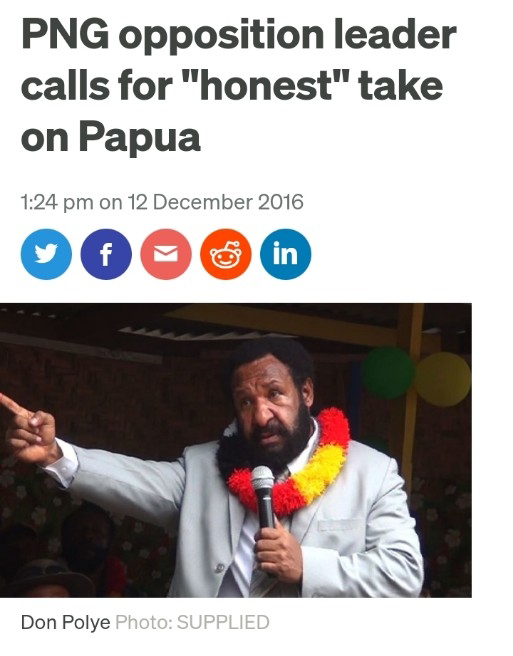
PNG opposition leader calls for "honest" take on Papua

Papua New Guinea's opposition leader says his country and Australia need to play a greater role in responding to human rights abuses in neighbouring West Papua.

Don Polye said basic human rights of West Papuans continue to be repressed by Indonesian authorities and security forces, requiring a more "honest" approach from neighbouring countries.

He said the problem had a set of direct consequences for PNG, yet its government continued to turn a blind eye to what was going on.

Mr Polye said recent remarks by Australia's Foreign Minister Julie Bishop playing down reports of rights abuses in Papua were unfortunate.

"She said that there is not enough justification or evidence to show if there is any human rights abuse along the border between Papua New Guinea and Indonesia. I believe that Australia should assess the situation more closely, in partnership with Indonesia as well as with Papua New Guinea, to be honest about it and to look at the issues more carefully," he said.

Mr Polye said as party to international conventions on human rights, PNG and Indonesia needed to engage more to address the situation in Papua.

He said that West Papuan calls for a legitimate self-determination process could no longer be ignored.

A need for meaningful dialogue at both international and bilateral level, he said, also required leadership from the Melanesian Spearhead Group.

However the MSG's full members - PNG, Fiji, Vanuatu, Solomon Islands and New Caledonia's Kanaks - are divided over advancing the Papua issue.

Governments of PNG and Fiji in particular appear opposed to granting the United Liberation Movement for West Papua full membership in the group.

They also firmly support Indonesian territorial control over Papua.

Yet Mr Polye says the example of France in granting a self-determination referendum to its Melanesian territory of New Caledonia shows that the Papua question could be solved peacefully.

“MAJOR LOGGING OPERATOR CHARGED K140M FOR TAX EVASION”

𝑀𝐸𝐷𝐼𝐴 𝑅𝐸𝐿𝐸𝐴𝑆𝐸: 𝑀𝑂𝑁𝐷𝐴𝑌 𝐽𝑈𝑁𝐸 26, 2023

𝐴𝑢𝑡ℎ𝑜𝑟𝑖𝑠𝑒𝑑 𝑓𝑜𝑟 𝑅𝑒𝑙𝑒𝑎𝑠𝑒.
𝑆𝑎𝑚 𝐾𝑜𝑖𝑚, 𝑂𝐵𝐸
𝐶𝑜𝑚𝑚𝑖𝑠𝑠𝑖𝑜𝑛𝑒𝑟 𝐺𝑒𝑛𝑒𝑟𝑎𝑙
 
THE Internal Revenue Commission (IRC) has imposed a substantial K140 million tax assessment against a prominent logging operator (𝑖𝑑𝑒𝑛𝑡𝑖𝑡𝑦 𝑤𝑖𝑡ℎℎ𝑒𝑙𝑑) in Papua New Guinea for engaging in illicit tax evasion, specifically through transfer pricing. 

This amended assessment (𝑡𝑎𝑥 𝑏𝑖𝑙𝑙) is a direct outcome of an extensive transfer pricing audit conducted on the taxpayer. 

This was revealed today by the Commissioner General Sam Koim when announcing the outcome of the first of more than twenty audits initiated since he took office.
 
The Commissioner General, in announcing this development, expressed, "The logging sector in PNG has long been suspected of involvement in tax evasion. 

Instead of turning a blind, we have initiated over twenty audits since I took office. 

Cross-border transfer pricing audits are intricate and time-consuming; hence it has taken some time. I am pleased to report that this is the first outcome of those audits."
 
Transfer pricing tax evasion, in simple terms, refers to the act of manipulating the prices at which goods or services are transferred between related parties or companies within a multinational group. 

The purpose of this manipulation is to reduce the taxable income of one party, typically in a high-tax jurisdiction, by artificially inflating expenses or lowering revenues. 

By doing so, the company aims to shift profits to lower-tax jurisdictions, thereby evading or minimizing its tax liabilities. 

This practice can result in significant loss of tax revenue for governments and is considered illegal.
 
Based on a risk assessment on the taxpayer, the taxpayer had significant volumes of transactions with related parties, did not file Schedule Seven (𝐼𝑛𝑡𝑒𝑟𝑛𝑎𝑡𝑖𝑜𝑛𝑎𝑙 𝐷𝑒𝑎𝑙𝑖𝑛𝑔 𝑆𝑐ℎ𝑒𝑑𝑢𝑙𝑒), was disclosing annual and historical losses in its income tax returns, and had not paid any corporate taxes in PNG for several years.
 
The main 𝑡𝑟𝑎𝑛𝑠𝑓𝑒𝑟 𝑝𝑟𝑖𝑐𝑖𝑛𝑔 𝑖𝑠𝑠𝑢𝑒 uncovered by the audit is that the taxpayer sold log species to related parties at prices lower than international market prices and thus reported a lower income than if its logs would have been sold at arm’s length. 

This means an under-pricing of log species sold by the taxpayer to related parties with significant pricing differences compared to market prices prior to and during the audit period, therefore not generating the fair amount of revenue and consequently not paying any corporate income tax.
 
PNG is deeply and negatively affected by forgone tax revenues because of base erosion and profit shifting done by taxpayers. 

The negative impact affects PNG citizens because the much-needed infrastructure, health and education coverage, security, and other public goods and services will not be available to guarantee economic growth and social welfare. 

The IRC finds it unfair and is working to tackle these behaviours for the benefit of the country.

To address this situation, the IRC performed a financial analysis of the taxpayer, considering liquidity, solvency, operational efficiency, net profitability, and working capital indicators, among others. 

The IRC concluded that the taxpayer’s financial performance shows a business that is not sustainable as its liabilities exceed its assets, it is at risk of bankruptcy, its revenues are not enough to cover its costs, it is not in a financial position to commit capital to growth and expansion, and it is financially unable to operate on a day-to-day basis. 

From a transfer pricing perspective, arguments such as these imply a non-arm’s length behaviour as it is difficult to understand that an independent business can maintain itself operating in the market with such a poor performance and such negative financial results.
 
During the audit, the taxpayer was not cooperative and provided limited information, which made the IRC’s audit, verification, and enforcement tasks more difficult and burdensome. 

The taxpayer even denied the existence of any association with the overseas parties and disclosed their residence to be in certain jurisdictions. 

However, thanks to the IRC’s progress in international tax cooperation in recent years, powerful tools like the exchange of information standard (which allows for the IRC to obtain information on foreign taxpayers from tax administrations in other jurisdictions) allowed the IRC to confirm the existence of association, as stipulated under Section 4(1) of the Income Tax Act 1959, strengthening its position, as well as confirming that the information provided by the taxpayer regarding the residency of its log buyer was false. 

The taxpayer’s failure to disclose the truth about the actual corporate residency of its log buyer was an indication that it intended to hide something.
 
The IRC concluded that the taxpayer was related to the overseas parties based i) on management (𝑠𝑎𝑚𝑒 𝑑𝑖𝑟𝑒𝑐𝑡𝑜𝑟𝑠 𝑚𝑎𝑛𝑎𝑔𝑖𝑛𝑔 𝑑𝑖𝑓𝑓𝑒𝑟𝑒𝑛𝑡 𝑒𝑛𝑡𝑖𝑡𝑖𝑒𝑠), ii) on shareholding and common interests (𝑠𝑎𝑚𝑒 𝑝𝑒𝑜𝑝𝑙𝑒 ℎ𝑜𝑙𝑑𝑖𝑛𝑔 𝑠ℎ𝑎𝑟𝑒𝑠 𝑖𝑛 𝑠𝑎𝑚𝑒 𝑒𝑛𝑡𝑖𝑡𝑖𝑒𝑠), and iii) on arrangements that would never take place between independent persons. 

In addition, the taxpayer’s Notes to the Financial Statements listed both companies as related parties. 

However, the taxpayer denied this relationship, arguing that there had been a wrong classification of related parties. 

This means that during the audit period (𝑎𝑛𝑑 𝑒𝑣𝑒𝑛 𝑏𝑒𝑓𝑜𝑟𝑒 𝑡ℎ𝑎𝑡), directors, shareholders, and the accounting firm did not recognize or correct the gross misstatement in the taxpayer’s audited financial statements.
 
To determine the arm’s length price of the exported logs, the IRC performed a comparable search of log prices for the various species sold by the taxpayer, using a public source of tropical timber prices. 

Based on it, the IRC calculated the deemed revenues the taxpayer should have realized to reflect market conditions.

In summary, for the years under audit, the taxpayer should have recorded additional revenues of K181 million and offset losses of K31 million. 

This implies that it must pay K46 million in corporate income taxes to the PNG Treasury, instead of claiming losses. 

After applying a 200% penalty (𝑎𝑐𝑐𝑜𝑢𝑛𝑡𝑖𝑛𝑔 𝑓𝑜𝑟 𝐾95 𝑚𝑖𝑙𝑙𝑖𝑜𝑛), the taxpayer is liable to pay K140 million.
 
The IRC continues to strengthen the capacity of its officials and the tools available to tackle tax fraud, evasion, and avoidance. 

Robust international instruments are about to change the way audits are performed and will allow for an increase in the exchange of information requests and joint audits. 

Penalties will also be tightened to ensure voluntary compliance.
 
Making false and misleading declarations to the IRC is a serious offense with a jail term of not more than four years. 

The IRC will prosecute not only the taxpayers but also those who are responsible for hiding information and making false declarations to the IRC to reduce their tax liabilities. 
 
In accordance with the taxpayer's right to the protection of the law and the appellate process to review the audit findings, the Commissioner General is unable to disclose the identity of the taxpayer at this time. 

However, the Commissioner General assured that the tax office has heard the clarion call for action and is taking action.
 
Ends//

Powes Parkop: Welcome to Indonesian President Joko Widodo


Seasonal campaigner for West Papua Independence movement and NCD Governor Hon. Powes Parkop has cordially welcomed visiting Indonesian President His Excellency Joko Widodo to Port Moresby and the entire country.

Thanking and appreciating the Prime Minister Hon. James Marape and his government of Papua New Guinea for hosting the president during his State Visit on Wednesday (tomorrow), Governor Parkop in welcoming President Widodo invited the President to also take some time to study the Papua New Guineans, understand our culture and know their history and heritage.
“PNGeans as Melanesians have a long history that we all are proud of and that has defined us to be who we are today. We are people who are defined by our connection to our land. The land is our life. So I want to invite him (President Widodo) to understand and appreciate that. It’s important for PNG and whole of Melanesia said Governor Parkop.
“More importantly, I want to invite the President and the Government of Indonesia to forge a new future by openly taking and discussing West Papua. It’s time to talk and we are ready for talks. We want to move forward in addressing this decade-long issues that have marred the relationship between our peoples, between different cultures and traditions, and history to forge a better future,” he said.
Governor Parkop assures the Indonesian Government that the pro-West Papuan campaigners are ready and open for dialogues.
“I want to invite him to think about the future, not to be defined by the past. We cannot change the past. The past has a lot of pains and issues. The past is a history that we cannot and are not proud of. The future we can absolutely re-define and make it better.
“As a strong campaigner, I am ready and willing to engage in dialogues. I have spoken to different organs of the West Papua people, especially United Liberation Movement for West Papua President, Benny Wenda and the Provisional Government.
“They are also ready for open, cordial dialogue. We can reshape our future and history of the region together so that it becomes better than the past. This is our call to the President Widodo.
Governor Parkop said they (West Papua supporters) want full membership for both West Papua and the Republic of Indonesia in the Melanesian Spearhead Group (MSG).
“That is the platform through which we can engage in this type of dialogues and discussions that will reshape our future and the history of our people so that we build a better future. In this way, we can live a greater legacy that we all can be proud of,” he said.

UN Resolution 2504 - On West Papua: Status Of Integration Into Indonesia, Final?


General Assembly Resolution 2504.

During the1813th plenary meeting, 19 November 1969, the UN General Assembly passed a resolution on West Papua.
The Act of Free Choice was provided by the New York Agreement. It is argued by Papuan nationalists fighting for independence that the status of West Papua was still subject to international law. And, its application as to the status of West Papua. In other words, the process of decolonisation is incomplete.
Here is why.
2504 (XXIV). Agreement between the Republic of Indonesia and the Kingdom of the Netherlands concerning West New Guinea (West Irian)
The General Assembly,
Recalling its resolution 1752 (XVII) of 21 September 1962, in which it took note of the Agreement of 15 August 1962 between the Republic of Indonesia and the Kingdom of the Netherlands concerning West New Guinea (West Irian), acknowledged the role conferred upon the Secretary-General in the Agreement and authorized him to carry out the tasks entrusted to him therein,
Recalling also its decision of 6 November 19635 to take note of the report of the Secretary-General on the completion of the United Nations Temporary Executive Authority in West Irian,
Recalling further that the arrangements for the act of free choice were the responsibility of Indonesia with the advice, assistance and participation of a special representative of the Secretary-General, as stipulated in the Agreement,
Having received the report on the conduct and results of the act of free choice submitted by the Secretary-General in accordance with article XXI, paragraph 1, of the Agreement,
Bearing in mind that, in accordance with article XXI, paragraph 2, both parties to the Agreement have recognized these results and abide by them,
Noting that the Government of Indonesia, in implementing its national development plan, is giving special attention to the progress of West Irian, bearing in mind the specific conditions of its population.
The demand for freedom is a specific condition of indigenous Papuans. This was the reason for the deadlock over Dutch New Guinea or West Papua between Indonesia and the Dutch.
It went on for 4 years from 1945 - 1949. After 1949, the Dutch began the decolonization process for West Papua. Indonesia invaded to stop the preparation for self - government.
The Act of Free Choice happened as provided by the New York Agreement. Finally, UN Resolution 2504.
West Papua is still a colony. UN Resolution 2504 says so.
The UN was in a position to only ' take note of the report of the Secretary-General on the completion of the United Nations Temporary Executive Authority in West Irian.'
Today, 61 years later. West Papua is still qualified to be free.

Port Moresby menekan pengibaran bendera Papua Barat menjelang kunjungan presiden Indonesia

Harlyne Joku
2023.07.03

Port MoresbyBagikan di WhatsAppBagikan di WhatsApp

Pendukung penentuan nasib sendiri untuk provinsi Papua Indonesia digambarkan dengan bendera kemerdekaan Bintang Kejora di kamp pengungsi Rainbow di Port Moresby, Papua Nugini pada 1 Juli 2023.
 Harlyne Joku/BeritaBenar
Pihak berwenang di Papua Nugini telah melarang pengibaran bendera kemerdekaan Papua Barat menjelang kunjungan presiden Indonesia ke negara pulau Pasifik minggu ini.

Papua Nugini, yang memiliki perbatasan sepanjang 760 kilometer (472 mil) dengan Indonesia, adalah rumah bagi ribuan pengungsi dari provinsi Papua dari tetangganya yang kuat, tempat gerakan kemerdekaan pribumi Melanesia dan pemberontakan bersenjata membara selama beberapa dekade.  

Petugas dari Organisasi Intelijen Nasional Papua Nugini menurunkan bendera dan spanduk kemerdekaan Bintang Kejora di kamp pengungsi Rainbow di ibu kota Port Moresby pada hari Sabtu. Pendukung penentuan nasib sendiri Papua menandai peringatan 1 Juli dari proklamasi kemerdekaan dari Indonesia yang telah berusia puluhan tahun.  

“Kami tidak akan mengizinkan pengibaran bendera West Papua,” kata salah satu petugas, yang mengidentifikasi dirinya kepada BeritaBenar sebagai dari Badan Intelijen Nasional. “Tapi Anda dapat melanjutkan program Anda,” kata petugas yang menolak menyebutkan namanya kepada penduduk di kamp.

Presiden Indonesia Joko Widodo akan tiba di Papua Nugini untuk kunjungan dua hari pada hari Rabu, kata pemerintah negara kepulauan Pasifik itu. Widodo terakhir berada di Port Moresby pada 2018 untuk KTT para pemimpin Kerjasama Ekonomi Asia Pasifik.

Indonesia, an archipelago nation of some 270 million people, is a rising Southeast Asian power that reaches into the South Pacific region and says it is on track to be the world’s fourth-largest economy by 2045. Its military, economy and population dwarfs Papua New Guinea’s. 

In recent years, Indonesia has contributed aid and technical assistance to Melanesian nations in the Pacific including Papua New Guinea, Vanuatu, Fiji and the Solomon Islands in an attempt to counter criticism of lack of development and militarization of its Papuan provinces. The region, which makes up the western half of the island of New Guinea, is referred to as West Papua in Pacific island countries and by supporters of independence.

The intelligence agency officers arrived at the refugee camp in Port Moresby in two unmarked white vehicles with tinted windows. 

Their activities caused a commotion and some women and men cried as they sang the West Papuan national anthem in protest. 

“Even if they remove our flag, they cannot remove us. We are the flag,” said Samuel Inggamer, a community leader. “I urge President Widodo to give us independence. He would make history if he did that.” 

anak-anak.jpg
Children of refugees from Indonesia’s Papuan provinces are pictured at the Rainbow refugee camp in Port Moresby, Papua New Guinea with Morning Star independence flags in the background on July 1, 2023. [Harlyne Joku/BenarNews]
Vincent Manukayasi, director of civil society group PNG Trust, said the intelligence agency’s actions called into question the independence of a state institution. 

“As a sovereign state, the NIO cannot be seen to be dictated to by another foreign government,” he said. 

Pejuang Papua yang bersenjata buruk – secara kolektif dikenal sebagai Tentara Pembebasan Nasional Papua Barat – telah memerangi Indonesia sejak awal 1960-an, ketika Indonesia mengambil alih wilayah pegunungan terpencil dari Belanda.

Orang Papua, yang secara budaya dan etnis berbeda dari daerah lain di Indonesia, mengatakan mereka tidak diberi hak untuk menentukan masa depan mereka sendiri. Kontrol Indonesia diresmikan pada tahun 1969 dengan referendum yang didukung PBB di mana sedikit lebih dari 1.000 orang Papua diizinkan untuk memilih.

Pembunuhan dan penganiayaan yang terdokumentasi dan diduga dilakukan oleh militer dan polisi Indonesia, dari tahun 1960-an hingga saat ini – bersamaan dengan impunitas dan eksploitasi sumber daya alam di kawasan ini serta kemiskinan yang meluas – telah memicu kebencian terhadap pemerintahan Indonesia. 

Pejuang pembebasan Papua juga menjadi lebih bersatu dan agresif dalam beberapa tahun terakhir, meningkatkan serangan terhadap tentara dan warga sipil Indonesia. 

Dalam serangan yang menarik perhatian baru-baru ini, sebuah unit pemberontak di bawah Egianus Kogoya menculik pilot Selandia Baru Philip Mehrtens dengan harapan mendapat perhatian internasional. 

Di Papua Nugini, ada dukungan akar rumput untuk gerakan kemerdekaan Papua di Indonesia. Pemerintah Papua Nugini mengaku mengakui kedaulatan Indonesia atas wilayah tersebut.

Setelah penundaan satu dekade, Papua Nugini pada bulan Maret meratifikasi perjanjian yang mengatur perbatasannya dengan Indonesia, kemungkinan membuka jalan untuk menghilangkan titik tekanan lama dalam hubungan.

Para peneliti mengatakan bahwa Jakarta prihatin dengan prospek pergerakan pemberontak Papua di antara kedua negara. Selama beberapa dekade Indonesia sendiri telah secara berkala melakukan serbuan ke wilayah Papua Nugini, disengaja dan tidak disengaja, kata mereka.

Menjelang kunjungan Widodo, maskapai nasional Indonesia Garuda, melalui anak perusahaannya Citilink, pada hari Minggu memulai penerbangan dua kali seminggu antara Port Moresby dan Denpasar, Bali.

https://www.benarnews.org/english

28 𝗜𝗡𝗧𝗘𝗥𝗘𝗦𝗧𝗜𝗡𝗚 𝗙𝗔𝗖𝗧𝗦 & 𝗙𝗜𝗥𝗦𝗧𝗦 𝗔𝗕𝗢𝗨𝗧 𝗬𝗢𝗥𝗨𝗕𝗔 𝗣𝗘𝗢𝗣𝗟𝗘


1)The first Nigerian Medical Doctor was Nathaniel Thomas King. His father was Rev Thomas King who assisted Bishop Ajayi Crowder in translating the Bible to Yoruba language. Dr King lived from 1847 to 1884.

2)The Yoruba language is the Niger-Congo language with the largest number of native speakers in the world, 50 million people speak Yoruba language natively in 2022 according to Ethnologue.

3)The first Nigerian Lawyer was Chief Sapara Williams. A Yoruba man who became a Lawyer in 1879. He was the Lodifi of Ilesa.

4)WNTV Ibadan was the first TV station in Nigeria and Africa. The first broadcast was aired on October 31, 1959. The government of Yorubaland were visionary enough ensuring their denizens had access to mass audiovisual media before countries like; Egypt: 1960, New Zealand: 1960, Israel: 1966 & South Africa: 1976. The station played a significant role in beaming taped Yoruba traveling theatre productions to households all over the old Western region.

5)The first Nigerian to release a music album was Canon Josiah Jesse Ransome-Kuti, Fela Anikulapo’s grandfather and Wole Soyinka’s great grandfather. He released it in 1878 and his last album was released in August 1921. His works are still kept at the British Museum. 

6)In 1894, Olayinka Herbert Macaulay became the first trained Nigerian Engineer. He also trained in England as an Architect. He was a Civil Engineer. He later ventured into politics and formed the first political party in Nigeria, Nigeria National Democratic Party, NNDP in 1923 and later the NCNC, the National Council of Nigeria and Cameroons. He was also a Journalist and a Surveyor. He is widely considered as the founder of Nigerian Nationalism. 

7)The first Nigerian woman to qualify and practice law was Stella Thomas, a Yoruba woman who became a Lawyer in 1935 and also became the first female magistrate in Nigeria in 1943.

8)Dr Elizabeth Abimbola Awoliyi nee Akerele was the first female physician in Nigeria. She became a Medical Doctor in 1910.

9)Folake Solanke was the first female Senior Advocate in Nigeria. She was also the first Nigerian female lawyer to wear the silk gown as Senior Counsel. 

10)The first indigenous Chief Justice of Nigeria was Sir Adetokunbo Ademola. He was also the longest serving Chief Justice of Nigeria between 1958 and 1972.

11)The Yoruba language and culture is one of the most influential on the African continent and in the Americas. The Yoruba are also one of the best researched ethnicities in Africa.

12)Chief Akintola Williams was the first Chattered Accountant in Nigeria who qualified in 1919 and also the first Nigerian to form a private accounting firm, Akintola Williams and Co in 1952.

13)The first woman to drive a car in Nigeria was Mrs Funmilayo Ransome-Kuti, the mother of Olikoye, Fela and Beko.

14)The Yoruba people have the highest spontaneous rate of twin births in the world- About 1 in 20 births. Twins were traditionally revered and highly sought after in Yoruba society. There is an Orisha that protects them.

15)Emmanuel Olatunde Odeku (born, Emanuel Olatunde Alaba Olanrewaju Odeku from Awe in Oyo state 1927, Lagos, Nigeria – died, London, 1974) was the first African neurosurgeon trained in the United States who also pioneered neurosurgery in Africa.

16)Chief Hubert Adedeji Ogunde and Moses Olaiya are regarded as the patriarchs of Nigerian theatre and movie industry. Ogunde was an actor, playwright, theatre manager, and musician who founded the first contemporary professional theatrical company in Nigeria, the African Music Research Party, in 1945.

17)The first bank in Nigeria was established in Lagos in 1894, 10 years before the amalgamation. Its second branch was opened in Calabar in 1912 and it was facilitated by King Jaja of Opobo. It had its first northern branch in Zaria. 
It is First Bank Nigeria.

18)The Yoruba homeland, based majorly in the Southwestern part of Nigeria, is home to more than 70% of Nigeria's industrial capacity and is also host to the backbone of Nigeria's entertainment industry.

20)In 1986, Professor Akinwande Oluwole Soyinka, the great grandson of Canon Josiah Jesse Ransome-Kuti became the first African to win a Nobel Laureate in the field of  Literature. 

21)In 1976, Shooting Stars Sports Club 3SC of Ibadan formerly known as WNDC Ibadan (Western Nigeria Development Company), and were later called IICC (Industrial Investment and Credit Corporation) won the African Winners’ Cup thereby becoming the first Nigerian club side to win continental honour for Nigeria.

22)The first Nigerian to score a World Cup goal was Rashidi Yekini. He was a Yoruba man from Kwara state. He scored it against Bulgaria at USA ‘94.

23)The area of Yorubaland covers approximately 145,000 Suare Kilometre of land. Were it to be an independent country, it would be physically bigger than Greece, Hungary, Serbia, South Korea, Portugal, Ireland, Sierra Leone and many more countries.

24)The first television station in Africa was the Western Nigerian Television Service located in Ibadan’s and established in 1959.

25)The first university in Nigeria is University of Ibadan. Today, the Southwestern part of Nigeria also has the highest number of private universities in Nigeria.

26)The Yoruba are a people with a historical propensity for living in large urban centres. Yoruba cities have always been among the most populous in Africa. Today, around 11.5% of all West Africans are ethnic Yoruba while Yorubaland contains more than 30% of all Nigerian cities with over 100,000 people. They have been described as the most Urban African ethnic group by various ethnologists, sociologists and anthropologic writers.

27)CMS Grammar School, Lagos is the oldest secondary school in Nigeria. It was established in 1859.

28)And the first known primary school in Nigeria was Nursery of the Infant Church established in 1843 in Badagry and moved to its permanent site and renamed St Thomas Primary School in 1845.

📸 A Yoruba Woman in 1959. (Elliot Elisofon) 

Credit: Yoruba Intelligence Network 

Guys let's get our YouTube channel (YT: Historical Africa) to 1○○k subscribers. Kindly click on the link to subscribe. 🙏 https://youtube.com/c/HistoricalAfrica