Search This Blog

Total Pageviews

Advertisement

Labels

Blog Archive

Showing posts with label Belden Namah. Show all posts

Namah: Tourism, agriculture, fisheries and forestry should earn any government’s ultimate respect

By David Lepi | January 20, 2026 

The recent call by Minister for Tourism, Arts and Culture, Hon. Belden Namah, for an intervention budget for tourism, agriculture, fisheries and forestry should be staging point of the much talked about ‘National Reset' or 'Hard Reset.’ 

Perhaps the no nonsense Minister Namah may be blunt but what he is saying is actually true. These sectors, once upon a time when the country was at its infancy were called the Primary Industry and of course was the cradle of the young economy. 

Today they are potentially the sustainable backbone of the economy, yet they remain trapped in a cycle of rhetoric and lip service. Successive governments acknowledge their importance in principle, but in practice continue to prioritize extractive industries while the renewable and people-centered sectors are left underfunded and under planned.

Namah goes further to say these sectors are inclusive sectors and stresses this point in saying you cannot teach a lad in Tambanum village along the Sepik River the art of carving. He is born with the chisel in hand and on the day he could walk he knows what shape, size and kind of wood to carve a mask, suspension hook or a clan totem of crocodiles and birds. The same could be said of a Sipaka in Tambul, where the country’s food basket is on vegetable farming or teach a _papu_ on Lou Island, beautiful Manus, about fish net.  
 
In this sense inclusivity mean everyone, olgeda _man na meri_ regardless of education or training, who is willing to participate is able to engage in tourism, agriculture, fisheries and forestry. Essentially our people have the traditional knowledge and skills passed on from generations on farming, carving, fishing etc where they can easily take part meaningfully in any of the above sectors. 

Notwithstanding, Papua New Guinea has never lacked grand visions or eloquent speeches about its economic future. What it has lacked, repeatedly, is the political courage to translate those visions into sustained, well-funded action. 

This contradiction is not new. PNG Vision 2050, the country’s flagship long-term development strategy, clearly states that Papua New Guinea must shift its economic base away from an overreliance on mining and hydrocarbons towards renewable sectors — agriculture, forestry, fisheries and tourism. The Vision, initiated by the country’s founding father Grand Chief Sir Michael Somare, recognizes that although mining dominates exports and revenue today, it does not provide inclusive or sustainable prosperity. By 2050, PNG aims to be among the top 50 countries on the UN Human Development Index, supported by effective service delivery, human capital development, wealth creation and the sustainable use of natural resources.

In other words, the policy intent already exists. What Minister Namah is calling for is the missing link: a properly costed intervention approach that answers the hard question governments often avoid — how much will it really cost to make this work, and what is the cost of doing nothing?

Minister Namah’s proposed intervention budget is not a slogan. It is a detailed financial plan that should capture all direct, indirect and opportunity costs of implementation, from programme design and staffing to infrastructure, monitoring and the economic losses borne by communities when opportunities are missed. It shifts policy debate from vague aspirations to measurable commitments. It envisions government to compare scenarios: investing now versus paying a much higher social and economic price later.

Prime Minister Hon James Marape has himself echoed this logic. When opening the Special Economic Zone Summit in May 2023, he stated plainly that “a sustainable economy is a diversified economy.” He was right. Diversification is not an abstract ideal; it is the effective anchor of long-term stability, resilience and national participation. Special Economic Zones will only succeed if they are connected to productive domestic sectors — farmers, fishers, foresters, tourism operators and SMEs — rather than operating as isolated enclaves. 

Tourism, in particular, remains one of PNG’s most underutilised economic enablers. Globally, tourism drives GDP growth, creates employment at scale (especially for women and youth), earns foreign exchange, stimulates SMEs and accelerates infrastructure development. It also delivers broader national benefits: cultural preservation, environmental stewardship, soft diplomacy and international visibility. 

Tourism offers something extractive industries cannot — inclusive growth that spreads income directly into communities.

The United Nations Tourism framework and the Sustainable Development Goals reinforce this point. Tourism is recognised as a tool for economic diversification, value-added services, green growth and resilience. Countries like Thailand has linked tourism with agriculture to keep the tourist dollar circulating locally, strengthening rural economies and reducing import dependence.

For Papua New Guinea, the choice should be obvious. Tourism, agriculture, fisheries and forestry are not fringe sectors to be acknowledged in speeches and abandoned in budgets. They are the pillars of a diversified, inclusive and resilient economy — exactly what Vision 2050 envisages and what the Prime Minister himself has publicly championed.

Minister Namah’s call is not just a sectoral plea, but is a challenge to the entire political establishment. Any government must respect these sectors that should show in budget allocations, programme design and long-term planning. 

If government is serious about economic diversification, human development and shared prosperity, then the time for chronic rhetoric is over. The intervention approach must begin now, with tourism and renewable sectors placed where they belong: at the very center of Papua New Guinea’s development agenda.

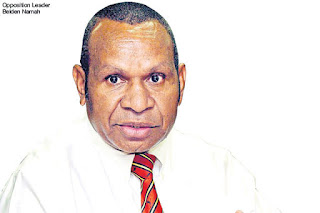
Belden Namah face to face. The man behind the enigma

16 August 2013
SONJA BARRY RAMOI

Belden NamahDEEP IN THE MOUNTAINS of Paru Paru village not far from Panguna mine - the village of the late secessionist leader and first president of Bougainville, Joseph Kabui – a delicate military action was underway.

Defence Force helicopter pilot, Captain Charlie Andrews, was ordered by PNG Defence Force Commander Brigadier General Jerry Singirok to get Captain Belden Norman Namah out of there.

The terrain was in enemy territory and under the control of the Bougainville Revolutionary Army. But there was no place for a chopper to land.

Captain Namah – in a daring display of bravery – was airlifted from the bush by hanging onto the skid of the chopper. Only a very strong and highly skilled man could do that. Namah was a highly trained Special Forces Unit commando.

Did Belden Namah, now Opposition Leader of Papua New Guinea, tell me the story to impress me? No. I heard the story from someone else and asked Namah to confirm if it was true.

"Yes it's true”, he replied. That was it.

There are many more tales of Namah’s military exploits and deeds to be told. Some, still classified, will no doubt surface later.

His role in rescuing OPM (Operasi Papua Merdeka) hostages the in two separate incidents near the PNG-Indonesia border in 1996 and 1999 still needs to be told.

I know Opposition Leader, Hon Belden Namah, very well. He is not scared of anything. He only fears God. He is a fighter and he doesn't go down easily.

If he was prepared to sacrifice his life and help save more than 360,000 lives on Bougainville and later go to jail with two comrades for resisting an intervention by mercenaries in the infamous Sandline Affair, does anyone seriously believe that an arrest warrant will scare him?

Why is so much speculation and false information about the Opposition Leader posted in the social media – especially Sharp Talk? Do his critics miss him that much?

Everybody loves a hero. PNG certainly needs many more heroes. When I wrote, during the political impasse, that retired Colonel Yaura Sasa would go down in the minds of many Papua New Guineans as a hero, I was criticised because Sasa had been charged with mutiny.

About one year later the mutiny charge against Sasa was thrown out thanks largely to leading Port Moresby lawyer Tony Waisi, from West Sepik. And the hero who quelled the so-called mutiny was none other than Belden Norman Namah, who should be credited for defusing a potentially deadly clash between factions of the army and the police force.

Some of us are too good at tearing down people and our political leaders based on false information and incomplete stories fed to us by a biased foreign and domestic media.

Napway Kunum, an engineer from Jiwaka Province, working on a fly in fly out basis on an offshore gas plant in Iraq, knows Belden Namah well from their student days at Sogeri National High school.

I asked Napway to share his recollection of Namah. Napway, was president of the Judo Club at Sogeri at the time and his room-mate was Gerald Alec from Sandaun Province.

Napway recalled that Belden - who was one year behind him and Gerald - would go to their room every Wednesday to join them at judo training.

“He is one of those that did not speak much but will listen attentively and then go ahead and will get things done,, recalled Napway, “on that you can depend on him. He was always in a hurry trying to get something done.”

He also described Namah as “quiet and easy going with determination.”

“If things aren’t right, he’ll throw himself at it to get it right. Those are his traits. One thing, he’ll call a spade a spade.

“He’ll be loyal to you when he knows that what you are doing is good for people and country. If it’s not he’ll be in the way. That’s all the way from Sogeri.”

It appears they spent a great deal of time talking about the OPM freedom movement in West Papua.

“OPM kept us busy discussing them into the night,” said Napway who added, “It’s not surprising that BN joined the army, and I thought Gerald also did.”

“One thing I found about BN is that he always had respect for me and Gerald, and he would listen attentively. Gerald and he would discuss the suffering of the West Papuans and I would listen in on how unfairly they were treated.

“They’ll say it’ll be best to help them out. So there and then I knew that BN would always fight for the underdogs, and that’s natural, his inbuilt character.”

When Napway, who has worked in many places in PNG and overseas as an engineer in the petroleum industry, was in Kutubu he knew three security supervisors who had been in the army and served in Bougainville during the civil war.

“They said BN is one hell of a person who can move single-handedly forward after he planned out an operation and those were daring ones. They didn’t tell me the full story but I could gather from what they were saying that BN was one hell of a warrior.”

I confided in Napway: “In this very volatile world, you and I know that PNG needs BN”.

Napway replied: “PNG needed BN 40 years ago, Sonja, and that’s not kidding. That’s not discrediting our fathers who brought us to independence. They did what they could. Between independence and now, we let greed get in the way of developing our nation. And that’s where we need him. And that’s 40 years back.”

Certainly nobody can rightfully claim that Belden Namah is greedy, certainly not when he is probably Papua New Guinea’s first multimillionaire philanthropist politician who gives from the goodness of his heart and not to get publicity.

Are there so many gullible people around? If it was true that Belden Namah is a power-hungry ‘would be dictator’, then why did he hand power over to Peter O’Neill, practically on a golden platter, when he had the numbers and the money to become prime minister himself?

One thing is for certain, considering the tremendous support he had at the time, he could have simply snapped his fingers and taken over the country if he had so desired.

Belden Namah is a world leader - whether some stupid people like it or not - who at least can afford to pay for his travels around the world using his own private funds.

Not long ago he was in Europe. Ask yourself - how many politicians can purchase airfares and stay in five star hotels using their own honest, hard earned money? It seems that not many people know that Belden Namah is a self-made multimillionaire today because he wisely invested the money he made - starting many years ago before he entered parliament - from his share of timber royalties.

Starting from day one, he has made his stance very clear on the asylum seekers and many other issues more than enough times already. Why should he keep on repeating himself like a fool for fools? If people missed what he has said they can always look it up!

Namah is a man who is short, sharp and straight to the point. He is a 'silent achiever' who does not go around boasting and bragging about what he has achieved in order to appear more popular by scoring likes on the social media forums.

Belden Namah is a leader who believes in sharing duties and responsibilities. He does not have a monumental ego that says, 'me, me, me’ unlike certain other politicians who enjoy scoring political points by attacking and trashing their opponents.

Namah certainly would never shout at anybody merely for asking questions, unlike some more loudmouth leaders.

Where other leaders are haughty and hypocritically full of themselves - with their egos maybe somewhere up in the sky - Namah is down to earth, humble and honourable.

I have met and spoken with many politicians and statesmen – governor generals, prime ministers, deputy prime ministers, opposition leaders, speakers, ministers, ordinary MPs, premiers, deputy premiers, presidents, lord mayors – at both national and local level from when I was a kid.

Politics is in my blood. It is in my family – on both sides.

I foresee that Belden Namah will become prime minister one day and that he has a long political career ahead of him – akin to two political icons and giants from the Sepik: Sir Michael Somare and Sir Pita Lus.

Until recently, I would normally keep confidential what politicians I know and what I know about them.

"We are duty bound to give back to our people their sovereignty, freedom, pride and independence,” Belden Namah said recently.

“We are an independent nation. Australians have f'ed us up since they colonised us. They left us with basically nothing when we became independent in 1975.

“We can't afford to bring them back. We do not need their support either. We have all the wealth in the world God has blessed us with. All we need is a strong, vibrant, prudent and patriotic leadership.

“We are the only ones who can provide that to protect our people from neo-colonialism and corporate greed.

“May we be God's instruments of change for our people and our beautiful country.”

Bonny Kaiyo: Kanaky Referendum No 3 - December, 2021: Freedom's Call.

In 2020, it was victory in defeat.
While pro-independence Kanak supporters rued another defeat in the second referendum on independence for New Caledonia, it was even narrower than the loss two years earlier.
Now there is a real prospect of a win in 2022.
“The path to independence and sovereignty is inevitable,” pledges the Front de Libération Nationale Kanak et Socialiste (FLNKS) – the umbrella group of the pro-independence parties – and the struggle will go on.
FLNKS is set to win the final vote.
West Papua. Almost.
PNG can see clearly, now. The rain has gone. Slowly, the obstacles fade away.


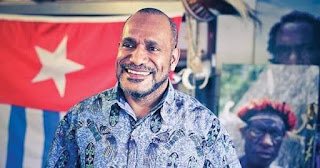
Photo caption: Decolonisation in the Pacific - vocabulary has changed; Kanaky - France offered 3 opportunities for international best practice to play out through referendum, the final chance is happening in December 2021 with FLNKS predicted to win the vote for independence; West Papua - PNG Prime Minister James Marape raised the issue of humanitarian crisis unfolding in West Papua at the 76th UN General Assembly Session; PNG foreign policy on West Papua - it is blurry, but increasingly clear since 2014 when former Prime Minister Peter O'Neill announced PNG approach to the West Papua issue was revised to give voice to the voiceless fellow Melanesians in West Papua fighting for their human rights; Opposition Leader Belden Namah - he pressed PNG Prime Minister James Marape and Peter O'Neill, his predecessor, to announce a foreign policy on West Papua including supporting demands for freedom from colonial tutelage by Indonesia; Benny Wenda - ULMWP chairman is confident MSG will grant full membership for West Papua as the only option left for the region to step up on West Papua as an international issue with a colonial context and therefore UN General Assembly resolution is on the table) 

PNG Oposisen lida Belden Namah toktok long hevi bilong West Papua

Papua New Guinea praim minista James Marape itokim PNG parliment tete olsem gavman bilong em bai respektim sovergnity bilong Indonesia na ino inap long toktok long ol human rights hevi long West Papua.

Mr Marape itok yet olsem sapos ol West Papua refugees ikam insait long PNG long ronowe long ol hevi bai PNG gavman ilukautim ol tasol ol lhevi insait boda bilong Indonesia em gavman blong em bai ino inap long mekim wanpla toktok long en

Listen HERE


from WordPress https://ift.tt/2VNfIRN
via IFTTT October 16, 2019 at 10:03PM