Search This Blog

Total Pageviews

Advertisement

Labels

Blog Archive

Showing posts with label New Guinea. Show all posts

Who Is the True Father of the Independent State of Papua New Guinea?

As we approach PNG’s 50th Independence celebration, this is a question we must ask ourselves.
The political system we use today was introduced by European explorers under the authority of the British Crown. The first recorded European to set foot on our shores was Jorge de Meneses, a Portuguese navigator, in 1526. He landed in the northern part of New Guinea what we now call the New Guinea Islands.
This means the northern coast of New Guinea and the New Guinea Islands were the first places in our country to make contact with the white man. Yet it took Europeans 300 to 400 years before they finally settled here.
Why did it take so long?
History tells us that in those days, New Guinea had no army, no police, and no centralized government only small villages and close knit communities. In other countries, this would have made colonial conquest easier. But our grandparents and great-grandparents had a secret strength:

Their belief system.

Our tumbuna believed only in their own chiefs, their own land, their own ocean, their own traditions, their own resources, and their own people. That loyalty was their greatest power and protection.
By the 1800s, Europeans realized New Guinea was difficult to control. The people simply weren’t interested in foreign rulers. So, they tried a different tactic: introducing religion bringing the idea of a foreign God in heaven and distributing “cargo” in His name.
Some of our ancestors resisted fiercely. There were clashes. Some of our people were taken away to work on sugar plantations in Queensland a dark chapter known as blackbirding often through trickery or force.
By the early 1900s, the world was in turmoil. World War II erupted in 1942, with Japan and the United States fighting across our islands. The war, like many before it, was ultimately about land and resources to feed the wealth of kings and queens.
During this time, one man rose to protect his people and their way of life: Paliau Maloat of Baluan Island, Manus Province. Witnessing the injustices of both Japanese soldiers and the Australian Administration, Paliau began defending his people politically, culturally, and spiritually.
In 1942 33 years before PNG independence he founded The Paliau Movement, the first Indigenous political movement that openly rejected the white man’s governance and religion. For nine solid years, he fought for self rule.
In 1951, the Australian and British Administration finally granted him the right to establish Baluan Native Council PNG’s first form of self government.
Thirteen years later, in 1964, Paliau became the first Member of Parliament for Manus. In Parliament, he met Michael Somare whom he himself name when born in Rabaul during the war, and together with other visionary leaders, they laid the groundwork for PNG’s independence in 1975.
Today, Paliau’s movement survives as Win Nation of which I am the current Interim President. For decades, outsiders have tried to dismiss it as a “cargo cult,” but we have always been clear: we believe in a government entirely run by our own culture, traditions, and Melanesian ways.
If Papua New Guinea truly wants to be independent not just in name but in spirit and governance Win Nation Manus has the answer.
Uroh.
Ngenge Sasa
Interim President, Win Nation Manus

Photo:

Paliau Maloat OBE, KBE, Esq. with Lady Paliau, MBE at 100 years old

Baluan Native Council, 1951 – First Self-Government of PNG

Flag of Win Nation Manus – Southern Cross and Kalopeu (Nautilus)

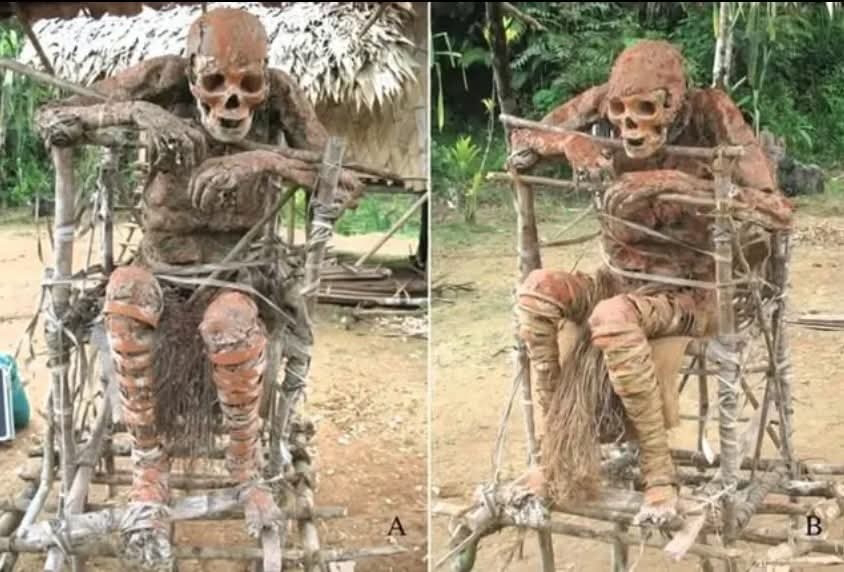
The Smoked Mummies of New Guinea Highlands

The smoked mummies of Papua New Guinea are an amazing example of how people in the past respected and honored their dead. These mummies were found in the Anga region of Morobe Province. The people there had a special way of preserving bodies. After someone died, their body was cleaned and wrapped in tree bark. Then, it was placed above a fire and slowly smoked for many weeks. This careful process dried the body and turned it black. It helped keep the body in good shape for a very long time.

For the Anga people, this was more than just a way to bury someone. They believed that keeping the body helped keep the spirit close. They thought the spirit of the dead could still watch over the family and the village. So, by preserving the body, they were also keeping the memory and presence of the person alive. This made the smoking process very special and meaningful.

The smoked mummies became known to the world in the 1960s when an anthropologist named Ronald Berndt studied them. Since then, people around the world have become interested in this old tradition. The smoked mummies show us how different cultures have their own ways of understanding life, death, and the spirit world. They remind us that even though customs may be different, honoring and remembering loved ones is something all people value.

Jen Biden's Uncle Eaten By Cannibals in New Guinea in WWII ?

US President Joe Biden claims that his uncle, 2nd Lieutenant Ambrose J Finnegan was eaten by 'cannibals' in Papua New Guinea (PNG) during World War 2.

MSNBC reported that Mr. Biden made the statement during a campaign stop in Pittsburgh, making a clear distinction between his family's military service and Donald Trump's reported criticisms of military members, as detailed in The Atlantic in 2020.

The statement has sparked debate about the appropriateness of using the word "cannibal" and its potential impact on U.S. reputation in the Pacific region, especially amid efforts to strengthen relationships with Pacific island economies amidst rising Chinese influence in geopolitics.

According to The Telegraph, Mr. Biden stated;

“He flew single-engine planes, reconnaissance flights over New Guinea,” Mr. Biden said of his maternal uncle, 2nd Lieutenant Ambrose J Finnegan.

“He had volunteered because someone couldn’t make it. He got shot down in an area where there were a lot of cannibals in New Guinea at the time.

“They never recovered his body. But the government went back, when I went down there, and they checked and found some parts of the plane and the like.”

But The Telegraph again revealed that official war records dispute all of Mr. Biden’s assertions about his uncle’s fate during the flight on May 14, 1944. Lt Finnegan was not flying the plane, nor was it shot down.

Firstly, it's crucial to note that Mr. Biden's comment was made in the context of a personal story about his family history. But Mr. Biden is well known for telling exaggerated stories. He once said his house got burnt down and that he got arrested trying to see Nelson Mandela in jail.

However, the use of the term "cannibal" carries historical and cultural weight, particularly in PNG and other Pacific islands.

Historically, Western explorers and colonizers often depicted indigenous peoples as "savages" or "cannibals," perpetuating harmful stereotypes and contributing to the marginalization of these communities.

The Pacific island economies have diverse cultural backgrounds and histories, and they value respect and sensitivity in diplomatic interactions.

The use of a term like "cannibal" by a U.S. President, even in a personal anecdote, can be perceived as culturally insensitive and may undermine efforts to build trust and positive relations.

Moreover, the timing of such statements is critical. As the US seeks to strengthen its engagement with Pacific island nations in the face of increasing Chinese influence, every word and action is scrutinized.

China has been actively expanding its presence in the region through infrastructure projects, economic partnerships, and diplomatic initiatives. In contrast, the U.S. has been working to reassert its commitment to the Indo-Pacific region, including the Pacific islands, as part of its strategic efforts to maintain a balance of power.