Search This Blog

Total Pageviews

Advertisement

Labels

Blog Archive

Showing posts with label PNG Prime Minister. Show all posts

Prime Minister Marape Meets Former UK Prime Minister Tony Blair at World Economic Forum, Welcomes Support on AI and Governance Reform


Prime Minister Hon. James Marape has welcomed the willingness of former United Kingdom Prime Minister Rt Hon Tony Blair to support Papua New Guinea in strengthening policy development, government capacity and the use of digital technology — particularly artificial intelligence — to improve public-sector efficiency and service delivery.

The meeting took place at the margins of the World Economic Forum (WEF) Annual Meeting in Davos, following an approach by Mr Blair requesting discussions with the Prime Minister.

Prime Minister Marape said the high-level engagement provided valuable global insight at a time when nations are navigating major geopolitical and economic shifts.

“It was a privilege to meet a senior global statesman of Mr Blair’s standing,” the Prime Minister said.

“He reached out to us for a meeting, and we held detailed discussions with our respective officials present. He expressed a strong willingness to assist Papua New Guinea, particularly in the areas of policy advisory support and institutional capacity upgrading.”

Focus on ICT, Artificial Intelligence and Government Efficiency

Prime Minister Marape said Mr Blair emphasised the strategic use of appropriate information and communications technology (ICT) systems and artificial intelligence tools to modernise government operations.

“His key advice centred on how technology — especially artificial intelligence — can be deployed to improve government efficiency, remove bureaucratic impediments, sharpen national priorities and ensure governments deliver tangible outcomes for their people,” the Prime Minister said.

“This aligns strongly with our own reform agenda as we modernise the public service and ensure better value for money in government.”

Global Perspective on Geopolitics and Emerging Economies

Prime Minister Marape said the discussion also covered broader global developments, including geopolitical tensions, conflicts in strategic regions, the role of major powers, and the position of emerging markets such as Papua New Guinea within the evolving global order.

“At his level, you gain a clear view of how the world is emerging under present circumstances — with several wars taking place in strategic regions and the increasing interaction between superpowers, advanced economies and emerging nations,” he said.

“His global perspective was insightful and deeply appreciated.”

The Prime Minister noted that Mr Blair currently serves in several international advisory capacities and was recently appointed to a global peace-related role focused on the Gaza situation, reflecting his ongoing contribution to international diplomacy and humanitarian dialogue.

“We commended him for his continued engagement on global forums in the interest of peace, stability and the goodwill of humanity,” Prime Minister Marape said.

Commendation for PNG’s Democratic Stability

Prime Minister Marape said Mr Blair spoke positively about Papua New Guinea’s political record and democratic maturity.

“He commended Papua New Guinea for its consistency in democratic governance, the maintenance of a free-market economy, and our commitment to constitutional stability,” the Prime Minister said.

“He conveyed nothing but his best wishes for our country and encouraged us to remain steadfast on a path of peace, stability and inclusive growth for all our citizens.”

Potential Visit to Papua New Guinea

Prime Minister Marape revealed that Mr Blair indicated his willingness to visit Papua New Guinea in the future, particularly during his travels through Singapore, the Philippines and the wider Southeast Asian region.

“He expressed interest in returning our way to continue discussions and to support efforts aimed at strengthening governance systems and long-term development planning,” the Prime Minister said.

Emphasis on Youth and Education Through AI

A central theme of the meeting was the future of young people and the role of technology in education.

“Mr Blair strongly emphasised the importance of deploying artificial intelligence to improve access to quality education for our youth,” Prime Minister Marape said.

“He highlighted the need to empower young people with the skills required to participate meaningfully in the economy of the future — an area that resonates deeply with our government’s vision.”

Prime Minister Marape said the discussions reinforced Papua New Guinea’s commitment to embracing innovation while safeguarding national priorities.

“As we mark our nation’s 50th year of independence, these global engagements reaffirm that Papua New Guinea is respected internationally and remains well positioned to learn from global experience while charting its own development path,” he said.

PRIME MINISTER MARAPE COMMENDS PNG–AUSTRALIA–INDONESIA TRI-NATION DEFENCE MINISTERS’ MEETING


Prime Minister Hon. James Marape has applauded the historic first Tri-Nation Defence Ministers’ Meeting between Papua New Guinea, Australia, and Indonesia, describing it as a powerful demonstration of regional unity, sovereign respect, and long-term stability across the Indo-Pacific.

Prime Minister Marape issued the statement on behalf of the three national leaders — Australian Prime Minister Anthony Albanese, Indonesian President Prabowo Subianto, and himself — commending their Defence Ministers for advancing an unprecedented level of cooperation among the neighbouring states.

Prime Minister Marape said the trilateral engagement reflects the immutable reality of geography, noting that PNG’s location places it at the heart of the South Pacific, East Pacific, and West Pacific intersections.

“Geography will never change. Papua New Guinea will always sit in this unique part of the world, and the peace, harmony, and coexistence we desire for the future depend on the interventions we make today,” the Prime Minister said.

He emphasised that the Asia–Pacific region—spanning Southeast Asia, Melanesia, and extending into North and West Asia—is home to over 60 per cent of the world’s population and around 60 per cent of global economic activity, making regional stability a shared responsibility.

Prime Minister Marape underscored the importance of strong, cooperative relationships between PNG, Australia, and Indonesia as foundational anchors for regional security.

“The coexistence of Papua New Guinea, Indonesia, and Australia forms the base of stability not only for our three nations but for the wider Southeast Asian and Pacific region,” he said. “With a rapidly growing youth population across Asia and the Pacific, building trust and ensuring peaceful relations among neighbours is crucial.”

He said that while the three heads of government maintain constant dialogue, it is essential for ministers and state agencies to develop the same depth of operational cooperation.“Our systems must work in sync — respecting sovereignty while deepening understanding.”

Prime Minister Marape highlighted the significance of three sovereign Defence Ministers meeting face-to-face.

“Defence ministries are custodians of national sovereignty. When three sovereigns come together in dialogue and mutual respect, it strengthens peace and cooperation across our region.”

He paid special tribute to Australia’s Deputy Prime Minister and Defence Minister Richard Marles for his continued engagement with Papua New Guinea.

“I commend the Australian Deputy Prime Minister for his humility and grace. He was with us during our Independence celebrations, he stood with us in the rain during the opening of the Lombrum Naval Base, and he has returned again to strengthen this important partnership.”

Prime Minister Marape reaffirmed that the PNG–Australia Defence Cooperation Treaty complements — rather than undermines — PNG’s sovereign relationships with other nations, including Indonesia.

“Today’s meeting with Indonesia demonstrates the versatility of the PNG–Australia Defence Treaty. It respects our other defence relationships in the region while safeguarding the sovereign interests of both our nations.”

He said the trilateral meeting reflects a maturing regional architecture built on trust, mutual respect, and a shared vision for stability in an increasingly complex global environment.

Prime Minister Marape concluded by reiterating PNG’s commitment to peace, cooperation, and responsible leadership in the Pacific and Southeast Asian region.

“As a senior Pacific nation situated at the crossroads of major global regions, Papua New Guinea will continue to champion peaceful coexistence, sovereign respect, and collective security.”

MARAPE: PAPUA NEW GUINEA IS NEVER SILENT ON WEST PAPUA HUMAN RIGHTS ISSUES


Prime Minister Hon. James Marape says his government will not remain silent on human rights concerns affecting Melanesians, including the people of West Papua,  and has consistently raised these matters with Indonesia.

Mr Marape said PNG’s foreign policy “is not being overshadowed or manipulated by Indonesia” and that concerns over alleged human rights abuses in West Papua have been communicated in multiple bilateral and regional meetings over the years.

He made the remarks in Parliament in response to questions from North Fly MP Hon. James Donald, who asked why the government was quick to comment on conflicts abroad but had not taken stronger public positions on West Papua, despite reports of killings, displacement and refugees crossing into PNG’s Western and East West Sepik provinces that share common land border with Indonesia’s West Papua region.

Mr Donald said more than 15,000 West Papuan refugees have entered PNG over the years, describing the situation as breaches of the UN Declaration on the Rights of Indigenous Peoples and international law. He questioned whether PNG’s “silence” could be interpreted as fear or submission to Jakarta.

Prime Minister Marape Rejects Claims PNG Is Afraid to Speak

PM Marape firmly rejected suggestions that PNG was outsourcing its foreign policy to Indonesia or reluctant to raise West Papua issues.

“There is no element of fear on our part,” he said.

Marape reflected on spending part of his childhood in the Telefomin area and in refugee camps, saying he personally understood the West Papuan struggle.

“When it comes to Melanesian human rights, James Marape or a Pangu-led government — or anyone for that matter — will always advocate for Melanesian human rights,” he said.

He stressed that PNG’s respect for Indonesia’s national sovereignty is separate from its duty to raise human rights matters.

“Sovereignty issues are different from human rights issues. We respect the full sovereign integrity of the Republic of Indonesia. But if atrocities happen in West Papua, we have every right to speak,” he said.

PNG Consistently Raises West Papua Concerns

Mr Marape said PNG had communicated its concerns at all major forums — the  United  Nations, the  Pacific  Islands  Forum,  the  Melanesian  Spearhead Group, and in private bilateral meetings.

He noted that both former Indonesian President Joko Widodo and current Pres- ident Prabowo Subianto had been briefed directly by PNG on Melanesian hu- man rights matters.

“In all diplomatic channels — whether at the United Nations, at PIF, through the MSG, or in bilateral meetings — human rights issues affecting Melanesian people are always relayed,” he said.

Marape said President Prabowo had assured him that human rights concerns “would be looked at”.

He added that PNG played a significant role in shaping the Pacific Islands Forum resolution on West Papua during the 2019 leaders’ meeting, which called for Indonesia to allow the UN Human Rights Commissioner access to the region.

Government Policy Remains Unchanged Since Independence

Marape emphasised that PNG’s foreign policy on Indonesia has remained consistent since 1975.

“We have maintained the same policy since Independence — respecting Indonesia’s sovereignty while raising concerns about human rights on the other side,” he said.

He assured Parliament that human rights issues in West Papua are “never ignored” and said PNG will continue to advocate respectfully but firmly.

Source: HERE

Oksapmin’s Son: From Barefoot Beginnings to Royal Encounters

Who would have imagined that a barefoot boy in Grade One at Oksapmin Primary School in 1978 would one day stand before the King of the Commonwealth nations? From one of the most remote places on earth to one of the most powerful — in just 55 years. It’s a story that few would believe, and even fewer would live.

Born in 1971 in Tari, high in the rugged mountains of Papua New Guinea, the Chief of PNG began life in the heart of isolation. At just two years old, he was carried to the depths of the Western Province, to a place called Nomad River — a remote mission station where modern life had not yet arrived. There was no electricity. No roads. No rice, soap, biscuits, or toys. English was foreign to his ears. He had no shoes. Clothes were reserved for special Sabbath worship days.

When Papua New Guinea gained its independence in 1975, he was four years old — a child of a newborn nation, still untouched by the outside world.

In 1978, he began Grade One at Oksapmin Primary School. His missionary parents had been transferred there, and with no shoes on his feet and no lunch in hand, he sat in class, absorbing the sounds of a new language, driven by curiosity and a quiet determination. He didn’t have much, but what he did have was priceless: faith, love, discipline, and the power of a dream.

He would go on to walk paths no one from his background had ever walked. Through education, faith, and hard work, he rose — not just through the ranks of leadership, but through life itself. From jungle trails to red carpets, from thatched huts to grand halls, he eventually stood face-to-face with presidents, prime ministers, monarchs — even the King himself.

But he never forgot where it began: in Oksapmin, where a little boy with dusty feet and big dreams first opened a schoolbook and imagined a bigger world.

His story is not just about personal triumph — it is a celebration of what is possible. It is about the power of education, the strength of Christian values, and the unshakable belief that no matter where you come from, your destiny is not limited by your beginnings.

This is Oksapmin’s son , a man and leader blessed by God who rose from the remotest corners of PNG to the very heart of global power.

This is Oksapmin’s pride and Papua New Guinea's Prime Minister, at his best.

Prime Minister Marape Holds Historic Bilateral Talks at the White House With U.S. Vice President

Washington D.C., USA | Thursday, 10 July 2025 - Prime Minister Hon. James Marape has
announced a landmark development in Papua New Guinea–United States relations following a historic first-ever bilateral meeting at the White House between a sitting Papua New Guinean Prime Minister and a U.S. Vice President.

This milestone meeting, held during Prime Minister Marape’s official visit to Washington D.C., took place at the White House with U.S. Vice President H.E J.D. Vance, and signals a
significant elevation in the bilateral relationship between the two nations.

“This is the first time in 50 years that a Papua New Guinea Prime Minister has held a formal
bilateral meeting at the White House,” Prime Minister Marape stated. 

“The engagement
was warm, respectful, and constructive, demonstrating the United States’ sincere interest in strengthening its ties with Papua New Guinea.”

During the discussions, the United States Government confirmed it will send a high-level
delegation to attend Papua New Guinea’s 50th Independence Anniversary celebrations in
September 2025. 

This delegation will be led by Deputy Secretary of State Christopher Landau, reflecting the importance the U.S. places on its relationship with PNG.

Prime Minister Marape and Vice President Vance also discussed shared democratic values,
mutual interests in the Indo-Pacific, and opportunities for expanded cooperation in trade,
security, and economic development.

“The United States is the greatest democracy, the strongest free-market economy, and the
leading Christian nation,” Prime Minister Marape said. “Papua New Guinea, too, is a robust
democracy, a free-market economy, and a nation founded on strong Christian values.

These shared beliefs continue to guide our alignment on many regional and global issues.”

He added that the two governments have agreed to continue technical-level engagements to prepare for a potential full bilateral meeting between President Donald Trump and Prime Minister Marape at a later date, when both the White House and Waigani are ready.

“Our officials will begin preparatory work on specific areas of bilateral cooperation,
including trade, security, development, and investment,” he said. 

“We hope to formalise this growing relationship through a future meeting between the President of the United States and the Prime Minister of Papua New Guinea.”

During the meeting, Prime Minister Marape also acknowledged and thanked major U.S.
companies operating in Papua New Guinea—ExxonMobil, Barrick Gold, Newmont
Corporation, Hilton, Marriott, and others—for their long-standing contributions to the
country’s economy.

“I also took the opportunity to invite more U.S. companies in manufacturing, agriculture,
fisheries, and sustainable forestry to explore investment opportunities in Papua New
Guinea,” he added. 

“Our economy is open for business, and we welcome responsible partners who share our vision for sustainable growth.”

The bilateral engagement caps off a series of high-level meetings during Prime Minister
Marape’s visit to the United States, which included strategic dialogues with U.S. defence,
trade, and development agencies.

“This visit marks the beginning of a new era in PNG–U.S. relations,” Prime Minister Marape
concluded. “As we mark 50 years of Independence, we are repositioning ourselves on the global stage, and fine tuning our relationships with all partner nations including this great United States of America .”

-///-

Prime Minister Marape Meets His Majesty King Charles III

His Majesty, The King, receives The Honourable James Marape, the Prime Minister of Papua New Guinea, in an audience at Highgrove House, 7th July 2025.

In a historic and heartfelt moment, Prime Minister James Marape was granted a private audience with King Charles III at Highgrove House on 7 July 2025, following a high-level gathering of Indigenous leaders and global partners working on nature-based climate solutions under the King’s Foundation.  

The King, a lifelong champion of environmental stewardship, brought together voices from around the world to advance his mission of harmony between humanity and nature, a cause Prime Minister Marape equally shares and champions for Papua New Guinea.  

In a one-on-one meeting inside the King’s personal study, the two discussed PNG’s unique role as a forest nation, the importance of biodiversity protection, and how Indigenous communities must be at the forefront of global climate solutions.  

“We are honoured to have His Majesty as an advocate for PNG and Indigenous-led conservation,” said PM Marape. “Our forests are not just national assets, they are global lungs.”

This meeting cements PNG’s growing role in global climate leadership and sets the stage for deeper cooperation ahead of COP30 in Brazil.

#PNG #KingCharlesIII #ClimateLeadership #Forests #NatureBasedSolutions #IndigenousVoices #GlobalPartnerships #PMJM #Sustainability #COP30

Marape-Rosso Government to Table Bougainville Referendum Results in National Parliament

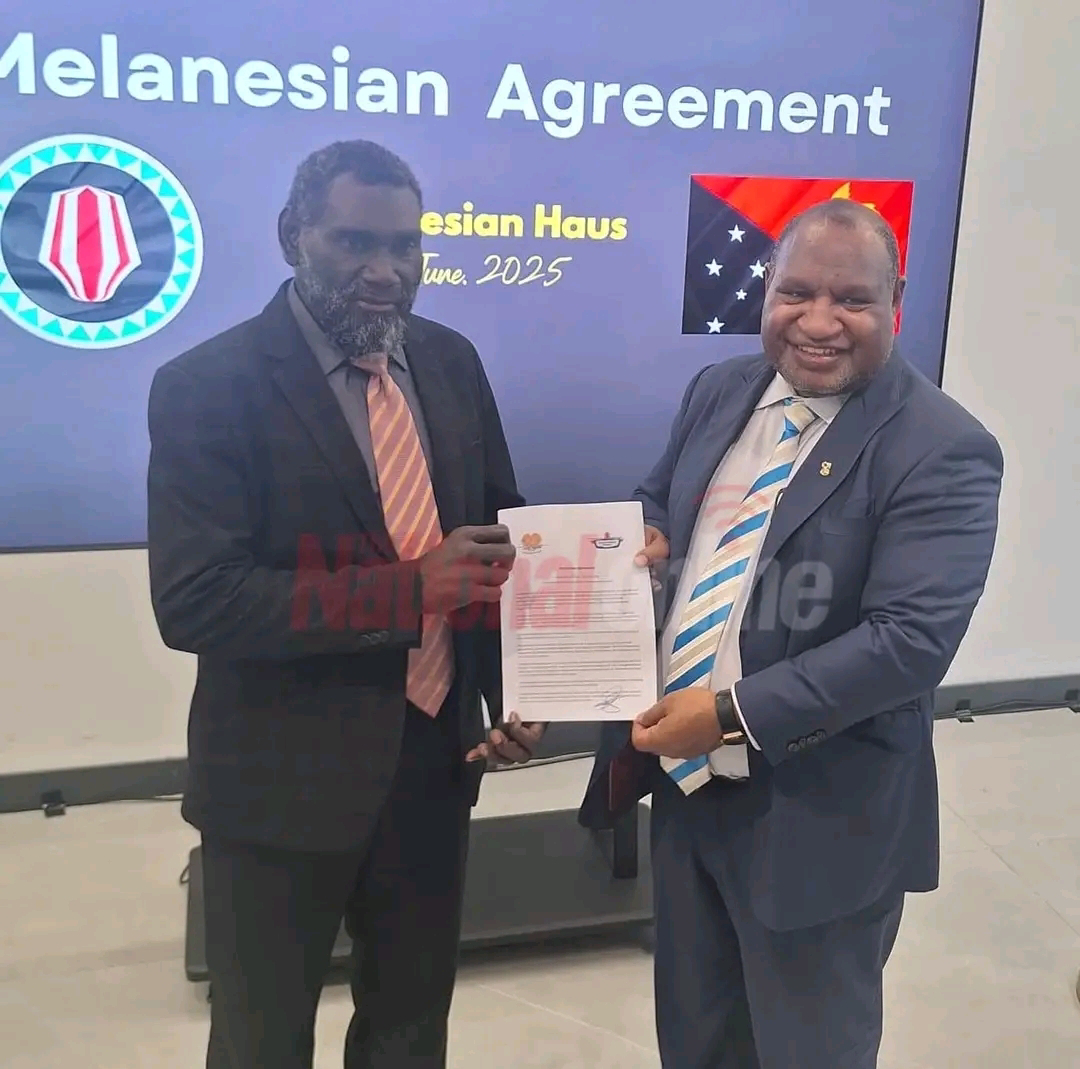
Port Moresby, Thursday, 26th June 2025– In a landmark move toward resolving Papua New Guinea’s long-standing political issue with Bougainville, the Marape-Rosso Government has confirmed that the results of the Bougainville Referendum will be formally tabled in the National Parliament.

This critical next step follows the signing of the Melanesian Agreement today by Prime Minister James Marape and Autonomous Bougainville Government (ABG) President Ishmael Toroama which is a historic pact that outlines a clear political roadmap for Bougainville’s future.

The signing took place after high-level bilateral consultations between the two governments, held at the Burnham Military Camp in Christchurch, New Zealand.

As part of the process, a parliamentary bipartisan committee on Bougainville matters will conduct awareness and public consultation to ensure national understanding before the referendum results are presented in Parliament.

Prime Minister Marape stated: “This agreement is a breakthrough and it respects the democratic voice of the people of Bougainville while upholding the unity and sovereignty of Papua New Guinea. We are committed to a peaceful, constitutional, and transparent process.”

President Toroama echoed similar sentiments, noting that the agreement recognizes Bougainville’s aspirations while building trust between the ABG and the National Government.

The Melanesian Agreement is seen as a significant milestone in the ongoing peace and reconciliation efforts since the 2019 referendum, in which Bougainvilleans voted overwhelmingly in favor of independence.

This development marks a new chapter in Bougainville’s political journey and underscores the Marape-Rosso Government’s commitment to honoring the referendum process through democratic and legal channels.

#Bougainville #Referendum #MelanesianAgreement #PNGGovernment #UnityInDiversity

Prime Minister Marape Delivers Historic BCL Share Transfer to the People of Bougainville

Port Moresby, Thursday June 26 , 2025– In a landmark moment of reconciliation and national unity, Prime Minister James Marape has today officially transferred the National Government’s shares in Bougainville Copper Limited (BCL)—valued at approximately K14.3 million—to the people of Bougainville.

The historic transfer was sealed during a formal ceremony at Government Haus, witnessed by Governor General Sir Bob Dadae, with the signing of documents by Prime Minister Marape and Autonomous Bougainville Government (ABG) President Ishmael Toroama.

The move honours the commitment made in the 2020 Joint Supervisory Body (JSB) meeting, where the national government pledged to hand over its stake in BCL to the rightful landowners and people of Bougainville.

"This is a defining act of justice and recognition," said one supporter. “BCL built this country, and now it’s time we truly honour the people of Bougainville for their sacrifice and contribution. Prime Minister Marape has shown true leadership—delivering not just on promises, but on healing and empowerment.”

The transfer is being hailed as a powerful symbol of trust-building and progress in the ongoing peace process between Papua New Guinea and the Autonomous Region of Bougainville, as the region continues its path toward greater autonomy.

PNG Prime Minister Affirms.to Support the Rights of Melanesians in West Papua and Torres Strait

Papua New Guinea has restated its support for collective dialogues on 'sensitive issues' of West Papua 'question' and New Caledonia's self-determination.

Speaking during this meeting, Prime Minister James Marape made this clear at the 23rd Melanesian Spearhead Group (MSG) Leaders’ Summit in Suva, Fiji. 

In a media statement this afternoon, PM Marape welcomed Indonesia’s continued participation in MSG talks, saying this does not affect Indonesia’s sovereignty but helps protect Melanesian cultural and land rights across all regions.

“MSG has a responsibility to all Melanesians — whether in sovereign Indonesia, the Torres Strait, or elsewhere,” PM Marape said. “We must protect people’s rights without interfering with national borders.”

Letters expressing unified MSG positions on both West Papua and New Caledonia will be sent to the governments of Indonesia and France.

PM Marape also called on MSG countries to strengthen unity by embracing their shared heritage. 

He reminded leaders that Melanesians are an ancient people, united through history, culture, and geography.

“Our roots go back over 4,500 years through the Lapita civilization. MSG must reflect that unity and help guide where we are heading as one Melanesian family,” he said.

Mr Marape supported reforms for how MSG leadership is chosen, calling for merit-based and fair processes. 

He also backed a review of MSG membership rules to avoid confusion about who can be a full, associate, or observer member in the future.

PM Marape encouraged more Melanesian trade, cultural exchange, and sports cooperation—proposing that the MSG Prime Ministers’ Cup become a regular event for both men’s and women’s football.

On climate change, he praised Australia’s renewed leadership and confirmed PNG’s active role in the next global climate talks, including cooperation with Brazil and other rainforest nations.

Marape ended his address by reaffirming MSG’s role in supporting Melanesian rights and development, while also helping strengthen the broader Pacific Islands Forum (PIF).

“MSG is not separate from the Pacific vision. It is part of it—protecting Melanesian culture, rights, and aspirations while supporting regional cooperation,” he said.

As PNG celebrates 50 years of independence, PM Marape thanked fellow MSG nations for their support and called for deeper unity for the next 50 years and beyond.

PM Marape is expected to be back in the country this evening.

Fifty years after independence, Papua New Guinea (PNG) remains one of the world’s poorest countries

Persistent poverty, weak infrastructure, and limited access to essential services continue to undermine development progress.

The IMF projects PNG’s nominal GDP to reach $31 billion in 2025. “Papua New Guinea’s economic outlook remains positive. Growth is expected to increase to 4.7 percent in 2025 from an estimated 3.8 percent in 2024 Nir Klein, IMF mission chief for PNG supported by the resumption of activities at the Porgera gold mine and improvements in access to foreign exchange.

However, these gains have yet to improve living standards for most citizens.

Poverty is widespread according to UNICEF report, with over 34 percent of the population living below the international poverty line of $2.15 per day. Rural poverty exceeds 40 percent, compared to 27 percent in urban areas. Most Papua New Guineans depend on subsistence agriculture, which suffers from low productivity due to inadequate training and poor infrastructure.

Access to electricity covers only about 20 percent of the population, and just 19 percent have safe drinking water. World Bank reported worsening education outcomes, with 72 percent of Grade 5 students unable to read age-appropriate texts. Health infrastructure is underdeveloped, contributing to malnutrition where nearly half of children under five are stunted. Youth unemployment remains high, with many young people neither in education nor employment.

PNG’s economy heavily relies on extractive industries, which account for over 70 percent of export earnings but employ only a small fraction of the workforce. The reopening of the Porgera gold mine and progress on major projects like Papua LNG and P’nyang gas developments offer growth potential but remain vulnerable to commodity price swings and infrastructure bottlenecks.

Foreign exchange shortages, power disruptions, and civil unrest, including the January 2024 riots in Port Moresby, have dampened business confidence as reported by local media. Inflation remains elevated at around 5.5 percent, driven by exchange rate depreciation and rising food and fuel costs.

Inequality persists, with wealth concentrated among political elites and urban centers while rural communities remain marginalized. The government’s Medium-Term Development Plan IV aims to improve infrastructure, social services, and stimulate private sector growth, but implementation challenges remain.

Despite these challenges, Prime Minister James Marape remains optimistic: “Our country’s challenges remain significant, but we can overcome them if we work together.”

PNG’s journey over 50 years has seen modest growth overshadowed by deep social challenges. Recent developments offer cautious hope, but turning economic gains into broad social progress remains the nation’s greatest challenge.

In challenging times, true leadership shines


Prime Minister, James Marape is leading with heart, showing real care for the everyday struggles of Papua New Guineans.

His government’s latest move to remove GST from essential household items is not just policy—it’s a lifeline.

Welcoming the initiative, PM Marape has confirmed that the government is ready to remove Goods and Services Tax (GST) on 13 essential household items.

This measure will start on June 1, 2025, to help reduce the cost of living for families across Papua New Guinea.

In a media statement this evening, PM Marape made the announcement after attending the Budget Management Committee meeting in Port Moresby.

Mr Marape praised the Internal Revenue Commission (IRC) for its quick and effective work in turning government policy into action.

“I commend Sam Koim and his team at the IRC,” Mr Marape said. “They have shown leadership by acting on the government’s commitment without delay.”

The Prime Minister said this tax relief is part of a bigger plan to help struggling families.

Other support includes free tuition from elementary to secondary school, the Higher Education Loan Programme (HELP), and scholarships for top students to study overseas. The government also raised the non-taxable income threshold to K20,000.

Next year, the government plans to remove 10% GST for first-time home buyers, on both land and houses. This builds on the previous removal of stamp duty for first-home purchases.

“These are real changes for real people,” Mr Marape, a son of a retired SDA pastor who served in most rural areas, said. “I come from the same background and I will not forget the struggles.”

He urged citizens to obey the law, work hard, and contribute to the country’s progress. “Grow your crops. Build your home. Take ownership,” he encouraged.

He ended by affirming his government’s vision of development that includes everyone, leaving no one behind

Easter Message from Prime Minister Hon. James Marape


| Port Moresby | Easter 2025
Fellow Papua New Guineans,
As we commemorate Easter in this 49th year since our country’s independence, I ask each and every one of us to pause and reflect on the life, sacrifice, and message of our Lord and Saviour, Jesus Christ.
Easter is a sacred reminder of the road to Calvary—a journey Christ took not for Himself, but for the salvation of all mankind. Though He was the Creator and King of the universe, He chose to be born in humility, live a simple life, and walk a lonely road to the Cross for the redemption of our sins. His life and death embody the true heart of leadership: selflessness, love, compassion, and forgiveness.
Today, in a time when our nation stands at a crossroads—divided too often by political toxicity, personal differences, and economic challenges—we must return to those same Christian principles. Christ’s example teaches us to be tolerant, forgiving, loving, and inclusive. These values are not outdated; they are timeless. They are what make us truly human and truly Papua New Guinean.
This Easter, I call on our people to reject division and embrace unity. Our nation needs:
 • Unity more than division
 • Progress more than regression
 • Forgiveness more than hatred
 • Hope more than hostility
As we mark this final Easter before our 50th Independence Anniversary, let us come together in a spirit of oneness—caring for each other, carrying one another’s burdens, and collectively carrying the cross of our country. This is not rocket science. This is not impossible. It simply requires a shift in attitude, a return to the heart.
Let me remind us that in Leviticus 25, the Bible declares the 50th year as a Year of Jubilee—a sacred time of reset, restoration, forgiveness, and freedom. According to Scripture, it is a time when debts are forgiven, captives are released, land is returned, and lives are given a fresh start.
Our national 50th year officially begins on 16 September 2025 and ends on 15 September 2026. During this sacred season, the Government will lead a national reset—whether in public service reform, provincial governance, or in our wider effort to take back PNG economically, fight corruption, and restore law and order.
But let me be clear: while government policy can drive institutional reform, the real reset must begin in the heart, mind, and soul of our people.
If all citizens of this country commit to Christian character—being loving, forgiving, hardworking, inclusive, and respectful—we will not just serve ourselves better; we will serve God better, and in doing so, we will build a more united, just, and prosperous Papua New Guinea.
That is the real reset: a reset of our national character—one that embraces Christian values without compromising our diverse cultures and Melanesian identity. By finding unity in our shared Christian foundations, we strengthen the national character that will carry us into the next 49 years with hope and purpose.
Let me also speak from the heart:
If I wasn’t a Christian, I would not be the man I am today.
Christianity has shaped my character to be a forgiving man. It has given me the ability to tolerate differing world views. It has helped me withstand extreme pressures without hate. It has enabled me to look at someone from another cultural group and say: “He or she is my own.”
It is this Christian teaching—deeply embedded in my life—that shapes my leadership and the kind of nation I want all of us to build.
We are all children of God, forgiven by Christ at the Cross of Calvary. And as He forgave us, we too must forgive others, even those who have wronged or offended us. That is how we build peace. That is how we move forward.
When President John F. Kennedy challenged America in 1962 to go to the moon, many doubted it was possible—but they achieved it. When he said in 1961, “Ask not what your country can do for you, but what you can do for your country,” he reminded us that nation-building starts with individual action.
So I say to all Papua New Guineans: let us stop waiting for handouts. Let us take responsibility, through our faith, attitudes, and actions, to be part of the reset we want to see.
Going to church every Sunday or Saturday is good—but it is not enough. The true Christian walk must be lived daily, in our relationships, workplaces, politics, and service to others.
That is why the Bible sits in Parliament, and why Christianity is our official national religion—not to divide us, but to unite us around love, humility, and service.
In the wake of recent political events, including the vote of no confidence, I hold no bitterness. To those who opposed me, including those who questioned the presence of the Bible in our nation’s affairs, I say again: You knew not what you were doing, and I forgive you.
As Prime Minister, I lead not only those who support me, but all citizens across every district and province. I respect your views. And in this Easter season, as we prepare for Repentance Month and our Jubilee Year, I urge all of us:
Let us forgive one another, tolerate each other, and live together in peace, unity, and love.
Because that is what the true Lord of our country—Jesus Christ, who died and rose again for all of us—would want each and every one of us to do.
Let this Easter be a time of spiritual renewal and national awakening.And as our nation steps into its 50th year, let it truly be a Year of Jubilee—a year of reset, restoration, and renewed commitment to Christian character and national unity.
God bless you all. God bless Papua New Guinea.
James Marape, MP
Prime Minister of Papua New Guinea

Papua New Guinea declares Christian identity in constitutional amendment

Papua New Guinea legislators overwhelming voted in favor of the constitutional amendment to recognise the Melanesian nation as a Christian state. Photo: Supplied

Papua New Guinea's Parliament has passed a constitutional amendment formally recognising the nation as a Christian country.

The decision, made on Tuesday (March 12), saw an overwhelming majority of 80 votes in favour and only four against.

The amendment introduces a declaration in the preamble of the Constitution, stating: "(We) acknowledge and declare God, the Father; Jesus Christ, the Son; and Holy Spirit, as our Creator and Sustainer of the entire universe and the source of our powers and authorities, delegated to the people and all persons within the geographical jurisdiction of Papua New Guinea."

In addition, Christianity will now be reflected in the Fifth Goal of the Constitution, and the Bible will be recognised as a national symbol.

Prime Minister James Marape, a vocal advocate for the amendment, expressed his satisfaction with the outcome.

"I am happy," he said.

"This constitutional amendment finally recognises our country as a Christian country. This reflects, in the highest form, the role Christian churches have played in our development as a country."

The amendment follows extensive consultations conducted by the PNG Constitutional Law Reform Commission in 2022.

Communities, churches, and civil society groups across the nation were engaged in discussions, with widespread support for the change.

Marape emphasised the historical and ongoing contributions of Christian churches to Papua New Guinea's unity and development.

"With so much diversity, languages, associated cultures, and tribal affiliations, no one can dispute the fact that Christian churches have anchored our country's unity and togetherness," he stated.

He also highlighted the role of churches in providing services in areas where government presence is limited.

Marape also clarified that the amendment does not infringe on the rights of individuals practicing other religions.

Section 45 of the PNG Constitution, which protects freedom of conscience, thought, and religion, remains intact.

Parliamentary Opposition is urging the government to listen to the voices of Papua New Guineans who are calling for a change

 By Malon Ere | PNG SUN|


As the Vote-of-No-onfidence (VoNC) against Prime Minister James Marape is looming, the Parliamentary Opposition is urging the government to listen to the voices of Papua New Guineans who are calling for a change.
Former Prime Minister, Peter O'Neill, in a press conference today in Port Moresby, bluntly called on PM Marape to resign from office.
This called was labelled by Pangu Party as 'rubbish and baseless.'
It, he said, is clear that the country has changed over the past six years.
O’Neill pointed out that during Marape’s leadership, global prices for key commodities like coffee, cocoa, gold, copper, oil, and gas have been high. “As a result, government revenue has increased,” he said.
However, O’Neill criticized the government, saying the increase in revenue does not reflect the reality of the country’s situation. “We still run a deficit budget of 4% to 5% every year.
The government continues to spend more than it plans,” he said.
He also claimed that the current government has taken loans totaling up to K17 billion, which he says will be a burden on future generations.
According to O’Neill, no new foreign investment has entered the country in the last six years.
He added that both social and economic indicators show poor performance. “Education standards are falling, health services are nearly non-existent, and basic services are not reaching many communities, towns, and cities,” he said.
“There is also a total breakdown in law and order,” O’Neill added, referring to the growing number of crimes reported daily in the media.
He warned that the country’s population is growing fast, with some estimates suggesting a 4% annual increase, which contributes to high unemployment.
O’Neill reflected on his own time as Prime Minister, saying he stepped down after listening to the people. “It was not an easy decision, but I felt I was doing the right thing,” he said.
He also spoke about the importance of Pangu Pati in the nation’s history. He urged government MPs to act with integrity. “The people gave you the power. Now it’s time to listen to them and act,” he said.
He stated that Prime Minister Marape has much more to contribute to the country but for now the people have lost confidence in him. “Let someone else lead until the 2027 election,” he suggested.
“There is no shame in resigning. It takes strength and courage to know when to step down,” O’Neill said.
In closing, he called on Marape to take responsibility during the VoNC process. “We are happy for change to happen from within. There are good leaders on the government side, and they must stand up for the country,” he said.

Peter O'Neill: The People Want Change. Hear their Call


I made this statement to the press this afternoon. Would appreciate you sharing.

In 2019, I thought as Prime Minister, that I was steering the Government I led in the right direction for the betterment of Papua New Guineans.

Whether it was keyboard warriors or whether it was politics from within my own
Government or whether it was just time for a change, the people of PNG told me clearly, they wanted me to step aside and hand over to another Prime Minister.

It was not an easy to decision to resign not the least because the Party I lead; the Peoples National Congress (PNC) had fairly won 29 seats in the 2017 National General Elections. The PNC MPs would undoubtedly also be impacted by my decision to resign. But I did it anyway knowing the MPs I stood with in PNC also understood that we could only govern if the people we represented wanted us to. I and PNC had lost the social licence to operate, and it was clear the people of PNG wanted me to stand down.

At the time, allegations of corruption against me were loud and drowning out my ability to represent my country properly and professionally. I understood and had faith in the Justice system that if I stood down without the power and influence that comes with the top job, it would allow investigations to be undertaken fairly. I was confident my record of integrity would be re-established by being tested in a court of law and I could see that this was impossible to achieve if I remained Prime Minister.

Being the Prime Minister is a privileged position and I loved the role. A lot of people around me had a vested interest in me hanging on to the role of PM and naturally, applied a lot of pressure for me not to resign. It is a very public role and a decision to step down would inevitably affect my own ego and self-confidence. I took counsel from people around me including former Prime Ministers, Sir Michael Somare and Sir Julius Chan. After weighing everything up, I resigned.

Resigning on the day in parliament was straightforward. The decision was made, and I felt an ease that I was doing the right thing. It was no longer for me to have an opinion about whether James Marape was ready for the role as he was well supported by both MPs and the public.

It is clear times have changed and after six years, the current Prime Minister, Honourable James Marape, a proud representative of Tari-Pori, Hela Province and Papua New Guinea needs to hear and heed the cries of our people.

Our country and democracy are in dire straits and the people are convinced that under the current Prime Minister we are not going to repair. Time for a new Prime Minister to lead at least until the 2027 election.

Prime Minister Marape has much more to contribute to our country but for now he has lost the confidence of our people and staying in the top job is doing more harm than good. I am sure this is not his intention, but it is the undeniable case.

There is no shame in resigning - the opposite. It takes strength and courage to know when to step down and be humbled.

Pangu Pati as a foundational political party also needs to show leadership as a collective.

Pangu formed government with coalition partners. These partners and Pangu Pati are being severely damaged at the party level and as individual MPs for hanging on to power when the people have clearly said “inap nau”. Pangu’s reputation matters just like PNC’s mattered in 2019. Pangu should not persist to cling on to power when it is clear it has lost the mandate of the people.

The winds of change are upon us. Time to listen to the people and act. Not listening to the winds of change will only make them stronger.

PO.

Enga Governor Grand Chief Sir Peter Ipatas has been officially reaffirmed as the Alternate Prime Minister nominee


By Steven Kenda | PNG SUN

In a dramatic turn of events shaking Papua New Guinea’s political landscape, Enga Governor Grand Chief Sir Peter Ipatas has been officially reaffirmed as the Alternate Prime Minister nominee.

The announcement was made moments ago at a press conference held at the Crown Hotel, where Sir Ipatas addressed the media flanked by key opposition figures. His nomination comes amid reports that four fellow Engan Members of Parliament — Sir John Pundari, Don Polye, Mikki Kaeyok, and Amos Akem — have declared their continued support for the current government, adding further complexity to the unfolding political drama.

Governor Ipatas was quick to clarify the nature of his nomination, stating, “I was not nominated by an individual party or the Engan Members.” He emphasized that his candidacy is a product of a collective decision by several opposition-aligned parties, united in their pursuit of a government change.
In a bold statement, Sir Ipatas called on all Members of Parliament, including those from Enga, to “leave the government to form a new government,” signaling a potential bid for a vote of no confidence in the current leadership.

Adding momentum to the move, former Prime Minister and prominent opposition figure Peter O’Neill has publicly endorsed Sir Ipatas. “We, the opposition, are backing his side,” O’Neill declared, highlighting a unified front within the opposition bloc.

This nomination marks a critical moment in the nation’s political timeline, as tensions escalate and strategic negotiations intensify behind the scenes. The stance of the four Engan MPs — all seen as key political players — will be closely watched in the days ahead, as pressure mounts for them to align with the newly declared opposition movement.

Whether this development will lead to a successful change in government remains to be seen, but one thing is clear: Papua New Guinea’s political future hangs in the balance.