WEST PAPUAN COUNCIL OF CHURCHES (WPCC)
(Together Fighting for the 'Dream of a Generation of Church Change Pioneers for the Entire Land of Papua’)
OPEN LETTER To President Joko Widodo As the Supreme Commander of the Army and Police: "Papuan people are not enemies of the Republic of Indonesia, Stop the REMILITERIZATION of the Land of Papua and follow up on the President's promise to meet with Papuan Pro-Referendum groups"
His eyes are on the ways of mortals; he sees their every step (Job 34:21)
Nothing in all creation is hidden from God's sight. Everything is uncovered and laid bare before the eyes of him to whom we must give account (Hebrews:4:13)
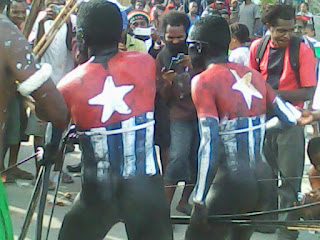
[caption id="attachment_3723" align="alignleft" width="660"]

OPEN LETTER To President Joko Widodo As the Supreme Commander of the Army and Police[/caption]
Shalom!
This open letter is addressed to the President in response to:
(a) Papuan Mourning which has gone viral on YouTube since the end of September 2020
(b) The Papuan People's Petition rejecting the Special Autonomy extension launched on 4 July 2020
(c) The violent and repressive response to peaceful protests against Special Autonomy. On Monday, September 28, 2020, students were shot at on the UNCEN Jayapura campus by the Army and Police. This sent a message that "Papua, by rejecting the extension of Special Autonomy is the enemy of the Republic of Indonesia".
(d) Remilitarization of Papua Land as a strategy of the Indonesian government in order to: 1. continue Special Autonomy unilaterally; 2. Return the Land of Papua to the status of a Military Operations Area (DOM) through the construction of new Military District
Commands (KODIM) & Military Area Commands (KOREM) since 2019 and sending additional troops to West Papua which began in August 29, 2019 and still continues; 3. In order to take control the natural resources of the Land of Papua at a large scale.
In our opinion, this letter does not come out of empty space or does not fall from the sky, but it comes out from the centre of Papuan dynamics. Therefore, through this letter, we ask the President as the Supreme Commander of the Army and Police, and the President of the member countries of the UN Human Rights Council, that he:
(a) terminate the status of Military Operations Area or 'Remilitarization' of the Land of Papua. Because this will continue to demonstrate the strength of the State's military without giving space for democracy and freedom of expression and assembly to Papuans.
(b) Through this letter, we also remind the President to follow up on your promise on September 30, 2019 to meet the “Papua Pro-Referendum group”.
This letter is conveyed by us from our position as Churches and Papuan Society that have been part of the modern Indonesian society since 1 May 1963.
1. Position and Identity of the Church & Papuan Society in modern Indonesian society since 1963
A Church document entitled: ‘Joint Statement’ which was signed by the leadership of the Protestant & Catholic Church of West Irian on March 9, 1964, states that the government established the position of the people of West Irian (Papua) and the Church as 'the other party', 'the other' to the government and the people of Indonesia. The government had the right and obligation to secure, manage and or control the people of West Irian according to their taste.
In the 'Joint Statement’ document, the first President of the Republic of Indonesia (9 March, 1964) positioned the people of West Irian as the 'target' of the Indonesian development model in West Irian (West Papua) which was aimed to equalize the people of West Irian so that they can be equal to other tribes in Indonesia, while the Indonesian government appointed itself as the 'representative of God' by quoting the Holy Scriptures, Romans 13: 1-3. The parties who invited our Church to sign the "Joint Statement" were: DGI (current PGI), the Indonesian Church Trustees Council (KWI now), in collaboration with the Secretariat for West Irian Affairs at that time.
Did the leaders of the West Irian Church at that time compile the "Joint Statement" or was it prepared by the inviting party? This is not clear. But the Joint Statement established the position of Papua in 'modern Indonesian society' ever since.
In the framework of 'equalizing' the people of West Irian (Tanah Papua), on May 2nd and 3rd, 1963, after UNTEA handed over government administration to the Government of Indonesia, the government collected books and magazines, pamphlets about history, ethnography, law, and other printed materials about Papua. They then burned them, while giving speeches and singing Indonesian national songs. There was a concern that the thoughts in these prints would hinder the Indonesian elite from imposing the “new imagined identity” of the Indonesian regime into the minds of the people of West Irian at that time.
The action of burning the books was continued by visiting and taking furniture and other items belonging to the people of West Irian at that time, in front of their families, and then also robbing goods from homes and shops that were left by Dutch citizens and the Dutch Government Office which had been vacated. They then loaded it all on trucks and brought them to the port to be sent their home villages outside Irian/Papua.
The above shows how the Indonesian nation positions the Papuan people as a nation without identity, without history and culture, a stupid, primitive, monkey nation, separatist, GPK, GPL, KKB, KKSB, spectator nation, while the Indonesian elite transported all the proceeds of wealth to outside Papua in the name of development.
This also serves as a framework for labelling all the Churches, NGOs, and civil society organizations that disagree with the regime as supporters of Armed Groups and who should be suspected. In fact, our people have been dying in our rich land due to malnutrition, poor health, poverty and very low education through kindergarten, elementary and high school (see the root of the Papuan conflict according to LIPI, including: Racial Discrimination) therefore the government has failed to develop the welfare of the Papuan people.
After positioning us in this way, the Indonesian government turned a blind eye to the four sources of the Papuan conflict mentioned by LIPI (see LIPI research, 2003) which consisted of: 1). Racial discrimination and marginalization 2) which caused Indonesia to fail to develop Papua in terms of: economy, education and health for the Papuan people; 3) differences in views between Papuans and Indonesians regarding Indonesia's steps to occupy Papua, and 4) Impunity of the Army and Police which allows human rights violations to continue to occur in Papua.
In conclusion, since May 1, 1963, we Papuans have experienced an 'apartheid ideology’ by the majority of Indonesia, in contrast to the majority blacks of South Africa who were under apartheid from the white minority'. So therefore, this Open Letter and the previous statement from the Papuan Pastors, takes the same tone as Desmond Tutu's voice in the apartheid era in South Africa which was described as Crying in the Wilderness1. With our position like this, it is only natural that Special Autonomy would fail; because with this apartheid system, the government and modern Indonesian society have turned a blind eye to the 4 sources of the Papuan conflict raised by LIPI.
2. The Land of Papua Remilitarization Program during the Special Autonomy Period
From the position described above, today we are following the developments leading to the program to return the Land of Papua to the status of a 'Military Operation Area' (DOM), including:
(a) All peaceful actions to protest racism in the Land of Papua (since 16 August 2019 at the Surabaya Dormitory) have been subject to treason charges.
(b) The peaceful actions against Special Autonomy have recently been faced with repression, for example, the action in Timika (23 September 2020), the Nabire action (24 September 2020), and the UNCEN student action (28 September 2020).
(c) The government has unilaterally provoked the people by announcing that Special Autonomy will be extended. Consider Mahfud MD's statement as Minister of Political, Legal and Security Affairs: Papua's Special Autonomy remains in effect - Extended Fund (CNN Indonesia 11 September 2020), Komarudin Watubun, 'Not the ending of Otsus, the Special Autonomy Fund' (Cenderawasih Pos, Saturday, 8 February 2020).
(d) The government is aggressively building KODAM, KOREM, KODIM, Battalions, Yonif Units and Combat Assistance throughout Papua. Specifically, regarding KODIM, before Special Autonomy there were 9 KODIMs and during Special Autonomy it had increased by 8 to become 17 current KODIMs (see Appendix I). In addition, there are also additional units of the Indonesian Navy and Air Force (see Appendix I). Additions also occurred in the Police Institutions by building local, regional and area Police Stations (POLDA, POLRES and POLSEK) as well as the addition of the Mobile Brigade Corps (BRIMOB) in West Papua.
(e) The dropping of Army and Police troops from outside West Papua has been carried out continuously from August 2019 until today.
(f) As a result of the intensification of military operations by the Army and Police in West Papua: hundreds of residents of Nduga, in the PT Freeport area have fled to the city of Timika since December 2019; Military forces that have been dropped since December 2018 have killed 243 civilian victims; In Intan Jaya since December 2019, it is not known how many tens or hundreds of residents have fled; the army shot dead Pastor Yeremias Zanambani on Saturday, September 19, 2020. Many residents have left their villages and places of worship to save their lives. A number of church buildings are now being used as security posts. Military operations in these villages also forced and pressured the community to accept the government program to extend Special Autonomy for the next 20 years until 2041.
(g) Recent security operations in various areas in West Papua have not been carried out independently, but we suspect that they are in order to support the hidden agenda of seizing land and customary forests (natural resources) belonging to the Papuan people by investors. This situation can be seen from the cries of the indigenous
Papuan people in Merauke (Malind, Muyu-Mandobo, Yakai), in Nduga, Timika, who have experienced repeated violence by the authorities after demanding their customary rights to land and forests that were confiscated for planting oil palm and other industrial plantations. Since 2018 the Papuan Indigenous Peoples in Tambrauw Regency have made demands against oil palm companies and the establishment of new military units in Tambrauw; Indigenous Papuans in Intan Jaya have just stated that they refuse enter to a subsidiary of PT ANTAM which intends to control a gold mining block in the region amidst the ongoing military operations which have resulted in the death and displacement of Intan Jaya residents (about 8 congregations have vacated their hometowns).
(h) Although the Indonesian government has become a member of the UN Human Rights Council, it does not recognize the human rights and freedoms of the Papuan people. At the same time, the Government of Indonesia (1) Supported a referendum for Palestine (in a speech at the General Assembly yesterday), (2) supported the Freedom of the Rohingya from Myanmar. (3) Promoted peaceful dialogue between the Islamic hardliners of Afghanistan and the Afghan government.
The institutions that cover the 'remilitarization agenda' for the integrity of the Republic of Indonesia are the top officials of the Republic of Indonesia (Indonesian National Police), who were mentioned in a discussion in Jakarta at the end of 2019. It was said that during the Soeharto era, the President prioritised the role of the Army in government. During Jokowi's time, he has prioritized the Indonesian National Police, so Jokowi entrusted important positions in the civilian government to the Police elite. The implications for Papua are: The Trio of the Republic of Indonesia who manage the remilitarisation process on behalf of the Republic of Indonesia, since racism protests 29 August 2019. Who are they?
(a) Budy Gunawan as the Head of National Intelligence Agency (BIN)
(b) Tito Karnavian, Ex Head of National Police who is now the Minister of the Interior.
(c) Paulus Waterpauw as the Field Guard in Papua
What unites this Trio of Police: The spirit of maintaining the integrity of the Republic of Indonesia. Their work was very visible when in 2017, when the Governor of Papua, Lukas Enembe was about to run as a candidate for a second term as Governor, the three Police officials contacted Enembe at midnight, asking Enembe to accept Paulus Waterpauw (at that time Head of Police in North Sumatra), to serve as candidate for Deputy Governor. They said due to the fact that Enembe's ‘Indonesian DNA’ was very low, he needed a companion with high Indonesian DNA. But Enembe refused. But the suspicion regarding the Indonesian DNA of Enembe was still visible when the racism protests broke out on 29 August 2019 in Jakarta: ULMWP was accused of being the actor behind the racism riots on 29 August. In Papua, there are Tabi elites who are members of the MRP (Papua Customary Council), Chairman of the City Council and the Regent of Jayapura Regency:
participated in accusing certain ethnic groups of being the provocateurs of the racism riots 29 August 2019; while promoting “the Tabi people as peace lovers” (Morning News RRI Nusantara 5 Jayapura, 30 August 2019).
The trio also arranged for 61 Papuan figures led by the chairman of the Jayapura City Council and a former church official to meet with President Jokowi to ask for the expansion of Tabi Province, which has a capital in Keerom Regency. After the racism riots, Paulus Waterpauw was re-appointed as Head of Police; the old Head of Police who had only been on duty for a few months was removed. Tito Karnavian, the Minister of Home Affairs, proposed to split Papua Province into 5 provinces on the recommendation of the Head of BIN Budi Gunawan. Waterpauw as Head of Police was assigned to secure this program for the sake of Indonesia. This trio is overseeing the program of injecting ' the love of the Republic of Indonesia' into the minds of Papuans by returning Papua to the status of a Military Operation Area (DOM) or a remilitarization of Papua; There is one goal, the integrity of the Republic of Indonesia, to the death.
3. Church Proposal: "The Politics of God" Facing the End of Special Autonomy
Faced with this reality, we ask for the attention of the President as the Supreme Commander of the Armed Forces of the Republic of Indonesia (ABRI), as well as the President of member countries of the UN Human Rights Council to resolve the issue of Papua peacefully through negotiations which in theology is called, 'The Politics of God' which states that God is very present in this world to bring peace. Negotiations are in the framework of safeguarding human rights and dignity. God asks the parties to protect and enforce the Right to Life. Therefore, facing the conditions of the West Papua in these days, we, the Church, propose the following:
(a) A Peaceful Approach to the Papuan Conflict which has been ongoing for more than 60 years. This was recently voiced by Pdt. Andrikus Mofu, Chair of the GKI Synod in Papua Land on September 19, 2020 (Suara Papua(dot)com, September 27, 2020).
(b) In the same spirit, the Papuan Church Council has recommended the way for the Peace Negotiations, through the Pastoral Letter of August 26 2019, which urges the Indonesian Government to show justice to the Papuan people with the solution: Negotiate with the ULMWP in the same way as President Susilo Bambang Yudhoyono took and Jusuf Kalla negotiated when facing the Bloody Conflict with Aceh which ended with the Helsinki Agreement on 15 August 2005.
(c) These calls remind us of the promise of the President on 30 September 2019: That the President is willing to meet with the Papuan 'pro-referendum group'.
(d) We also reject the Joint Fact-Finding Team for the shooting case of Pastor Yeremias Zanambani in Intan Jaya, which was formed by the Coordinating Minister for Political, Legal and Security Affairs, Mahfud MD, who has been promoting remilitarization in the
West Papua, because the team is not independent (consisting of security apparatus, government and intelligence units) so it will not be able to investigate incident properly, fairly and transparently. Based on the facts held by the Papuan Church Council, the shooting was carried out by an Army unit.
(e) The proposal is based on the results of LIPI Research which called for the Indonesian Government to use a peaceful dialogue approach against Papua (m.hukum online.com, 27 August, 2016; www.gatra com, 25 September 2019). Therefore, our proposal is not new.
(f) It is in this spirit that the Papuan Church Council reminds President Joko Widodo to keep his promise to the Chairperson of the High Commissioner of the UN Human Rights Council in February 2018 in Jakarta to visit Papua. This has also been stated:
1) In the Address of the Prime Minister of Vanuatu, Mr. Bob Loughman on 26 September 2020 at the United Nations General Assembly in New York;
2) Communique of the leaders of the Pacific Islands Forum (PIF) in August 2019 in Tuvalu;
3) ACP leaders' communique (Africa, Caribbean, Pacific) in December 2019 in Kenya.
(g) With this proposal, we urge the President as Commander of the Armed Forces not to allow the REMILITERIZATION program imbued with racism against Papua to continue.
As we end this letter, the Papuan Church Council would like to thank the family and congregation of Pastor Yeremias Zanambani in Intan Jaya, who have stood firm, bravely taking responsibility to speak out about the shooting that killed Pastor Zanambani. We pray that God will give them strength.
The Papuan Church Council would also like to thank the current Prime Minister of Vanuatu and the previous Prime Ministers, the leaders of other Pacific countries along with the people and the church who have not forgotten the suffering of the Papuan people; by consistently standing in front of the UN and in various forums, voicing violence and human rights violations against the Papuan people committed by Indonesia.
The Papuan Church Council appreciates and is grateful for the people's faith action through raising funds within one month amounting to IDR 773,000,000 to return Veronika Koman's study fees.
The Papuan Church Council thanks and at the same time prays for the people of Papua and all citizens of Indonesia and the international community who are in solidarity with Papua in facing the challenges of humanity, racism and injustice faced by the Papuan people.
The Papuan Council of Churches would also like to thank: Students, Academics, Journalists and Activists, Humanitarian Workers in Indonesia, the Pacific, Asia, Europe, Africa, America and anywhere who have noble hearts and have stood with us for a long time.
And to Mr. President Jokowi, I hope that the Pancasila and Human Rights Instruments can provide you with a stepping-stone to realize your promise of September 30, 2019 to "meet with the Papua Pro-Referendum group". We believe even this proposal is nothing new, it reminds us all of the footsteps of President Susilo Bambang Yudhoyono in resolving the Bloody Conflict with Aceh.
May God give the President Strength. Amen.
1 Desmond Tutu, Crying in the Wilderness, gathered by oleh John Webster (1986), Mowbrays Popular Christian Perspectives: London & Oxford.
2 In America this discourse is encouraged by public theologians: John Howard Yoder through his reflections raised in the book Politics of Jesus and through reflection & Jim Wallis, Gods Politics.