Search This Blog

Total Pageviews

Advertisement

Labels

Blog Archive

Showing posts with label Fiji. Show all posts

Israel Prime Minister and Fiji Prime Minister Inaugural of Fiji Embassy in Jerusalem

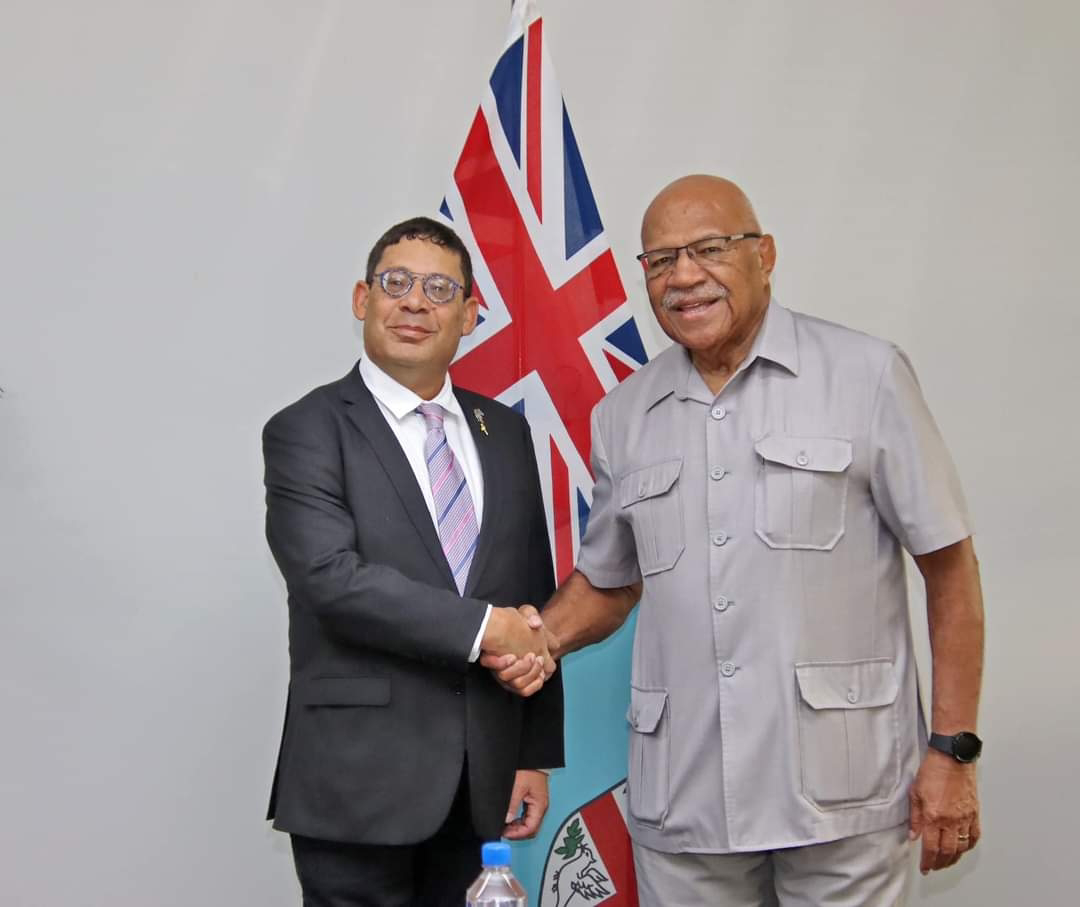
Prime Minister Benjamin Netanyahu, today, attended the dedication of the Fijian Embassy in Jerusalem, together with Fijian Prime Minister Sitiveni Rabuka and Foreign Affairs Minister Gideon Saar.

Prime Minister Netanyahu at the ceremony:

"It's a moving moment to have you here, with your ambassador, your staff, your delegation, our foreign minister, deputy foreign minister and all the friends who've gathered here at this important moment.

First of all, only one time you can be seventh. Then comes eighth, ninth; seven is an important number, it's a symbolic number in our tradition.; You're opening an embassy in the 'City on the Hill,' the city of Jerusalem. 

Here, next to the walls of our ancient city, the prophets spoke, the kings of Israel ruled, and some of the greatest insights of human faith and values were inscribed here. They were etched in our hearts and in the hearts of people all over the world.

When I listened to your anthem just now, I heard words that came from Zion, from Israel, from here – from Jerusalem.  The words that came from here. So we have a common bond, a common civilization, even though you are on the other side of the Earth in the middle of an ocean, happily surrounded by water. As long as it doesn't rise, it's very good.
 
But we are together over the years, in many instances, in many great issues, and the first one is peace. You mentioned it. You were a soldier of peace.  You were in a peace-keeping force. The idea of peace, peace between nations, peace between men and women around the world. That idea that all human beings are endowed with the right to live, the right to be free, the idea that slavery wasn't permanent. Three thousand years ago, that was a crazy idea, that people are basically important in themselves, every individual. That is a bedrock of our common faith and our common values. So this is more than a political moment. It's a sharing of great values and great purposes.
 
These values are challenged in our region. We have just been engaged for close to two years in a seven-front war against those who don't accept anything that I've just said. They celebrate a cult of death, they wish to extinguish the life of the Jewish state, but they threaten the lives of all who share our values and all who share the core of our civilization. It's very important that we brothers help one another. I'm proud of the fact that we have been involved in the development of Fiji. We talked today about many other things we can do and we intend to take this on with much vigor and much enthusiasm. 

But the most important thing is what we're doing now.

The fact that you have come here, and you have put your embassy in Jerusalem and you recognize a truth that everybody should recognize, but few governments have so far. That this has been our capital for 3,000 years, since the days of King David, and in many ways, you spoke about the fact that you enabled, you're very proud of the fact that the first ambassador, you accepted him into your house. Welcome to our house, Mr. Prime Minister, which is your house and the house of the people of Fiji."

Video: GPO

FIJI MELANESIAN ARTS & CULTURE FESTIVAL 2026 NATIONAL TASKFORCE HOLDS MEETING

Chaired by the Minister for iTaukei Affairs, Culture, Heritage & Arts, the Hon. Iferemi Vasu, the Fiji MACFEST26 National Taskforce held its inaugural meeting at the Ministry of itaukei Affairs HQ on Monday 22nd September 2025. 

The first meeting brought together key stakeholders who will advice and direct the Secretariat established to implement the Festival proper. 

We thank you for agreeing to our humble invitation and we look forward to working with you to ensure that a successful and uniquely different MACFEST is celebrated in Fiji recognizing the many artistic, heritage and cultural elements that embody our nation. 

The MACFEST Secretariat will soon roll out necessary decisions made by the National Taskforce and will keep you informed. 

Vinaka 

#MSG
#MACFEST
Fiji Arts Council 
Fiji Museum 
National Trust of Fiji Islands 
MSG Secretariat

𝐒𝐨𝐥𝐨𝐦𝐨𝐧 𝐈𝐬𝐥𝐚𝐧𝐝𝐬 𝐚𝐧𝐝 𝐅𝐢𝐣𝐢 𝐒𝐭𝐫𝐞𝐧𝐠𝐭𝐡𝐞𝐧 𝐁𝐢𝐥𝐚𝐭𝐞𝐫𝐚𝐥 𝐓𝐢𝐞𝐬 𝐰𝐢𝐭𝐡 𝐒𝐞𝐜𝐮𝐫𝐢𝐭𝐲 𝐀𝐠𝐫𝐞𝐞𝐦𝐞𝐧𝐭

>𝙋𝙧𝙞𝙢𝙚 𝙈𝙞𝙣𝙞𝙨𝙩𝙚𝙧 𝙈𝙖𝙣𝙚𝙡𝙚 𝙣𝙤𝙩𝙚𝙙 𝙩𝙝𝙖𝙩 𝙁𝙞𝙟𝙞 𝙞𝙨 𝙬𝙚𝙡𝙡-𝙥𝙡𝙖𝙘𝙚𝙙 𝙩𝙤 𝙛𝙞𝙡𝙡 𝙎𝙤𝙡𝙤𝙢𝙤𝙣 𝙄𝙨𝙡𝙖𝙣𝙙𝙨' 𝙣𝙖𝙩𝙞𝙤𝙣𝙖𝙡 𝙘𝙧𝙞𝙩𝙞𝙘𝙖𝙡 𝙨𝙚𝙘𝙪𝙧𝙞𝙩𝙮 𝙜𝙖𝙥𝙨, 𝙨𝙖𝙮𝙞𝙣𝙜, "𝙒𝙚 𝙝𝙤𝙥𝙚 𝙖𝙣𝙙 𝙥𝙧𝙖𝙮 𝙬𝙚 𝙬𝙞𝙡𝙡 𝙣𝙤𝙩 𝙩𝙧𝙞𝙜𝙜𝙚𝙧 𝙩𝙝𝙚 𝘼𝙜𝙧𝙚𝙚𝙢𝙚𝙣𝙩, 𝙗𝙪𝙩 𝙨𝙝𝙤𝙪𝙡𝙙 𝙩𝙝𝙚 𝙣𝙚𝙚𝙙 𝙖𝙧𝙞𝙨𝙚, 𝙬𝙚 𝙝𝙖𝙫𝙚 𝙥𝙡𝙖𝙘𝙚𝙙 𝙁𝙞𝙟𝙞 𝙤𝙣 𝙤𝙪𝙧 𝙨𝙥𝙚𝙚𝙙 𝙙𝙞𝙖𝙡."

HONIARA, Solomon Islands, (9 September 2025) - The Prime Minister of Solomon Islands, Hon. Jeremiah Manele MP, and the Prime Minister of Fiji, Hon. Sitiveni Rabuka, have signed a bilateral agreement for the deployment of Fijian security personnel to Solomon Islands.
At the signing ceremony on the sidelines of the 54th Pacific Islands Forum Leaders Summit in Honiara on Tuesday, both leaders hailed the agreement as a testament to the enduring and growing relations between the two Melanesian neighbours.
"We are connected by the Pacific Ocean, Culture, and our Shared History," Prime Minister Manele said, highlighting the deepening relations between the two Melanesian countries.
Mr. Manele acknowledged the long-standing ties between the two nations, including Fijian missionaries and soldiers who have served in Solomon Islands during pre-colonial times and World War II, and during the recent social unrest events.
“Fijian missionaries have worked in parts of the Solomon Islands, who have served in the colonial days. The deployment of Fijian soldiers goes back to World War II; some have paid the ultimate sacrifice. Solomon Islands pays tribute to them for their service,” Manele said.
Prime Minister Manele noted that Fiji is well-placed to fill Solomon Islands' national critical security gaps, saying, "We hope and pray we will not trigger the Agreement, but should the need arise, we have placed Fiji on our speed dial."
The agreement aligns with the Biketawa and Boe Declarations and reflects Solomon Islands' security strategy of broadening partnerships and deepening relations with Melanesian neighbours.
“This agreement aligns with the ‘Biketawa and Boe Declarations. Given Solomon Islands' special situation as a post-conflict country, we have adopted a security strategy of broadening our security partnerships and deepening our security relations with our Melanesian Wantoks to support national and regional stability,” Prime Minister Manele said.
The signing ceremony, held against the backdrop of a traditional canoe (The Tepuke) and a symbol of peace, highlights the shared blue Pacific identity and commitment to peace, progress, and prosperity, and the importance of cooperation between the two nations.
Ends///.
Full story is also on the link⬇️⬇️⬇️⬇️
https://sbm.sb/𝐒𝐨𝐥𝐨𝐦𝐨𝐧-𝐈𝐬𝐥𝐚𝐧𝐝𝐬-𝐚𝐧/

Media Release: Forum Foreign Ministers United on Regional Priorities

19 August 2025

Suva, Fiji – Pacific Islands Forum Foreign Ministers met in Suva last week for the 2025 Forum Foreign Ministers Meeting (FFMM). Chaired by HRH Crown Prince Tupoutoʻa ʻUlukalala, Minister for Foreign Affairs of the Kingdom of Tonga, the one-day meeting brought together Forum Foreign Ministers and Senior Officials of the 18 Forum member countries to consider key regional priorities, and emerging issues and challenges. 

Ministers held robust exchanges on the political developments in the region, including ongoing developments in New Caledonia and West Papua (Papua). Ministers also discussed the ongoing reforms under the Review of the Regional Architecture, including the Partnership and Engagement Mechanism, and heard a presentation on the High-Level Political Talanoa Report developed by the High-Level Political Group. Recognising the 40th anniversary of the signing of the Rarotonga Treaty, Ministers welcomed the Republic of the Marshall Islands as a new signatory to the Treaty and encouraged ratification by all Forum Members. 
Read full release here: https://bit.ly/474H9x6 

#Regionalism #OneBluePacific #54PIFLM

MSG, "THE POWERHOUSE OF THE SUBREGION"

SUVA, FIJI (18 July 2025): The Melanesian Spearhead Group (MSG) could be the powerhouse of the region as a platform to advance issues of national interest for Melanesia.

This was agreed at a recent discussion between the MSG Secretariat led by the Acting Director General, Ilan Kiloe, and Fiji’s Ministry of Foreign Affairs, led by Permanent Secretary, Dr Raijeli Taga.

PS Dr Taga said the MSG, being resource-rich in terms of population, land mass and natural resources can be very effective “if all of MSG’s constituent body meetings in arts & culture, trade, environment, sports and security, among others, are coordinated well.

“It (MSG) is already a powerhouse but we need to better plan and coordinate properly if we are to see issues from these meetings advanced into the PIFS system and elevated to a level where instructions can be made and actions taken,” she said.

Dr Taga stated, “there is a lot of responsibility on us to advance these initiatives further and use MSG to our advantage”.

“In doing so we can provide the opportunities for the other groups in the region and we must proceed to implement some of the outcomes by the Leaders.

“Fiji’s intent is not to go with the flow but to grow the MSG,” she added.

Acting Director General of the MSG Secretariat, Ilan Kiloe, firstly congratulated Fiji’s chairmanship, adding that he fully concurred with the directions which the Chair is ready to take. 

“Indeed, MSG is a strength in the Pacific and we must ensure that what we are doing fits into the ambitions of the wider Pacific,” ADG Kiloe said.  

He suggested that the MSG look at areas which it is able to influence and advance for instance climate change, since the MSG participated at the ICJ, amplifying the Pacific’s call for climate justice during the ICJAO proceedings on Climate Change.

ADG Kiloe said another area the MSG could take the lead on is Security, considering that Melanesia’s instability is dominated by ethnic conflicts and tribal wars, hence the need for a specifically designed strategy just for Melanesia.

The MSG Security Strategy, following the green light from Leaders last month, is expected to be endorsed at the upcoming MSG Police Minister’s Meeting this September.

The MSG Secretariat will also identify issues to update the Chair, prior to the upcoming Pacific Island Forum Leaders Meeting in Honiara.

Caption: Fiji's Permanent Secretary Foreign Affairs, Dr Raijeli Taga & Acting Director General of the MSG Secretariat, Ilan Kiloe, with members of their respective teams.

LEADERS ACKNOWLEDGE NEW CHAIR FOR HOSTING 23rd SUMMIT

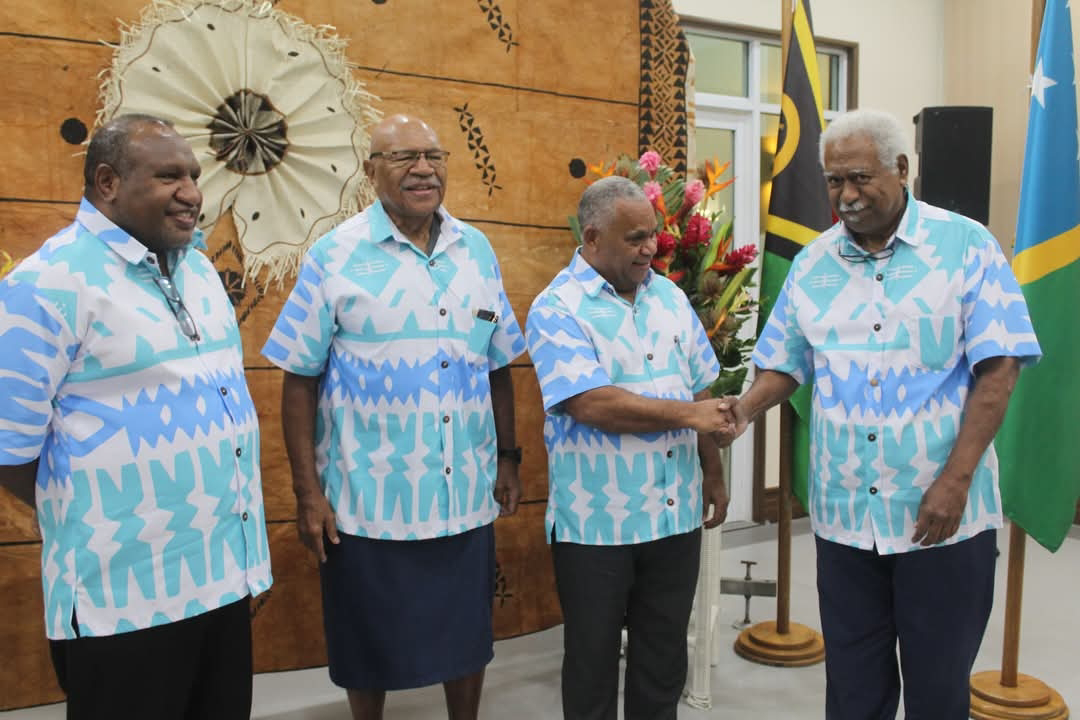
SUVA, FIJI (24 June 2025): Leaders from the Melanesian Spearhead Group extended deep appreciation to the Government and people of Fiji for successfully hosting the 23rd MSG Leaders’ Summit 2025 and related meetings during its conclusion at the Bose Levu Vakaturaga in Suva yesterday. 

They further expressed their gratitude and appreciation for the warm hospitality extended to all the Leaders and delegates. Among other decisions, the Leaders have endorsed the Secretariat’s ongoing participation in the ICJ process, particularly in the implementation of the Advisory Opinion acknowledging that the pathway is not immediate, nor is it one-size fits all, and will be implemented in a nationally determined way.

This is in recognition to the fact that all MSGs are still dependent on fossil fuels, are highly vulnerable to the worsening impacts of climate change, are not responsible for the climate crisis, and have limited financial, technical and human capacity.

Leaders also reaffirmed their commitment to the Friends to All, Enemy to None Foreign Policy as it will guide the MSG Members’ relationship with countries and Development Partners.

Leaders have also agreed to maintain the relationship and dialogue with Indonesia at the MSG Leaders Level and reiterated the MSG Leaders decision during the 22nd MSG Leaders Summit in 2023, to request the MSG Chair to write to the PIF Chair to ensure that the visit of the UN Human Rights Commissioner to the Papuan Provinces of Indonesia is undertaken.

In addition, Leaders agreed that they write to the President of Indonesia to seek ways in which cordial dialogue arrangements can be fostered whereby the issues of Papuan Provinces in Indonesia can be discussed and addressed. 

Additionally, Leaders reaffirmed MSG solidarity with the People of Kanak - New Caledonia, and support for FLNKS through various multilateral platforms, including the UN-established processes such as the Special Committee on Decolonisation (C-24). They further agreed that the matter of political developments in Kanak will remain as a standing agenda item on the MSG Leaders’ Agenda until an amicable political pathway is attained.

As well, Leaders approved for a High-Level MSG Ministerial Visit to New Caledonia; and agreed for the MSG Leaders to write to His Excellency, Emmanuel Macron, the President of France to foster dialogue arrangements on the decolonisation processes in New Caledonia.

Furthermore, Leaders noted the development of the MSG Business Travel Card as a catalyst for deeper economic integration and development, noting that Papua New Guinea will host the facilitation of the processing and issuance, and will support the MSG Secretariat in legislative reviews and the development of the Standard Operating Procedures (SOP).

On the Draft MSG Security Strategy, the Leaders agreed to defer the Joint Communiqué for Information Sharing and Cooperation between the Pacific Fusion Centre (PFC) and the MSG Secretariat pending the Review of the Regional Architecture, which was presented by the High-Level Persons Group (HLPG).

With regards to the status of the MSG Building following the December 2024 earthquake, Leaders approved the option of its demolition and reconstruction subject to receiving a full Structural Report and Geotechnical Report. Leaders also welcomed the proposed Haos Blo Melanesia (HBM) concept for the MSG Building.

Among other decisions made was the commitment to continue to support the MSG Prime Ministers Cup; continue discussions with Fiji as host of next MACFEST in support of preparations; acknowledgement of the Australia Government, through the DFAT for the initial funding towards the establishment of the PCMU; and welcoming of the proposed Yut4Melanesia Project to be implemented under the auspices of the PCMU.

On the MSG Land allocated by the Government of Fiji for Diplomatic Missions, the Leaders noted the progress of work by Members to undertake developments on the land for their diplomatic missions.

With respect to the Climate Finance Strategy/Sectoral Needs Assessment and the MSG Roadmap for Inshore Fisheries, the Leaders welcomed the review of Climate Finance Strategy and the MSG Roadmap for Inshore Fisheries. Leaders. 

The Secretariat has also been tasked to develop a Terms of Reference (TOR) for the review for the consideration of SOM out-of-session. 

At the conclusion of the meeting, the Chair thanked all the Leaders for their support and contributions during the 23rd Leaders’ Summit. 

Leaders also thanked the incoming Chair for his Leadership during the Summit and the outgoing Chair for maintaining solidarity.

PNG Prime Minister Affirms.to Support the Rights of Melanesians in West Papua and Torres Strait

Papua New Guinea has restated its support for collective dialogues on 'sensitive issues' of West Papua 'question' and New Caledonia's self-determination.

Speaking during this meeting, Prime Minister James Marape made this clear at the 23rd Melanesian Spearhead Group (MSG) Leaders’ Summit in Suva, Fiji. 

In a media statement this afternoon, PM Marape welcomed Indonesia’s continued participation in MSG talks, saying this does not affect Indonesia’s sovereignty but helps protect Melanesian cultural and land rights across all regions.

“MSG has a responsibility to all Melanesians — whether in sovereign Indonesia, the Torres Strait, or elsewhere,” PM Marape said. “We must protect people’s rights without interfering with national borders.”

Letters expressing unified MSG positions on both West Papua and New Caledonia will be sent to the governments of Indonesia and France.

PM Marape also called on MSG countries to strengthen unity by embracing their shared heritage. 

He reminded leaders that Melanesians are an ancient people, united through history, culture, and geography.

“Our roots go back over 4,500 years through the Lapita civilization. MSG must reflect that unity and help guide where we are heading as one Melanesian family,” he said.

Mr Marape supported reforms for how MSG leadership is chosen, calling for merit-based and fair processes. 

He also backed a review of MSG membership rules to avoid confusion about who can be a full, associate, or observer member in the future.

PM Marape encouraged more Melanesian trade, cultural exchange, and sports cooperation—proposing that the MSG Prime Ministers’ Cup become a regular event for both men’s and women’s football.

On climate change, he praised Australia’s renewed leadership and confirmed PNG’s active role in the next global climate talks, including cooperation with Brazil and other rainforest nations.

Marape ended his address by reaffirming MSG’s role in supporting Melanesian rights and development, while also helping strengthen the broader Pacific Islands Forum (PIF).

“MSG is not separate from the Pacific vision. It is part of it—protecting Melanesian culture, rights, and aspirations while supporting regional cooperation,” he said.

As PNG celebrates 50 years of independence, PM Marape thanked fellow MSG nations for their support and called for deeper unity for the next 50 years and beyond.

PM Marape is expected to be back in the country this evening.

Solomon Islands High Commissioner Celebrates PNG’s 50th Anniversary with a Message of Pacific Unity


In a moving address on the final day of the Pacific Story celebrations at Sir Hubert Murray Stadium, Solomon Islands High Commissioner to Papua New Guinea, His Excellency William Soaki, delivered a heartfelt tribute to PNG on its 50th Anniversary of Independence.

Speaking before a vibrant crowd, Commissioner Soaki reflected on the unbreakable cultural, historical and spiritual bonds between the Solomon Islands and Papua New Guinea. 

"We are neighbours by geography, brothers and sisters by our common Melanesian identity, and united in spirit through our churches and many shared ties," he said.

He acknowledged the deep people-to-people connections—from missionaries and trade to education and intermarriages—emphasizing shared milestones such as former Solomon Islands Prime Minister Manasseh Sogavare being born in PNG and current Prime Minister Jeremiah Manele graduating from the University of Papua New Guinea.

Commissioner Soaki extended warm congratulations to the government and people of PNG on behalf of the Solomon Islands Government and people, praising NCD Governor Hon. Powes Parkop and the NCDC for giving Pacific communities a platform to celebrate unity through culture.

He also acknowledged the contributions of Pacific Island communities from Fiji and West Papua, expressing unity with them.

Soaki lauded Governor Powes Parkop and the National Capital District Commission for their vision in hosting the Pacific Story, highlighting its platform for showcasing Pacific cultures and providing a voice for Pacific Islanders residing in PNG.

He called for the celebration to be more than just a celebration, but a catalyst for new friendships, partnerships, and cultural exchanges across the Pacific family.  

“Let tonight not just be a celebration but the beginning of deeper friendships and regional solidarity,” said Soaki. 

“To you PNG, you do not just stand tall in the Pacific—you lead as you rise.”

"In all our diversity, we are strongest when we stand together," concluded Soaki.  

The event featured Solomon Islands performers including Wantok Point of View, Cool Roots, and cultural groups from Malaita and Western Province.

𝐇𝐞𝐚𝐝 𝐨𝐟 𝐒𝐭𝐚𝐭𝐞 𝐡𝐢𝐠𝐡𝐥𝐢𝐠𝐡𝐭𝐬 𝐤𝐞𝐲 𝐝𝐢𝐬𝐜𝐮𝐬𝐬𝐢𝐨𝐧𝐬 𝐨𝐧 𝐅𝐢𝐧𝐚𝐥 𝐃𝐚𝐲 𝐨𝐟 𝐂𝐡𝐢𝐞𝐟𝐬 𝐌𝐞𝐞𝐭𝐢𝐧𝐠

The final day of the Bose Levu Vakaturaga (Great Council of Chiefs) meeting held at the Vale ni Bose in Draiba yesterday concluded with the adoption of key recommendations tabled by traditional leaders during breakout sessions. 

Chiefs canvassed issues of concern in their three confederacy or Matanitu Vanua groupings — Kubuna, Burebasaga, and Tovata—and presented the outcomes of their group discussions.

In his remarks, the President of the Republic of Fiji, His Excellency Ratu Naiqama Lalabalavu, addressed critical issues such as land ownership, indigenous rights, legal reform, and environmental stewardship.

Discussions during the two-day meeting covered several key topics, including the Fiji Pine Trust, the Vola ni Kawa Bula (VKB), the Native Land Trust Act, the Native Lands Act, and the authority vested in the two reserves commissioners under these laws.

President Lalabalavu revisited the origins of the Fiji Pine industry, noting that it was established by the Alliance Government led by the late Tui Nayau, Sau ni Vanua o Lau, Ratu Sir Kamisese Mara. He explained that the development was developed with New Zealand aid support and did not generate profits in its early years. The Fiji Pine Trust was then established to allow landowners to participate in and benefit from the scheme.

The Head of State went on to clarify overlapping legal responsibilities under the Native Lands Act and the Native Land Trust Act, particularly regarding the roles of the two Reserve Commissioners established under the two laws.

A major concern raised by the Burebasaga Confederacy was the consistency of VKB registration, especially for iTaukei children born overseas. Under an earlier policy, such children were automatically registered in the VKB.

To address indigenous grievances and provide legal clarity, the Head of State proposed the establishment of a Tribunal tasked to oversee the Deed of Cession rights. A sub-committee of the BLV was established to look further into this proposal.

In concluding his remarks, the President thanked the Chiefs and encouraged them to reflect deeply on the issues raised, urging them to work collectively toward a legal and cultural framework that promotes prosperity, clarity, and dignity for all.
 
#FijiNews #CoalitionGovernment #CoalitionGovernment

How ‘Blackbirders’ Forced Tens of Thousands of Pacific Islanders Into Slavery After the Civil War

Estimates of the number of Pacific Islanders captured by blackbirders and forced to work on cotton and sugar plantations in Fiji and Australia range from 61,610 to more than 100,000. Public domain via Wikimedia Commons

The decline of the American South’s cotton and sugar industries paved the way for plantations in British-controlled Fiji and Australia, where victims of “blackbirding” endured horrific working conditions

No Pacific Islander was safe from the “blackbirders,” slave traders who lured, coerced or outright kidnapped tens of thousands of people for forced labor in Australia and Fiji in the late 19th and early 20th centuries.

Some blackbirders disguised themselves as missionaries, going ashore with their collars reversed, books under their arms and the word of God on their tongues. Others enticed islanders to their ships with the promise of traded goods from far-off lands.

One man dressed in the costume of the Ku Klux Klan, a waterproof bag hidden under his robes, writes historian Gerald Horne in The White Pacific: U.S. Imperialism and Black Slavery in the South Seas After the Civil War. He would mesmerize a crowd by seemingly sucking saltwater into his growing belly. Then, when the man appeared to be on the brink of exploding, he’d tear off his costume, revealing the sleight of hand. The audience, so disarmed by the performance and startled by its finale, was said to be easy to snatch.

At times, slavers bypassed tricks altogether, arriving under the cover of night to ambush a village and kidnap its inhabitants. Locals referred to the raids as “blackbirding” because the perpetrators wore dark clothing when they crept ashore; the term also referenced a derogatory slang name for Pacific Islanders.

At the height of blackbirding, European powers occupied much of Oceania, the collective name for the islands scattered across the Pacific Ocean. With limited resources deployed over the vast distances between Vanuatu, the Solomon Islands, Papua New Guinea and other islands in the subregion of Melanesia (the main target of blackbirding), colonial governments found it virtually impossible to keep up with the slave trade. On one of the last frontiers of European and American expansion, blackbirders had little fear of being caught in the act.

“The [Pacific Islands’] relative isolation made it easier for unscrupulous frontier individuals to conduct themselves and their various operations in ways that were contrary to the laws of their own countries,” says Robert Nicole, a historian at the University of Canterbury in New Zealand. “Reports of abuses were slow to reach the governments and newspapers of these countries, and the criminal activities often went unpunished.”

Scholars’ estimates of the number of Indigenous people captured by blackbirders and forced to work on cotton and sugar plantations in Fiji and Australia vary widely. Horne cites figures ranging from 61,610 men, women and children to more than 100,000, all taken from their Pacific Island homes between 1863 and 1904. Young men and boys were especially prized: Sturdy and strong, they were the most likely to survive the backbreaking work, meager rations and physical abuse. But attractive women fetched the highest prices, due to their scarcity in mid- to late 19th-century settler communities.

While some individuals captured by blackbirders were promised a minimum annual wage of £3 and a return to their homeland after three years of labor, others were sold directly to planters or forced to continue working after their term was up. Such distinctions have historically cast doubt on whether this form of human trafficking was slavery or indentured servitude, in which individuals work for little or no pay for a set period of time as a way of repaying a debt.

The vast majority of those taken by blackbirders, however, had no debts to repay. Before being removed from their homes, they’d likely had little to no contact with foreign settlers. Blackbirding ships were commonly equipped with shackles and other means of preventing passengers from escaping, and they rarely had enough space or supplies to transport their human cargo—evidence that supports the argument that blackbirding was slavery rather than indentured servitude. If the islanders had signed contracts in good faith and received the necessary provisions, restraints wouldn’t have been necessary to keep them from jumping ship.

“This was employment enforced through the barrel of a gun or the crack of a whip,” says Nicole. “In this economy, foreign individuals and their associates create wealth for themselves on the backs of islanders who were given little or no choice in the matter.”


The fact that the South Pacific slave trade arose just as the United States became embroiled in a conflict over slavery is no coincidence. Perhaps the biggest irony of the Civil War is that the December 6, 1865, ratification of the 13th Amendment, which abolished slavery (except for convicted criminals) in the U.S., did not put a nail in the coffin of the global slave trade. Instead, its locus was simply transplanted to a new region.

The South Pacific slave trade grew out of cotton, or rather a lack thereof. In the early 1860s, plantations in the American South produced 75 percent of the cotton used around the globe. The outbreak of the Civil War in 1861 ground textile manufacturing to a halt but did not diminish demand for its output. In Great Britain and Europe, the price of cotton exploded.


Global powers had already started discussing the diversification of the cotton industry, especially as the U.S. slipped further and further toward conflict. As early as the 1850s, the British government experimented with Fiji and Australia as cotton-friendly alternatives to the American South. The results were promising, but the crop was labor intensive. Its production was only profitable in the U.S. because those who worked on plantations were enslaved, and the enslaved did not earn salaries.

Only by replicating the conditions pioneered in the U.S. could a South Pacific cotton industry be as lucrative as the one it was replacing. Unsurprisingly, white European settlers and Confederate refugees who sought respite from the Civil War in the South Pacific played a pivotal role in the new plantations’ development.

“The obvious source of labor to turn to was local Fijian labor, but very few Fijians were available or willing to work for planters under the exploitative conditions that often prevailed on these plantations,” says Nicole. “In 1864 and 1865, the first ships carrying laborers from Vanuatu arrived in Fiji, [and] before long, an entire labor trade emerged to service Fiji’s new plantations.”

Beyond Fiji, the British colonies of Queensland and New South Wales in Australia offered similarly attractive ecosystems for re-establishing the cotton industry. Sugar cane, another labor-intensive good whose production was disrupted by the Civil War, soon followed.

The blackbird trade was disjointed. Independent operators controlled the ships and set their routes without coordinating with one another or local authorities. Most blackbirders were citizens of the U.S. and Britain who’d come to the region as traders or settlers and found a lucrative business in trafficking human beings.

Although British law technically outlawed slavery in the empire’s colonies in the South Pacific, only a handful of Royal Navy ships patrolled the area. Even if a ship was suspected of blackbirding, the law could only be enforced against those of British origins, and even then, enslavers were rarely convicted due to the fine line between the definitions of indentured labor and enslavement.

In 1869, a Royal Navy ship seized the schooner Daphne on the suspicion that it was transporting enslaved laborers. Authorities found that the Daphne was carrying twice as many Pacific Islanders as it had been licensed to contract, in terrible conditions without sufficient supplies. The schooner’s South Australian owner escaped conviction on slavery charges because the prosecution didn’t have enough evidence to prove that working conditions at the ship’s destination of Fiji constituted slavery.

In truth, the Indigenous islanders blackbirded for plantation work in Fiji and Australia endured living conditions that, in many ways, mirrored the ones enslaved Americans had just escaped. Shelter was inadequate, food was limited and of poor quality, and hours were long. Workers faced violence and coercion from plantation owners and managers, and they had little access to medical care. Deaths from diseases to which they had no immunity were extremely frequent.

The South Pacific slave trade had an equally devastating effect on the communities targeted by blackbirders. “Robbed of their able-bodied men, the trade caused massive challenges for social cohesion on [enslaved people’s] home islands [that] took decades to rectify,” says Nicole. “Those who lost men had to rely on the elderly, on women and on the young to survive.” Familial relationships and cultural traditions practiced for centuries, like strategically arranged marriages between clans, disintegrated in the span of just a few decades.

Fiji’s cotton plantations rapidly declined in the early 1870s due to the industry’s resurgence in the American South. But both cotton and sugar cane remained significant industries in Queensland and New South Wales through the early 20th century, even after the fledgling Australian government passed federal legislation in 1901 requiring the deportation of Pacific Island laborers, including those who’d been blackbirded and their descendants, as part of a push to keep the country’s population white.

Deportations began in 1906, but not everyone who was given the choice trusted that they would be returned to their communities. In the past, individuals who’d been told they’d be brought home after their labor ended were dropped nowhere near the places from which they’d been taken—a situation that, due to conflict or a lack of resources, could result in death. At the same time, many wanted to remain in the country where they’d been forced to build new lives. Around 2,500 Pacific Islanders received exemptions or defied the order and stayed behind in Australia. Another 2,700 reportedly remained in Fiji in 1908.

After the mass deportations, Australia’s plantation workers were replaced by fairly paid white workers. Between 1919 and 1964, it was actually illegal for people of color to work in Queensland’s sugar industry.


 Reas complete story here

The Pacific civil society organisations (CSOs) and solidarity movements

The Pacific civil society organisations (CSOs) and solidarity movements are reminding Pacific leaders of their longstanding responsibility to West Papua, and to urgently address the ongoing gross human rights abuses.

Yesterday, the 1st of December 2024, marked 63 years since the Morning Star flag was first raised in West Papua to signify the territory’s sovereignty. Yet Indonesia’s annexation of the territory, military occupation, and violent oppression, gross human rights violations on West Papuans continue to be ignored internationally and unfortunately by most Pacific leaders.

We remind our Pacific leaders of their responsibility to sixty-three years of injustice by Indonesia, and the resilience of the West Papuan people against this oppression to this day. 📢

In solidarity with the people of West Papua, we demand that our Leaders:
1. Honor the resolutions of the Melanesian Spearhead Group (MSG) and Pacific Islands Forum, which call for a peaceful resolution to the West Papua conflict and the recognition of the rights
of West Papuans;

2. Take immediate and concrete action to review, and if necessary, sanction Indonesia’s status as a dialogue partner in the PIF, associate member of the MSG, and as a party to other privileged bilateral and multilateral arrangements in our Pacific region on the basis of its human rights record in West Papua;

3. Stand firm against Indonesia’s colonial intrusion into the Pacific through its cheque-book and other diplomatic overtures, ensuring that the sovereignty and rights of the people of West Papua are not sacrificed for political or economic gain; and

4. Pacific Islands Forum must take immediate action to establish a Regional Human Rights Commission or task force, support independent investigations into human rights violations in West Papua, and ensure accountability for all abuses.

#WestPapua #WestPapuaLivesMatter #EndColonialism #IndonesiaOutOfThePacific 

Pacific Network on Globalisation Fiji Women's Crisis Centre Indonesian Embassy Suva - Fiji

PM RABUKA COMMENDS CHINA’S POVERTY ALLEVIATION AND RURAL REVITALISATION PROGRAM

Prime Minister Hon. Sitiveni Rabuka began his 10-day official visit to China with a tour of Ping'anpo and Nanyou villages in Malipo County, Yunnan Province yesterday, where he observed firsthand transformative and innovative solutions being implemented to improve local livelihoods.

The two villages, located on the China-Vietnam border in the Southeastern part of Yunnan, are beneficiaries of the Republic of China's targeted poverty alleviation and rural revitalisation program. 

The poverty alleviation program in the two villages is being led by China's Ministry of Foreign Affairs. 
The innovative decision by President Xi Jinping to allocate counties to particular government ministries has borne fruit with the eradication of poverty in Malipo County. 

Prime Minister Rabuka was briefed on the two villages’ transformation over the past 32 years, from its former state of poverty to its current development progress, showcasing how agriculture, aquaculture and niche products including traditional foods, weaving and crafts have significantly improved the livelihoods and standard of living of members of the two communities.

Home to more than 200 people, Ping'anpo boasts a lush environment with modern agricultural development techniques and community projects for sustainable livelihoods.

In Nanyou Village, the villagers are actively involved in the development of rural tourism, aquaculture, entertainment and leisure agriculture and traditional embroidery products among other income-generating activities for improved livelihoods.

Prime Minister Rabuka said he was impressed with China’s poverty alleviation strategies, highlighting that Fiji has much to learn from China's success in improving the lives of millions of people.

The PM said Fiji stands to benefit from China’s technological innovation and sustainable practices to improve livelihoods, ensure food security, productivity, and economic diversification.

By adopting these practices, Fiji could accelerate its own efforts to alleviate poverty and promote sustainable rural development.

“Fiji is also committed to reducing poverty, and China's approach to rural development and poverty eradication in Malipo County in Yunnan Province serves as an inspiring model,” he said.

“These strategies were introduced in Malipo county in 1992 when I started my first term as Prime Minister of Fiji. Now that I am back in office, it's indeed an eye opener, in the sense that we thought we were doing our poverty alleviation as well as regional, rural and outer island development programs. But when you look at the scale of improvements in Malipo in the same period, it's really amazing.

“We have a lot to learn, and I have been making a lot of notes since I arrived on how we might be able to turn what people think are "little things" in the villages into "big things" in the provinces and the nation."

In this regard, Prime Minister Rabuka congratulated President Xi for his vision in improving the livelihoods of fellow citizens in poverty-stricken areas.

“I also congratulate Chinese leaders of the past for their concerted efforts and vision to alleviate poverty and raise the standard of living for those people in disadvantaged areas including where minority ethnic groups live,” he concluded.

The Prime Minister and his delegation were later hosted to a dinner by the Vice Governor of Yunnan Province, His Excellency Mr Wang Hao at Wenshan City.

Mr Wang expressed the province of Yunnan’s appreciation to the Prime Minister, adding that they look forward to future collaboration in areas of mutual interest.

The Prime Minister’s visit to Malipo County marks the first ever visit by a Pacific leader to the county.

#FijiGovernment #CoalitionGovernment #FijiNews #OfficialVisit #China #Fiji

PRIME MINISTER RABUKA MEETS WITH THE AMBASSADOR OF STATE OF ISRAEL TO PACIFIC

Prime Minister and Minister for Foreign Affairs Hon. Sitiveni Rabuka received a courtesy visit from the non-resident Ambassador of Israel to Fiji and the Pacific, Mr. Roi Rosenbilt, whilst he commences a weeklong official visit to Fiji and the region.
 
The meeting recognized the deep relationship between the two countries and highlighted prospects to further elevate Fiji and Israel’s ongoing cooperation, particularly in development areas such as agriculture and economy.
 
This particularly through renewing cooperation on the internship program in agriculture sector which will enable 12 Fijians to continue a training program in Israel to develop their expertise in agriculture and learn new technologies.

As part of the agricultural cooperation, the Government of Israel had earlier this year signed a Memorandum of Understanding (MOU) with the Ministry of Agriculture.

Ambassador Rosenbilt engagements here this week is to see how best this cooperation can be materialized to yield return on investment for Fiji.

Further, Israel has reaffirmed its commitment to expand opportunities through the collaborative public-private sector partnership and investment in Fiji, that supports our hub status in the region.  

Ambassador Rosenbilt said his visit to Fiji is to see how best Israel can advance relations with Pacific, saying his grateful for the opportunity to meet with Prime Minister Rabuka and exchange views on mutual issues of importance to Fiji and the Pacific.
 
On the same note, Ambassador Rosenbilt acknowledged Prime Minister Rabuka’s concept on the Oceans of Peace, saying it is an inspiring and commendable initiative to advance global solidarity and peace.

He said Israel hopes that Fiji will consider opening an Embassy in Jerusalem, in the near future to further strengthen the two countries’ relations and collaboration.

During his visit this week, Ambassador Rosenbilt aims to have several discussions with Government and Non-Government agencies to advance Israel’s cooperation with Fiji.

The Ambassador is expected to pay a courtesy visit to the newly appointed Secretary General of the Pacific Islands Forum (PIF) Mr Baron Waqa.  

#peoplescoalition #FijiNews #GovernmentNews #FijiGovernment

Almighty God, Loving God, Free West Papua

Almighty God, 
Our Redeemer and Saviour of the world, Our Creator and Source of Life, Love and Peace;
We come before you on this special day as we witness another year of commemoration day for the people of West Papua. 

Loving God, 
as we gather here, miles away from our brothers and sisters in the islands of Papua and in particular, West Papua, we confess the sins of humankind, the greed, the violence, the victimization, the power hunger, throughout history. 
As humans, it is difficult for us to forgive those who cause hurt, pain and suffering. But as your children, we humbly ask Your forgiveness upon us all – humankind; for perpetrators of violence and inhumane acts, for perpetrators of prejudice and injustice. 
We also ask Your forgiveness upon each one of us who may not feel directly affected by the situation, but continue to be arrogant, blind and deaf to the injustices in our Pasefika region. Lord have mercy on us, your children. 

Loving God,
as we commemorate this day, with all the history and pain it has brought about, for some it may be a day to remember victory, while to many, a day of pain.
We can only give You thanks and praise for all Your blessings and for helping your people through all the challenges, trials and tribulations they have faced over the years and continue to face today as they strive for self determination.
We give you thanks for those gone before us. 
We give you thanks for the many rich natural resources that West Papua has to offer. And we give you thanks for the people who continue to be resilient, strong and courageous in all they endure. 
We give You thanks for those today who continue to be the prophetic voice in your lands. We give you thanks for the work of the Pacific Conference of Churches, the Pacific Network on Globalization, and many others, known and unknown to us, who through their acts of service, continues to be a pillar of hope to our people of West Papua. 

Loving God, 
You are familiar with suffering and the pain of your children doesn't escape your gaze of compassion.
We ask for you to set people free in West Papua. We pray for the ones who have been oppressed and in fear for so long. We pray for those in power, who are giving the orders for violence out of greed or fear of scarcity, or prejudice.

May your kingdom of justice, peace, joy and forgiveness transform the situation. Bring courage and peace to those in the independence movement. Please bring your healing and your making things right and new.
We make this our humble prayer which we ask and plead in the name of God the Father, Christ His Son, and the Holy Spirit. Amen. 

[Prayer for The West Papua Annexation Day]

The Pacific Network for Globalization (PANG) asks that the UN human rights mission be allowed to go to West Papua

Jayapura, Jubi – The Pacific Network for Globalization (PANG) in Suva Fiji has issued a statement of solidarity with civil groups and student protesters who demonstrated against the torture of Papuan man Definaus Kogoya by Indonesian troops in Tanah Papua (West Papua) in early February 2024 .

"PANG said the peaceful demonstration occurred after a video circulated showing Defianus Kogoya tied in a barrel filled with water, beaten and slashed with a knife, allegedly by Indonesian soldiers," as quoted by Jubi from postcourier.com.pg, Sunday (7/4/2024) .

It was also reported in the PANG statement that in the same incident, two other Papuan men, Warinus Murib and Alianus Murib, were also arrested and allegedly tortured. Warinus Murib died from his injuries.

Reports also said 62 students were arrested and questioned before they were released, while two were seriously injured. In previous protests, 15 people were arrested for distributing pamphlets. Protesters demand that all military operations must stop in West Papua.

“We condemn the excessive military presence in West Papua and the associated human rights violations against the Papuan people. "We also condemn the use of violent tactics by the Indonesian police to attack and detain students who should have the right and freedom to express their views," he said.

He added that this shows the ongoing oppression by the Indonesian government in West Papua, despite decades of official denial and media censorship.

UN experts have expressed serious concern about the deteriorating human rights situation in Papua and West Papua Provinces, including child murder, disappearances, torture and mass displacement.

In concluding its observations on the second periodic report on Indonesia, based on the International Covenant on Civil and Political Rights adopted on March 24 2024, the Human Rights Committee (HAM) expressed deep concern over the pattern of extrajudicial killings, enforced disappearances, torture , and other forms of cruelty and degrading human dignity, ill-treatment, particularly of indigenous Papuans and failure to hold perpetrators accountable for their actions.

The Committee also calls on the Melanesian Speardhead Group (MSG), the Pacific Island Forum (PIF), and the communities and governments of all Pacific Island countries to demand that Indonesia allow the implementation of the PIF Leaders' decision in August 2019 for the UN High Commissioner for Human Rights to undertake a mission to West Papua.

"We call on the PIF special envoy for West Papua to accelerate their mandate to facilitate dialogue with Indonesia, in particular to pave the way for an emergency UN visit," he said.

He added that he would echo the call made by the 62 students arrested by the Indonesian government to stop all military operations in West Papua and allow the UN to do its job.

"Our Pacific governments should not expect anything less from Indonesia, especially considering its special position as a member of the MSG and as a dialogue partner of the PIF," said PANG.

Quoted from https://thousandcurrents.org/ Pacific Network on Globalization (PANG) is a regional monitoring institution that promotes the right of Pacific peoples to self-determination.

PANG mobilizes movements and advocacy based on substantive research and analysis to advocate and promote a Pacific people-centered development agenda.

PANG operates through a network model to support and work with community groups representing diverse constituencies and interests, including trade unions, feminists, young people, traditional landowners, community and environmental groups, scientists, lawyers, economists, political analysts, academics, members parliament and government.

Founded in 2000 by a regional NGO based in Suva, Fiji, the Pacific Network on Globalization (PANG) is a regional organization that describes itself as ‘the people's watchdog on trade and economic issues’.

PANG sees how civil society is not involved in the debate on trade liberalization and how the free trade agenda ignores the priorities of human development and poverty alleviation. PANG developed into a research, advocacy, capacity building and campaign organization. (*)

https://jubi.id/pasifik/2024/jaringan-pasifik-untuk-globalissi-pang-minta-misi-ham-pbb-diizinkan-ke-west-papua/

#WestPapua #HumanRight #Genocide #FreeWestPapua #Melanesian #Pacific

1st MEETING OF THE COMMITTEE FOR REINFORCING COMMITMENT TO MSG, A SUCCESS

PORT VILA, VANUATU (25 March 2024): The Inaugural Committee for Reinforcing Commitment and Obligation towards the MSG (CRCO) was successfully convened at the Melanesian Spearhead Group (MSG) Secretariat on 15 March 2024.

Chaired by Mr Kalfau Kaloris, Director General of the Ministry of Foreign Affairs, International Cooperation and External Trade of Vanuatu, the CRCO was convened to examine the institutional, regulatory and operational mechanisms in Members’ bureaucracy that might be affecting commitment to, and cohesion of the MSG and the effective implementation of MSG Leaders’ decisions.

The same issues were examined of the Secretariat and suggestions to strengthen its operations, commitment to the MSG and the effective implementation of Leaders mandates were put forward.

During opening statements, Members reaffirmed their commitment towards the MSG and its objectives. They also noted the Secretariat’s efforts to strengthen its operations and capacity needs and undertook to improve their support to the Secretariat with its work. 

Additionally, they reiterated their commitment towards ensuring that the MSG continues to be relevant, and that the cohesion of the Group is further strengthened to ensure it plays an effective leadership role in the region on matters of particular interest to the MSG Members.

Members agreed to the need for adjustments and strengthened cooperation within the MSG Membership in the changing regional and global political and economic landscape.

In terms of Legislative, Members called for the need to review the Agreement Establishing the MSG, among other things, to make it consistent with International Law and practice. The review would ensure a stronger and versatile subregional Organization, that MSG will remain faithful to its original objectives and truthful in the service of its Members interests, and the Organization will remain relevant amidst changing times.

With regards to operational matters, Members urged for concerted efforts to be made to increase the visibility of the MSG as a Group and the Secretariat, and aggressively promote what the MSG does.

Among other things, Members acknowledged the importance of the Committee’s work and agreed for the CRCO to become a Standing Committee of the MSG that would report to the Senior Officials Meeting (SOM) directly and endorsed that the outcome of the discussions be presented to and considered by the MSG Governing Bodies.

Committee Members in attendance were Chairman, Mr Kaloris; Ambassador Amena Yauvoli, Fiji’s Ambassador to Indonesia; Mr Patrick Jomessy, Representative of the FLNKS Political Bureau; Mr Elias Wohengu, Secretary of the Department of Foreign Affairs of Papua New Guinea (online) and Ambassador Collin Beck, Permanent Secretary of the Ministry of Foreign Affairs and External Trade of Solomon Islands.

No timeframe– PM Regarding REINSTATEMENT OF OUSTED MINISTER FOREDUCATION


BY SERAFINA SILAITOGA - The Fiji Times

THE reinstatement of ousted minister for education Aseri Radrodro may take six months, a year or the end of the four-year Coalition Government term, says Prime Minister Sitiveni Rabuka.

In an interview yesterday, Mr Rabuka said there was no time frame as he reiterated that he does not tolerate nor condone such behaviour from Cabinet Ministers in defying his orders.

He said he had made such decisions in his last term as prime minister where he suspended Cabinet ministers in his past Soqosoqo Vakavulewa ni Taukei party that was in power in the 1990s.

He confirmed receiving the resolution document from SODELPA leader and Minister for Tourism Bill Gavoka and they had a long discussion.

Grant to benefit 10,000 farmers


Business, Local News, News | Published: 1 day ago | By Meri Radinibaravi

More than 10,000 Fijian farmers will now benefit from a $US25,000 ($F55,955) grant that the Indonesian government handed over to Prime Minister Sitiveni Rabuka on Thursday.

Assistant Minister in the Office of the Prime Minister Sakiasi Tubuna told The Fiji Times that the purpose of the grant was to help establish coffee farmers in the highlands of Viti Levu, particularly in the Sigatoka region.

“Government is looking at a more innovative approach to ensure that we substantially increase coffee production in the country, and the other aspect of it is we’re working with the private sector. Bula Coffee will be establishing these farms and at the same time, purchasing the matured beans from these farmers,” Mr Tubuna said.

“We’re looking at around 10,000 farmers, initially but we will be phasing out the approach all over (the) Keasi area, Nanoko, up in Nabutautau areas, all those villages will be involved in this project.”

Indonesia’s Ambassador to Fiji Dupito Darma Simamora said being one of the largest coffee-producing country in the world, Indonesia was well-positioned to be a partner for Fiji in developing its coffee industry.

“Indonesia is pleased to support the smallholder coffee project, a project that empowers Fiji in the agriculture sector while at the same time advancing its rural development, food security, alternative development, and livelihood for the people at the grassroot,” he said.

“This collaboration marks an important date in our bilateral relationship as both friendly countries celebrate the 50th anniversary of their bilateral relations.”

The assistance is scheduled to reach identified farmers by next week, through Bula Coffee

Pacific Conference of Churches Support West Papua 1 December 2023

Romans 8: 16-21
The Spirit himself testifies with our spirit that we are God’s children. Now if we are children, then we are heirs—heirs of God and co-heirs with Christ, if indeed we share in his sufferings in order that we may also share in his glory. I consider that our present sufferings are not worth comparing with the glory that will be revealed in us. For the creation waits in eager expectation for the children of God to be revealed. For the creation was subjected to frustration, not by its own choice, but by the will of the one who subjected it, in hope that the creation itself will be liberated from its bondage to decay and brought into the freedom and glory of the children of God.

On the first of December 1969, the Morning Star was raised in the land of Tannah Papua. A Year later, the Indonesian Army invaded the land and placed a stranglehold on Papuans and the land. Today, the Pacific Conference of Churches, Fiji Council of Churches, Fiji Council Of Social Services (FCOSS), PIANGO Pacific 2030, Pacific Network on Globalisation, National Youth Council of FIji, Social Empowerment and Education Program- SEEP and other Civil Society representatives raised the morning star flag once again to commemorate the ongoing struggle for self-determination and freedom for our brothers and sisters in Tannah Papua. 

Rev Siera Bird, shares a reflection on the plight of West Papuan women especially, sharing a letter from Rode Wanimbo of the GIDI in West Papua who speaks to the hope that Pacific solidarity for freedom in West Papua is a beacon of hope for those in Tanah Papua. The reading from Romans Chapter 8 speaks to the hope for liberation that we find in Christ. 

As we continue to observe the 16 Days of Activism, we remember the unique violence that women and children face in the ongoing military occupation of Papua. The Pacific must stand up and speak out against the atrocities that are a lived reality for Papuans and reiterate the urgency with which we must work to end Indonesian Occupation of West Papua. 

From all corners of the Pacific, we shout #Merdeka! #MerdekaPapua! #Merdeka! #WestPapua #tannahpapua #FreeWestPapua

Prime Minister Rabuka selected as Melanesian Spearhead Group Special Envoy to Address West Papua Issue

The Melanesian Spearhead Group (MSG) has appointed Prime Minister Sitiveni Rabuka and Prime Minister James Marape of Papua New Guinea (PNG) as special envoys to Indonesia. 

Their mandate is to meet with the President of Indonesia to discuss the pressing issue of West Papua.

This significant development emerged from today's MSG Caucus meeting, during which Prime Minister Rabuka proposed sending a representative to Indonesia to facilitate dialogue on the West Papua situation. 

He emphasised that these efforts are an extension of his ongoing work to nurture the concept of the Pacific as a zone of peace.
"The idea of the Pacific as a zone of peace aligns with my campaign motto of "let love shine," a vision rooted in promoting unity and harmony in Fiji. I saw that my country had become contentious."

Prime Minister Rabuka believes that this initiative is a crucial step forward.
The MSG Caucus reached a consensus that sending a ministerial envoy, as opposed to a bureaucratic-level envoy, would be the most effective approach to addressing the West Papua issue. 

This decision complements the Pacific Islands Forum (PIF) Leaders' 2019 resolution, which called for the United Nations High Commissioner for Human Rights to conduct a mission to West Papua and the Papuan Provinces.

In earlier discussions at the MSG Leaders Meeting, it was agreed that the most appropriate forum for addressing human rights matters is the United Nations, specifically through the UN Human Rights Council. 

This aligns with the position of PIF Member States, which also reaffirm Indonesia's sovereignty over West Papua.

The MSG has actively pursued the implementation of PIF Leaders' 2019 decision to allow the UN High Commissioner for Human Rights to conduct a mission to West Papua and the Papuan Provinces. 
The MSG remains committed to finding a peaceful and diplomatic resolution to the West Papua issue and looks forward to engaging in meaningful discussions with Indonesia to address this pressing concern.