Search This Blog

Total Pageviews

Advertisement

Labels

Blog Archive

Showing posts with label Climate Change. Show all posts

ICJ to deliver climate ruling July 23, Vanuatu awaits legal turning point

July 23, Vanuatu awaits legal turning point
By Ezra Toara

The International Court of Justice (ICJ) has announced that it will deliver its highly anticipated Advisory Opinion (AO) on the obligations of States in relation to climate change on Wednesday, 23 July 2025 at 3:00pm Central European Summer Time (CEST), during a public sitting at the Peace Palace in The Hague.

According to the Court's official press release, Judge Iwasawa Yuji, President of the Court, will deliver the opinion during the session. The sitting will be open to members of the diplomatic corps from participating States and international organisations involved in the proceedings, who will be seated in the Great Hall of Justice. Representatives from non-participating States will follow the proceedings from the Small Hall of Justice.

Following the ICJ’s announcement, the Government of Vanuatu issued a statement through the Office of the Prime Minister, acknowledging the historical importance of the forthcoming opinion in advancing the global response to climate change.

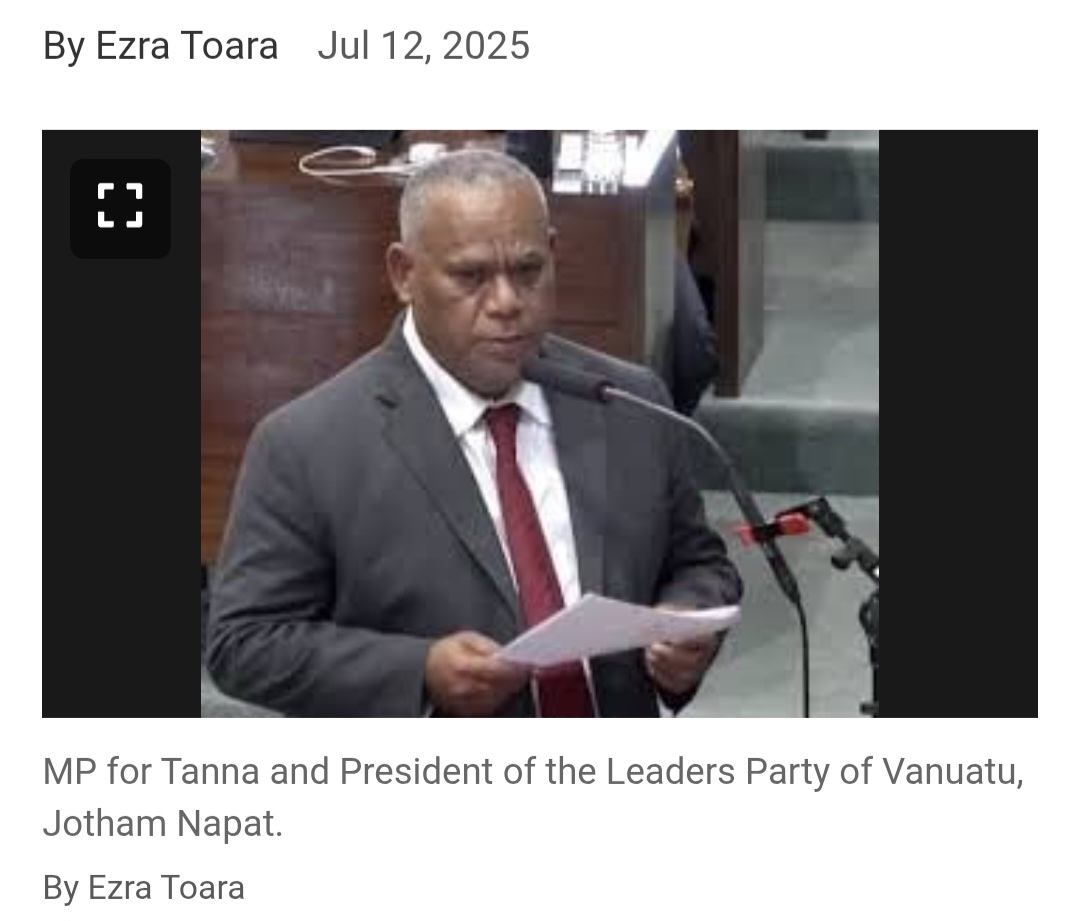
Prime Minister (PM) Jotham Napat said Vanuatu is awaiting the ruling with anticipation. “We eagerly await the landmark opinion of the world’s highest court on the greatest existential challenge facing our planet: the climate crisis. The AO from the ICJ, which will be issued on July 23 at 3:00pm CEST, is not just a legal milestone—it is a defining moment in the global climate justice movement and a beacon of hope for present and future generations.”

He said that Vanuatu and its fellow Small Island Developing States (SIDS) have long warned of the growing impacts of climate change—rising sea levels, stronger storms, and the mounting cost of inaction. Their advocacy, he added, comes from a deep conviction that justice must prevail and that international law must protect those most at risk.

“This case was born from a spark of hope ignited by Pacific youth who dared to bring the world’s biggest challenge before the world’s highest court, and their call was supported by over 80 nations standing together for climate justice,” said PM Napat.

He referred to recent United Nations data, which recorded 152 extreme weather events in 2024 alone—a number expected to rise with accelerating climate change. While international mechanisms such as the United Nations Framework Convention on Climate Change (UNFCCC) and the Paris Agreement have laid down foundations for action, he said they have not delivered the scale or urgency required.

“We turned to the Court to clarify what international law already requires of States, because relying solely on mechanisms like the UNFCCC and Paris Agreement is not producing the action the world urgently needs,” he said. “We sought confirmation that States’ legal obligations extend to their climate-related actions, especially when those actions cause harm beyond their borders.”

The PM said a favourable AO could affirm States’ long-standing obligations under international law to address climate change, clarify the legal consequences of failure to act, provide courts and negotiators with stronger legal tools, improve access to finance and support for vulnerable nations, and help shift global efforts from promises to accountability.

“I am hopeful for a powerful opinion from the ICJ. It could set the world on a meaningful path to accountability and action,” he said.

Regardless of the outcome, the PM said the process itself had already helped raise the voices of climate-vulnerable nations, increase global awareness, and lay the groundwork for stronger future action.

“This ruling will give us a foundation to build upon and inspire continued efforts to protect our planet,” he said.

Although the ICJ’s AO is non-binding, it is expected to influence international law, climate negotiations, and cooperation well into the future.

ezra@dailypost.vu

Vanuatu's climate envoy slams Australia and 'world's largest greenhouse gas emitters' at ICJ

Vanuatu's Special Envoy for Climate and Environment, Ralph Regenvanu,says he is "obviously disappointed" by the Australian government's statement during the International Court of Justice (ICJ) proceedings regarding legal obligations of nations in relation to climate change.

Australia has taken a different view from Vanuatu and other Pacific Island nations.

On Monday, Australia argued that the United Nations Framework Convention on Climate Change (UNFCCC) and the Paris Agreement are the primary sources of international obligations to address greenhouse gas emissions.

Regenvanu said he was disappointed by Australia's position, along with what was shared from the United States, Saudi Arabia, and China.

"These nations, some of the world's largest greenhouse gas emitters, have pointed to existing treaties and commitments that have regrettably failed to motivate substantial reductions in emissions," Regenvanu said in a statement.

"It is particularly concerning that some of these nations, upon whom we depend for aid and support, have not acknowledged the severity of the crisis or their responsibilities under international law.

"Our dependency on their assistance makes it all the more critical for them to act responsibly and in solidarity with vulnerable nations like ours."

He hopes that former colonial powers, France and the United Kingdom, will instead back Vanuatu.

Greenpeace Australia Pacific's general counsel Katrina Bullock said Australia's position "completely undermined its Pacific neighbours".

"It disregards decades of international human rights legal developments and directly contradicts the powerful legal submissions of Pacific, African, and Caribbean nations."

Australia has put in a bid to host COP31 in partnership with the Pacific.

The country, along with United States, is also trying to reassert its influence in the Pacific, as China becomes more involved in the region

The ICJ will decide on two questions: What are the obligations of states under international law to protect the climate and environment from greenhouse gas emissions?

And, what are the legal consequences for states that have caused significant harm to the climate and environment?

Fiji was the last Pacific island nation to give its submission on Wednesday.

The country's Attorney-General Graham Leung said land and resources are becoming increasingly vulnerable.

"Is it just that our people are forced to abandon their ancestral lands and heritage because of the inaction of those most responsible for climate change, is it? How do we protect the future of our people?" Leung asked the court.

He said international law requires states to not cause trans boundary harm and this also applied to greenhouse gas emissions.

"No state has the right to use its territory in a way that causes significant harm to another state."

Vanuatu started the proceedings with Regenvanu who told the ICJ countries conduct are on trial for consistently failing to rein in emissions.

"I must emphasis that since 1990 emissions have increased by over 50 percent reaching an all time high in 2023 last year, more than half of all CO2 emissions since 1750 were emitted after 1990, whatever the timeframe, there is no excuse."

The United Nations climate meeting COP29, which wrapped up last month in Baku, Azerbaijan, was labelled disappointing for the Pacific and developing countries.

Regenvanu said the Baku summit was another example of the process failing.

"The prolonged and systematic failure of the COP has cost them [Vanuatu people] their wellbeing, their cultures and even their lives.

"There is an urgent need for a collective response for climate change grounded not in political convenience but in international law."

The case landed in the ICJ after campaigning from Vanuatu students.

Pacific Islands Students Fighting Climate Change - the group which initiated the campaign - president Cynthia Houniuhi said UN negotiations had been hijacked by major fossil fuel producers.

"As judges of the world court you possess the power to help us course correct and renew hope in humanities ability to address the greatest challenge of our time and you can do this simply by applying international law to the conduct responsible for climate change," Houniuhi from Solomon Islands said.

The Pacific Community's (SPC) director of climate change Coral Pasisi said during an online press conference that legal opinions from the ICJ can serve as a catalyst for international law's being developed to correct injustices.

"We know that a legal opinion is not legally binding but we do know a legal opinion from the International Court of Justice has a very strong moral weighting."

- RNZ

How old is the climate crisis?

Published: September 4, 2024 6.05pm BST

I was born in 1994, when the concentration of CO₂ in the atmosphere was measured at 360 parts per million; today it is close to 420. Furnaces, engines and former forests emitted 23 billion tonnes of this planet-warming gas in 1994; today they spew more than 37 billion tonnes. With some exceptions (economic downturns, the pandemic), humanity has released more CO₂ into the atmosphere each year than the one before it for at least two centuries.

Earth is not only hotter as a result of all this additional greenhouse gas, it is also getting hotter at a faster and faster rate. Where did it all begin? Figuring that out can tell us who or what is responsible – and what a possible solution looks like.

This roundup of The Conversation’s climate coverage comes from our award-winning weekly climate action newsletter. Every Wednesday, The Conversation’s environment editor writes Imagine, a short email that goes a little deeper into just one climate issue. Join the 35,000+ readers who’ve subscribed.

One way to answer the question at the start of this newsletter is to identify when people first noticed that the planet was warming. This happened during the mid-20th century. Tragically, it did so among scientists whose funders preferred that the world remain ignorant.

The 1970s: a critical decade
One company intimately involved with the emerging science of climate change was Exxon (now ExxonMobil). Scientists working for this oil and gas giant were modelling Earth’s climate in the 1970s to understand how the increasing carbon content of the atmosphere would affect temperatures – and Exxon’s future as a business.

According to a study published in 2017 that involved scouring the company’s internal documents, Exxon scientists acknowledged back then that climate change was real and overwhelmingly caused by burning the same fossil fuels Exxon sold.

“Yet over 80% of Exxon’s editorial-style paid advertisements over the same period specifically focused on uncertainty and doubt, the study found,” says Katharine Hayhoe, professor and director of the Climate Science Center at Texas Tech University.

Exxon knew better – a lot better. An investigation published last year showed that forecasts of the future climate made by Exxon scientists in the 1970s were remarkably accurate. The company knew where the world was headed by continuing to burn coal, oil and gas and instead endeavoured to cover it up.

fiction and non-fiction books on colonialism and other topics, locates in this story the seeds of the climate crisis.

“Colonialism, genocide and structures of organised violence were the foundations on which industrial modernity was built,” he writes. By making such destruction economically rational, capitalism encouraged activities that gradually degraded Earth’s living systems, say Julia Taylor and Imraan Valodia, climate and inequality researchers familiar with Ghosh’s work.

For a sense of how this legacy still frustrates efforts to solve climate change, look no further than the international negotiations convened by the United Nations.

The COP27 summit in Sharm El-Sheikh, Egypt was the fifth to be held in Africa. One debate at COP27 asked whether African countries had the right to exploit their natural gas reserves, as many richer countries had already done. Those same “developed countries”, in UN parlance, may owe their wealth to past plunder in Africa. And despite promises to the contrary, few countries are meeting their pledges to finance renewable energy in Africa.


Read more: China is already paying substantial climate finance, while US is global laggard – new analysis


“Calls to cease all gas exploration in Africa that fail to account for where historical responsibility for climate change lies and the need to close the current finance gap are the most audacious kind of climate imperialism,” say Chukwumerije Okereke and Youba Sokona, environment and development experts at the University of Bristol and UCL respectively.

“On this basis, it is argued that developed countries are enacting a renewed form of colonialism – what some might call climate colonialism.”


PNG and France Forge Cooperation in Forest Managem3nt, Conservation and Climate Change

Papua New Guinea and the Republic of France have established a landmark cooperation in Forest Management, Conservation, and Climate Change during a bilateral meeting between Prime Minister James Marape, and French President , His Excellency Emmanuel Macron, in Port Moresby on Friday, July 28, 2023.

Prime Minister James Marape expressed his satisfaction with the fruitful meeting, emphasising that it paves the way for elevating the long-standing good relations between the two nations to new heights.

The leaders mutually agreed to intensify their collaboration in forest management, conservation, and climate change. 

“This is an issue that I have been passionate about, as many of you know from my interventions at the United Nations level," Prime Minister Marape stated.

Among the key areas of intervention discussed, both leaders have agreed to:

1. Establish an office for expertise from France in Papua New Guinea.
2. Foster cooperation in energy transition initiatives.
3. Allocate funding for works at the Port of Rabaul to enhance its climate resilience.
4. Extend support for green finance in the Pacific region.

"The above interventions clearly demonstrate France's commitment to sustaining its long-term partnership with PNG and the wider Pacific region. This step is highly welcome and timely," Prime Minister Marape said.

During the meeting, President Macron assured Papua New Guinea of France's readiness to allocate a funding of EUR$63 million (K238 million) for the period 2021-2024 under the Forests, Climate Change, and Biodiversity (FCCB) intervention programme in PNG. The Managalas Conservation area in the Northern Province will be one of the projects featured in this programme.

The FCCB will also encompass support for government, community service organisations, private sector, education, and research, complementing and enhancing existing programmes in the country.

On the topic of ongoing private sector engagement, both leaders discussed France's continued investment in the oil and gas sector, particularly in Papua LNG through TotalEnergies EP PNG Ltd. This substantial investment is set to further transform Papua New Guinea's economic landscape and boost the Gross Domestic Product (GDP) in the future.

Prime Minister Marape extended an invitation for French companies to participate in Special Economic Zones (SEZs) to engage in downstream processing and add value to agriculture, timber, and fisheries products before exporting them to overseas markets.

"To conclude, President Macron and I will count on the support of our Ministers, Officials, and business community to take appropriate actions towards the realisation of these projects," Prime Minister Marape stated.

Reflecting on the significance of the visit, Prime Minister Marape acknowledged the historical links between France and Papua New Guinea that date back to the 1800s when the first French Catholic Missionaries arrived on Woodlark Island in the Milne Bay Province, and later to Yule Island in the Central Province. He expressed gratitude for their contributions to the spread of the Catholic religion, education, healthcare, and other essential services that continue to support the country.

The visit by President Macron marks a historical event as the first visit by a French President-in-Office to Papua New Guinea, signifying the strengthening and reshaping of bilateral relations since the formalisation of ties in 1975.

"On behalf of the people of PNG, I extend appreciation to the government of France for their contributions to our development agenda, including our trade relations through the European Union. We are extremely grateful for the support rendered to developing countries like PNG," Prime Minister Marape concluded.

The year 2023 has undoubtedly become a momentous year for Papua New Guinea, with a multitude of global leaders visiting its shores. Prime Minister Marape expressed that such visits are unprecedented since independence and contribute significantly to the country's development priorities, particularly in the realm of Forest Management, Climate Change, and environmental sustainability.

PNG and France Forge Cooperation in Forest Managem3nt, Conservation and Climate Change

Papua New Guinea and the Republic of France have established a landmark cooperation in Forest Management, Conservation, and Climate Change during a bilateral meeting between Prime Minister James Marape, and French President , His Excellency Emmanuel Macron, in Port Moresby on Friday, July 28, 2023.

Prime Minister James Marape expressed his satisfaction with the fruitful meeting, emphasising that it paves the way for elevating the long-standing good relations between the two nations to new heights.

The leaders mutually agreed to intensify their collaboration in forest management, conservation, and climate change. 

“This is an issue that I have been passionate about, as many of you know from my interventions at the United Nations level," Prime Minister Marape stated.

Among the key areas of intervention discussed, both leaders have agreed to:

1. Establish an office for expertise from France in Papua New Guinea.
2. Foster cooperation in energy transition initiatives.
3. Allocate funding for works at the Port of Rabaul to enhance its climate resilience.
4. Extend support for green finance in the Pacific region.

"The above interventions clearly demonstrate France's commitment to sustaining its long-term partnership with PNG and the wider Pacific region. This step is highly welcome and timely," Prime Minister Marape said.

During the meeting, President Macron assured Papua New Guinea of France's readiness to allocate a funding of EUR$63 million (K238 million) for the period 2021-2024 under the Forests, Climate Change, and Biodiversity (FCCB) intervention programme in PNG. The Managalas Conservation area in the Northern Province will be one of the projects featured in this programme.

The FCCB will also encompass support for government, community service organisations, private sector, education, and research, complementing and enhancing existing programmes in the country.

On the topic of ongoing private sector engagement, both leaders discussed France's continued investment in the oil and gas sector, particularly in Papua LNG through TotalEnergies EP PNG Ltd. This substantial investment is set to further transform Papua New Guinea's economic landscape and boost the Gross Domestic Product (GDP) in the future.

Prime Minister Marape extended an invitation for French companies to participate in Special Economic Zones (SEZs) to engage in downstream processing and add value to agriculture, timber, and fisheries products before exporting them to overseas markets.

"To conclude, President Macron and I will count on the support of our Ministers, Officials, and business community to take appropriate actions towards the realisation of these projects," Prime Minister Marape stated.

Reflecting on the significance of the visit, Prime Minister Marape acknowledged the historical links between France and Papua New Guinea that date back to the 1800s when the first French Catholic Missionaries arrived on Woodlark Island in the Milne Bay Province, and later to Yule Island in the Central Province. He expressed gratitude for their contributions to the spread of the Catholic religion, education, healthcare, and other essential services that continue to support the country.

The visit by President Macron marks a historical event as the first visit by a French President-in-Office to Papua New Guinea, signifying the strengthening and reshaping of bilateral relations since the formalisation of ties in 1975.

"On behalf of the people of PNG, I extend appreciation to the government of France for their contributions to our development agenda, including our trade relations through the European Union. We are extremely grateful for the support rendered to developing countries like PNG," Prime Minister Marape concluded.

The year 2023 has undoubtedly become a momentous year for Papua New Guinea, with a multitude of global leaders visiting its shores. Prime Minister Marape expressed that such visits are unprecedented since independence and contribute significantly to the country's development priorities, particularly in the realm of Forest Management, Climate Change, and environmental sustainability.

Pacific leaders call for action from industrial nations

Pacific Island Forum leaders have urged the United Nations Secretary General to persuade the world’s industrial powers to take urgent action to reduce their carbon emissions.

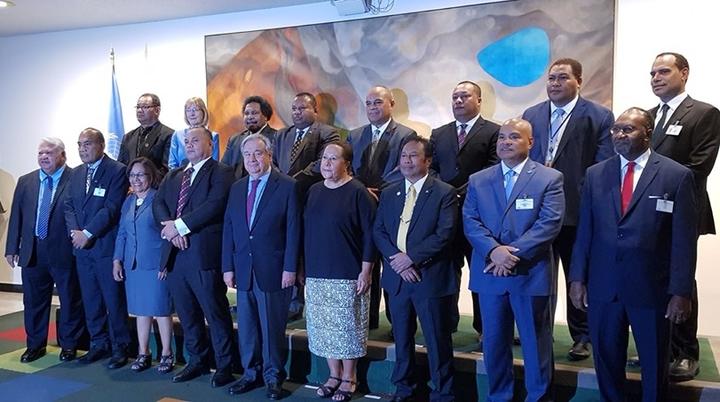
Pacific leaders meet in New York with UN Secretary General Antonio Guterres.
Pacific leaders meet in New York with UN Secretary General Antonio Guterres. Photo: Aupito William Sio

Forum leaders met with António Guterres on Saturday ahead of the UN supremo’s special Climate Action Summit and UN General Assembly.Listen to more on Dateline Pacific duration4′ :22″Add to playlistDownload

Listen to more on Dateline Pacific

They highlighted critical priorities to securing the future of the Pacific region.

New Zealand’s Minister for Pacific People’s represented the country ahead of Prime Minister Jacinda Ardern’s arrival.

Aupito William Sio says beyond the plea for action, Pacific leaders urge industrial nations to then stay on course to achieve net-zero carbon emissions by 2050 in order to limit temperature rise.

“One-point-five degrees as agreed to in the Paris Agreement and I was quite proud of the way the Pacific Island Forum leaders co-ordinated and raised all the valid issues that were raised at the Tuvalu PIF conference.”

The 21 September meeting at UN Headquarters in New York gave Forum leaders the opportunity to formally table issues, including those discussed at the 50th Pacific Islands Forum (PIF) Leaders Meeting in Tuvalu last month, before the 74th session of the UN General Assembly.

Leaders also raised issues previously discussed with Antonio Guterres during his visit to Fiji, New Zealand, Tuvalu and Vanuatu in May.

“The Blue Pacific is the frontline of the fight against climate change which represents the single greatest threat to the future of our region,” said Nauru’s new president, Lionel Aingimea, who chaired the meeting on behalf of the Forum Chair, Tuvalu.

Forum Leaders briefed the UN Secretary-General on the Kainaki II Declaration for Urgent Climate Change Action Now as agreed in Tuvalu. The Declaration sets out ten actions for urgent and effective climate action by all countries at the Climate Action Summit and at COP 25 in Chile in December.

Leaders also discussed the development of a new 2050 Strategy for the Blue Pacific Continent to drive and lead the collective future of the Pacific region including the importance of securing and protecting ocean and marine resources for the future.

“Including our commitment to conclude all outstanding maritime boundaries claims in order to safeguard our maritime zones in the face of sea level rise and climate change.

“Our resolve to accelerate collective action to address the legacies of nuclear testing including on fisheries was also discussed,” said President Aingimea.

Pacific Leaders also raised the situation in West Papua at the meeting.

“Leaders reiterated their calls from the Forum Communique agreed in Tuvalu – for all parties to protect and uphold the human rights of all residents and to address the root causes of the conflict by peaceful means. The urgency around the Leaders’ request for the parties to finalise the timing for a mission of the UN High Commissioner for Human Rights to West Papua (Papua) was also conveyed,” said Pacific Islands Forum Secretary General, Dame Meg Taylor.

Pacific to seek easier access to climate finance

Easing access to climate finance will be a focus for the Pacific at the Climate Action Summit.

The Pacific Regional Environment Programme’s principal climate change advisor said Pacific countries were making these firm commitments despite their own very low carbon emissions.

However, these countries were highly vulnerable to the climate crisis, and Espen Ronneberg said access to climate finance for adaptation was a priority for them.

“The resources are available, it’s just that it’s complicated to access them and doing so requires quite a bit of human capacity and expertise that sometimes is lacking or is simply too over-worked with other responsibilities.”

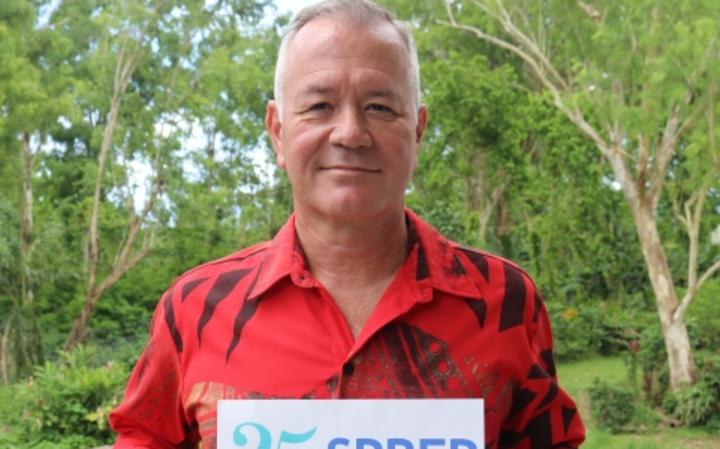
Espen Ronneberg
Espen Ronneberg Photo: SPREP

The Climate Action Summit takes place on 23 September at the United Nations in New York.


from WordPress https://ift.tt/2mQQfsV
via IFTTT September 26, 2019 at 11:15AM

UN Chief’s Call to ‘Save the Pacific to Save the World’

.N. Secretary-General Antonio Guterres said it was vital “to save the Pacific to save the world” as he wrapped up his brief South Pacific tour in Vanuatu on Saturday.

Guterres has spent the past week in the region pushing for urgent action ahead of a U.N. summit in September billed as a last chance to prevent irreversible climate change.

According to the U.N., Vanuatu is the world’s most at-risk country from natural hazards, but Guterres said it was also “leading the way” with is resilience.

At a joint press conference with Vanuatu’s Prime Minister Charlot Salwai, Guterres praised the way the country had bounced back from the catastrophic Cyclone Pam which lashed the archipelago in 2015.

It claimed at least 15 lives, flattened villages and impacted nearly half the 300,000 population.

“It is clear that the Pacific is on the frontline of climate change even though they don’t contribute to climate change,” Guterres told AFP, referring to low-lying Pacific islands which are threatened by rising sea levels.

“So the Pacific has the moral authority to offer a lesson for the rest of the world. We absolutely need to save the Pacific to save the world.”

What’s Next

The U.N. target is to limit rises to 1.5 degrees Celsius (2.7 degrees Fahrenheit) above pre-industrial revolution levels and Guterres urged governments “to understand that we need transformative measures, in industry, in agriculture and in relation to the oceans.”

“I believe it is time to recognise that we need to shift taxation away from people to carbon and pollution instead,” he said.

“We need to stop subsidies for fossil fuels. It doesn’t make any sense that taxpayers’ money is contributing to increased storms, the spread of drought, glaciers melting, corals bleaching and putting these islands in danger.”


More on the Subject

On Saturday, The Guardian has become the first outlet to change the language it uses to cover climate change.

“Instead of ‘climate change’ the preferred terms are ‘climate emergency, crisis or breakdown’ and ‘global heating’ is favoured over ‘global warming,’ although the original terms are not banned,” Damian Carrington, the Guardian’s environment editor wrote.

https://theglobepost.com/2019/04/10/food-climate-change-solution/


from WordPress http://bit.ly/2HCwH3s
via IFTTT May 18, 2019 at 09:24PM

Pacific Forum calls for action against climate change

With the United Nations Climate Action Summit slated for September, leaders of the Pacific Islands Forum issued a joint statement asking UN Secretary-General António Guterres to deliver their message to the world.

Source: https://pacificnewscenter.com/

The Pacific Islands Forum is a group of 18 independent states and self-governing territories who are vulnerable to rising sea levels, displacement, and other impacts of climate change.

Forum leaders recently had a high-level political dialogue with the UN Secretary General in Suva, Fiji on May 15.

In the collective statement, the  presidents representing the Pacific Island nations said, “Climate change is the single greatest threat to our Blue Pacific region. All countries, with no caveats, must agree to take decisive and transformative action to reduce global emissions, and ensure at scale mitigation and adaption support for those countries that need it.”

“If we do not, we will lose. We will lose our homes, our ways of life, our well-being and our livelihoods. We know this because we are experiencing loss already.”

The members of the forum are: Australia, Cook Islands, Federated States of Micronesia, Fiji, French Polynesia, Kiribati, Nauru, New Caledonia, New Zealand, Niue, Palau, Papua New Guinea, Republic of Marshall Islands, Samoa, Solomon Islands, Tonga, Tuvalu, and Vanuatu.

Here’s the complete statement from the Pacific Forum:

Our Message

Leaders of the Pacific Islands Forum warmly welcome the United Nations Secretary-General, António Guterres, to our Blue Pacific region – to witness the everyday reality of climate change and drive momentum in the lead up to his Climate Action Summit in September.

As we approach the 25th iteration of the Conference of the Parties, it is difficult to find new words, new anecdotes, new experiences to press our Blue Pacific message – but our commitment to multilateralism is unwavering, as is our commitment to continue the fight for a safer climate for a safer world.

At the Climate Action Summit, platitudes and repackaged commitments cannot be the substance of our deliberations. We need transformational change at scale, and courageous leaders prepared to deliver on it.

Leaders of the Pacific commit to doing all we can to make the Climate Action Summit a global turning point for ambitious climate change action.

We ask the United Nations Secretary-General to share our message with the world:

The Blue Pacific – our great ocean continent, our thousands of islands, our strong and resilient people – is running out of time.

We need to act now. Our survival, and that of this great Blue Pacific continent depend on it.

Climate change is the single greatest threat to our Blue Pacific region.

All countries, with no caveats, must agree to take decisive and transformative action to reduce global emissions, and ensure at scale mitigation and adaption support for those countries that need it.

If we do not, we will lose. We will lose our homes, our ways of life, our well-being and our livelihoods. We know this because we are experiencing loss already.

We have talked and debated about the science for years. Now we find there is no doubt. We are facing an unprecedented global catastrophe for our beautiful Blue Planet.

We must change this course. Limiting warming to below 1.5°C remains feasible and the only viable path. We urge all parties, at all levels, to act now. Our actions must be swift and they must be ambitious.

As one Blue Pacific, we are – and will continue – to take decisive action.

We enacted the Boe Declaration to put climate change at the forefront of our collective security action. We have driven global advocacy on climate change and set ambitious Nationally Determined Contributions. We have taken a world-leading integrated approach to tackling climate change and disaster risks through our Framework for Resilient Development in the Pacific.

After meeting today, we will return to our island homes. Some of us will find our villages inundated by waves and our homes and public infrastructure wrecked by cyclones. Our coral reefs are dying, our food is disappearing, and we fear for the safety of our loved ones, who are being injured and even killed by some of the most ferocious of cyclones and other extreme weather events ever witnessed in our region.

The multilateral concurrence of targets and commitments is not enough. Multilateralism must be effective, and we must do better at orientating our collective efforts towards action at all levels – international, regional, national and local.

Let us together seize the opportunity of the UNSG’s Climate Action Summit to make the changes we need to reverse climate change.

To the major polluters – our today in the Pacific is undoubtedly your tomorrow.

Sea level rise in Tuvalu is sea level rise in New York, though one might go under before the other.

Climate change impacts will undermine – and potentially reverse – economic development, create instability and conflict, and threaten lives all over the globe. No one country or individual will be spared.

We urge all world leaders to listen and to act.

Act for all of us.

Act for our children and their children.

Act for our future.

Let us come together to save our Blue Planet.

This must be our legacy.


from WordPress http://bit.ly/2wnyumA
via IFTTT May 17, 2019 at 09:11PM

UN chief’s call to ‘save the Pacific to save the world’

Port Vila (Vanuatu) (AFP)

UN Secretary-General Antonio Guterres said it was vital “to save the Pacific to save the world” as he wrapped up his brief South Pacific tour in Vanuatu on Saturday.

Guterres has spent the past week in the region pushing for urgent action ahead of a UN summit in September billed as a last chance to prevent irreversible climate change.

According to the UN, Vanuatu is the world’s most at-risk country from natural hazards, but Guterres said it was also “leading the way” with is resilience.

At a joint press conference with Vanuatu’s Prime Minister Charlot Salwai, Guterres praised the way the country had bounced back from the catastrophic Cyclone Pam which lashed the archipelago in 2015.

It claimed at least 15 lives, flattened villages and impacted nearly half the 300,000 population.

“It is clear that the Pacific is on the frontline of climate change even though they don’t contribute to climate change,” Guterres told AFP, referring to low-lying Pacific islands which are threatened by rising sea levels.

“So the Pacific has the moral authority to offer a lesson for the rest of the world. We absolutely need to save the Pacific to save the world.”

The UN target is to limit rises to 1.5 degrees Celsius (2.7 degrees Fahrenheit) above pre-industrial revolution levels and Guterres urged governments “to understand that we need transformative measures, in industry, in agriculture and in relation to the oceans”.

“I believe it is time to recognise that we need to shift taxation away from people to carbon and pollution instead,” he said.

“We need to stop subsidies for fossil fuels. It doesn’t make any sense that taxpayers’ money is contributing to increased storms, the spread of drought, glaciers melting, corals bleaching and putting these islands in danger.”

? 2019 AFP


from WordPress http://bit.ly/30NVVnp
via IFTTT May 18, 2019 at 08:55PM