Search This Blog

Total Pageviews

Advertisement

Labels

Blog Archive

Showing posts with label USA. Show all posts

Prime Minister Marape Holds Historic Bilateral Talks at the White House With U.S. Vice President

Washington D.C., USA | Thursday, 10 July 2025 - Prime Minister Hon. James Marape has
announced a landmark development in Papua New Guinea–United States relations following a historic first-ever bilateral meeting at the White House between a sitting Papua New Guinean Prime Minister and a U.S. Vice President.

This milestone meeting, held during Prime Minister Marape’s official visit to Washington D.C., took place at the White House with U.S. Vice President H.E J.D. Vance, and signals a
significant elevation in the bilateral relationship between the two nations.

“This is the first time in 50 years that a Papua New Guinea Prime Minister has held a formal
bilateral meeting at the White House,” Prime Minister Marape stated. 

“The engagement
was warm, respectful, and constructive, demonstrating the United States’ sincere interest in strengthening its ties with Papua New Guinea.”

During the discussions, the United States Government confirmed it will send a high-level
delegation to attend Papua New Guinea’s 50th Independence Anniversary celebrations in
September 2025. 

This delegation will be led by Deputy Secretary of State Christopher Landau, reflecting the importance the U.S. places on its relationship with PNG.

Prime Minister Marape and Vice President Vance also discussed shared democratic values,
mutual interests in the Indo-Pacific, and opportunities for expanded cooperation in trade,
security, and economic development.

“The United States is the greatest democracy, the strongest free-market economy, and the
leading Christian nation,” Prime Minister Marape said. “Papua New Guinea, too, is a robust
democracy, a free-market economy, and a nation founded on strong Christian values.

These shared beliefs continue to guide our alignment on many regional and global issues.”

He added that the two governments have agreed to continue technical-level engagements to prepare for a potential full bilateral meeting between President Donald Trump and Prime Minister Marape at a later date, when both the White House and Waigani are ready.

“Our officials will begin preparatory work on specific areas of bilateral cooperation,
including trade, security, development, and investment,” he said. 

“We hope to formalise this growing relationship through a future meeting between the President of the United States and the Prime Minister of Papua New Guinea.”

During the meeting, Prime Minister Marape also acknowledged and thanked major U.S.
companies operating in Papua New Guinea—ExxonMobil, Barrick Gold, Newmont
Corporation, Hilton, Marriott, and others—for their long-standing contributions to the
country’s economy.

“I also took the opportunity to invite more U.S. companies in manufacturing, agriculture,
fisheries, and sustainable forestry to explore investment opportunities in Papua New
Guinea,” he added. 

“Our economy is open for business, and we welcome responsible partners who share our vision for sustainable growth.”

The bilateral engagement caps off a series of high-level meetings during Prime Minister
Marape’s visit to the United States, which included strategic dialogues with U.S. defence,
trade, and development agencies.

“This visit marks the beginning of a new era in PNG–U.S. relations,” Prime Minister Marape
concluded. “As we mark 50 years of Independence, we are repositioning ourselves on the global stage, and fine tuning our relationships with all partner nations including this great United States of America .”

-///-

President Donald Trump breaks the divorce law that has been tormenting men in the US

BREAKING NEWS 

President Donald Trump breaks the divorce law that has been tormenting men in the US.

Divorce has become a very lucrative business for women in the United States and I'm gonna put an end to it. If a woman marries a rich man, it doesn't mean she gets to leave as a rich woman after divorce. 

If upon divorce the woman needs money, the man can borrow her a maximum of $1-million if she has a colleteral. $1-million isn't alot of money for the rich man but it should be a lot about for the woman because she didn't work for it. 

If I'm worth $50-million, I'm not gonna give you $25-million after divorce. It's my money and I worked very hard for it. I don't care if we've been married for 6 years or even 25 years or even have children. If you don't have enough money to take care of our children, leave them with me. I think that just because  somebody marries somebody that built something huge, doesn't necessarily mean that just because they get a divorce, that they should end up like the Queen of Sheba”.

On the Same note President Trump hits on Gay and Transgender Group and Thier organization LGBTQ+Saying that “There Are Only Two Genders in the world (Male and Female)

Many Nations in the world particularly the African Countries applauded for such radical decisions since they alliance with African cultures and norms, they termed them as not just human rights but natural rights from the creation.

White evangelical voters show steadfast support for Donald Trump’s presidency

By — Peter Smith, Associated Press

Politics Nov 7, 2024 2:57 PM EST

After former President Donald Trump gave his victory speech early Wednesday, at the Palm Beach Convention Center, dozens of his supporters gathered in a lobby to sing "How Great Thou Art," reciting from memory the words and harmonies of a classic hymn, popular among evangelical Christians.

It was a fitting coda to an election in which Trump once again won the support of about 8 in 10 white evangelical Christian voters, according to AP VoteCast, a sweeping survey of more than 120,000 voters. That margin — among a group that represented about 20% of the total electorate — repeats similarly staggering margins of evangelical support that T rump received in 2020.

Pastor Robert Jeffress of First Baptist Church of Dallas, one of Trump's most prominent evangelical supporters since the 2016 campaign, called the election a "great victory."

"Yes, there were some faith issues important to evangelicals, but evangelicals are Americans, too," Jeffress said. "They care about immigration, they care about the economy."


Jeffress dismissed concerns of those who predict a Christian nationalist administration.


"People who are not Christians are unduly worried he's going to institute some kind of oppressive theocracy. He has no interest in doing that," Jeffress said, noting that Trump has shown no interest in banning same-sex marriage or imposing an absolute abortion ban.

Trump's strongest supporters among evangelical leaders can likely expect the kind of White House access they had in the first Trump term.

Trump has proclaimed a sense of divine mandate.

"Many people have told me that God spared my life for a reason," Trump said in his victory speech, referring to the widespread proclamations among evangelical supporters that he received miraculous divine protection in the near-fatal assassination attempt in Butler, Pennsylvania, on July 13. "And that reason was to save our country and to restore America to greatness."

Some Trump critics fear he will implement a Christian nationalist agenda they see as giving Christians a privileged position in the country and flouting the separation of church and state. Others wonder how such an agenda would look in practice.

On the campaign trail, Trump pledged to "protect Christians in our schools and in our military and our government" and in "our public square." Many church-state battles in recent years have focused on Christian symbols in public settings, such as displays of crosses.

The Republican platform pledged to defend Christians as well as Jews facing persecution. While it included a general pledge to protect the worship of all faith groups, those were the only two singled out by name. The platform also championed the right to "pray and read the Bible in school."

Trump is pledging to support other evangelical priorities, such as support for Israel and a pushback on transgender rights, saying, "God created two genders, male and female." Evangelicals have been dismayed that Trump has distanced himself from the strictest antiabortion proposals, though evangelical leaders saw Trump as preferable to Harris' strong advocacy for abortion rights.

Trump is pledging to support other evangelical priorities, such as support for Israel and a pushback on transgender rights, saying, "God created two genders, male and female." Evangelicals have been dismayed that Trump has distanced himself from the strictest antiabortion proposals, though evangelical leaders saw Trump as preferable to Harris' strong advocacy for abortion rights.

Pro-Trump rallies featured expressions that have been embraced by Christian nationalists, such as the song "God Bless the U.S.A." Many at Trump rallies wear shirts proclaiming, "Jesus is my savior, Trump is my president."

Evangelicals' support of Trump initially took many by surprise, given his casino ventures, multiple marriages, accusations of sexual misconduct and, more recently, his central role in fomenting the 2021 Capitol riot and his conviction on fraud charges. But many supporters dispute these accusations or see him as an imperfect but powerful champion.

"People support President Trump not for his piety but for his policies," Jeffress said.

John Fea, a history professor at Messiah University in Mechanicsburg, Pennsylvania, who wrote a book on the evangelical backing for Trump in his 2016 campaign, said the persistence of that support was not surprising.

In this campaign, Fea said he spoke with evangelicals who were uncomfortable with Trump. They were "looking for any reason to vote for Harris," such as some moderation on abortion. "I don't think Harris was giving them much."

It wasn't just white, non-Hispanic evangelicals supporting Trump. So did about just over half of Latino evangelicals and about 6 in 10 white Catholics, according to AP VoteCast. Overall, about 6 in 10 Mormons also backed the former president.

Pastor Abraham Rivera of La Puerta Life Center in North Miami, Florida, attributed Trump's popularity among all Latinos, and evangelicals in particular, to their conservative values regarding morality and family.

"The gender identity issue that the left pushes a lot, I think it puts off a lot of Latino evangelicals," Rivera said. Members of his congregation voiced some concerns about Trump's "personality or things he says," but not his policies, Rivera said.

He expects the frequent contacts that Latino evangelical leaders had with Trump's first administration to continue, giving them a voice. In contrast, he felt doors "were shut closed" in the Biden White House, which seemed to disregard the values of many conservatives.

But Rivera added: "The idea that some evil Christian right is going to take over everything is just crazy."

Fea said a Christian nationalist agenda may be more rhetorical than substantive on the national level — whereas he said there are genuine cases of it on the local level. He anticipated that the Trump administration would not push back against such things as a new Louisiana law requiring the posting of the Ten Commandments in public schools and an Oklahoma education official's order for public schools to incorporate the Bible into lessons. Both face court challenges.

Even if the administration's expressions of religion are in rhetoric rather than policy, that can have an impact in a country that is more secular and religiously diverse than in past generations, said Andrew Whitehead, author of "Taking America Back for God: Christian Nationalism in the United States."

"For those who do not embrace that expression of Christianity or the Christian religion or no religion at all, they will feel marked as 'other' and not truly American," said Whitehead, associate professor of sociology at Indiana University Indianapolis.

Whitehead anticipated that a Christian nationalist view will likely motivate restrictive immigration policies on the grounds of protecting traditional American culture, such as the first Trump administration's ban on travel from several Muslim-majority countries.

READ MORE: Putin congratulates Donald Trump on his election victory in first public comments on US vote

The 2024 Republican platform pledged to use "existing federal law to keep foreign Christian-hating Communists, Marxists, and Socialists," as well as "jihadists" out of America. On the campaign trail, Trump said he would form a federal task force to fight the "persecution against Christians in America."

Other groups, nationally and within local churches, are poised to push back on a Christian nationalist agenda.

Americans United for Separation of Church and State pledged to resist any Trump administration policies that privilege Christians and use claims of religious freedom as a "license to discriminate," said Andrew Seidel, the group's vice president of strategic communications.

He anticipates the incoming Trump administration has a plan to implement the Heritage Foundation's Project 2025, which he said has a Christian nationalist blueprint, despite Trump distancing himself from it.

"This time, they are ready for a win," Seidel said. "Last time they were the dog that caught the car. They didn't know what they were doing. They're going to be ready to go on day one."

The Rev. Tim Schaefer, pastor of First Baptist Church of Madison, Wisconsin, said he opposes Christian nationalism in part because it defies the separation of church and state – an important belief in his Baptist tradition.

"Our job then is to remind folks that we were not established as a Christian nation," he said. "There was a desire on behalf of the founders to be a religiously pluralistic nation."

𝐏𝐀𝐏𝐔𝐀 𝐍𝐄𝐖 𝐆𝐔𝐈𝐍𝐄𝐀 𝐀𝐍𝐃 𝐔𝐍𝐈𝐓𝐄𝐃 𝐒𝐓𝐀𝐓𝐄𝐒 𝐇𝐎𝐋𝐃 𝐅𝐈𝐑𝐒𝐓 𝐒𝐓𝐑𝐀𝐓𝐄𝐆𝐈𝐂 𝐏𝐀𝐑𝐓𝐍𝐄𝐑𝐒𝐇𝐈𝐏 𝐃𝐈𝐀𝐋𝐎𝐆𝐔𝐄 𝐈𝐍 𝐖𝐀𝐒𝐇𝐈𝐍𝐆𝐓𝐎𝐍 𝐃𝐂

Approved for release: Monday 28th October, 2024

Deputy Prime Minister Hon. John Rosso, accompanied by a delegation of senior ministers and government officials from Papua New Guinea, participated in the first-ever PNG-USA Strategic Partnership Dialogue in Washington, DC earlier this month.

This historic meeting marks the first bilateral dialogue between Papua New Guinea and the United States, signaling the beginning of a new era in the diplomatic and strategic relations between the two countries.
The dialogue underscored the shared commitment of both nations to deepening their partnership across a range of critical areas, including economic cooperation, security, education and training, business investment and climate change.

The discussions highlighted the mutual benefits of strengthening these ties and the importance of a close, ongoing partnership between Papua New Guinea and the United States.

Deputy Prime Minister Rosso expressed his gratitude to the US government for hosting the dialogue, describing it as a crucial step forward in enhancing Papua New Guinea's international partnerships and addressing some of our country's most pressing challenges.

One of the key focuses of the visit was improving internal security and sovereign assistance to combat illegal fishing, drug smuggling and illegal trade on high seas. During their time in Washington, the PNG delegation had interactions with the US Department of Homeland Security and the US Coast Guard of whom we have a ship-riders agreement with.

These visits provided valuable insights into security frameworks that could be adapted to strengthen Papua New Guinea’s internal security systems. 

Discussions were held on capacity-building opportunities and collaborative efforts to address transnational crime, maritime security, and intelligence sharing.

“This dialogue is a significant milestone in our relations with the United States. It is the first of what we hope will be many such discussions as we build a strategic and mutually beneficial partnership.

“From trade and investment to security and environmental cooperation, the opportunities for collaboration are vast, and look forward to strengthening these partnership.” Deputy Prime Minister Rosso said.

The dialogue also covered key areas of economic growth, with both countries agreeing to explore further cooperation in energy, infrastructure, and trade. The importance of collaboration on climate change and environmental protection was reaffirmed, with both parties committing to working together on sustainable development initiatives.

“Education and capacity building were also central topics of discussion, with both sides expressing interest in expanding exchanges and training programs to enhance skill development in Papua New Guinea.” Deputy Prime Minister Rosso explained.
The first PNG-USA Strategic Partnership Dialogue marks the beginning of a formal, structured approach to bilateral engagement. The dialogue paves the way for closer cooperation and underscores both nations' commitment to achieving shared goals of peace, security, and prosperity in the Indo-Pacific region.

Australian Big Dtick Approach to Pacific Islands Countries

https://www.greenleft.org.au/content/pacific-activist-says-hot-mic-incident-exposes-australias-big-stick-approach-African People's Socialist Party - Africa Region
5 September 2024

During the Pacific Island Forum (PIF) in Tonga, August 26-30, Prime Minister Anthony Albanese and United States Deputy Secretary of State Kurt Campbell were caught out by a New Zealand journalist’s “hot mic” joking about Australia’s new deal to meddle in the police forces of Pacific Island states.

Anyone watching this saw the PM arrogantly acting as an imperial deputy sheriff to the US.

Albanese told Campbell it was “so important” and “It’ll make such a difference”. The US official replied that the US had been considering a similar move until Kevin Rudd, Australia’s ambassador to the US, asked it not to.

He then joked with Campbell that he could “go halvies [sic] on the cost if you like”, followed by them both breaking into laughter.

Earlier, Vanuatu PM Charlot Salwai had tagged the program as a possible Australian-US “strategic denial” move against China.

“We’ve given you the lane, so take the lane!” Campbell told Albanese, who looked like a poodle that had been given a treat.

Epeli Lesuma, Nuclear Justice Campaigner with the Fiji-based Pacific Network on Globalisation, who observed the forum, along with other civil society activists, told Green Left how people of the region saw the exchange.

“An incident like this reinforces the fact that there is a member of the [Pacific] family who has a stick held over our heads, ready to smack us.

“This member of the family gets Australia to get us all into line with what they are now calling a ‘free and fair Indo-Pacific’”, Lesuma said.

Australia had the biggest delegation — about 70 people — at the PIF, he said. Many Tongans he spoke to joked about Australia’s over-the-top efforts to have a bigger delegation than China.

But is there a serious problem of China asserting its power in the Pacific?

“I don’t think it is as much of a problem as some people say,” Lesuma replied. “If you are talking to people in Tonga and Fiji, they see that what the Australians and the Americans say that China is doing in the Pacific is what they are doing as well.

“So, for Pacific states, the challenge becomes: who can they get the most out of to benefit our people?”

Around Tonga there are small villages which have signs declaring “sister relationships” with Chinese villages that have helped them build footpaths and community halls, he said. “But you don’t see similar signs with the kangaroo emblem”.

“Tonga now has a big, brand new and state-of-the-art stadium … built by the Chinese, not the Australians”. Australia has pressured Pacific Island states to give its police a greater role in their police forces.

While Pacific people have strong links with Australia and the US, Lesuma said “it’s China that seems to be coming through for [Pacific people]”.

He added that there was great concern in the Pacific about Australia’s AUKUS deal with the British and the US to acquire nuclear-powered submarines.

“It is a slap in our face. We have the Treaty of Raratonga [the South Pacific Nuclear Free Zone Treaty] in place and Australia is a signatory… It cannot say to us ‘You don’t need to know’ about these submarines.

“This treaty was birthed out of the trauma and legacy of nuclear testing in the Pacific by Britain, France and the US,” Lesuma said.

“We would never want the Pacific to be a waterway for nuclear weapons or nuclear-powered submarines”.

“France’s last nuclear test in the Pacific was in 1996. I was three years old then. There are many young people, like me, who were born when the last nuclear tests were still being done in our sacred Pacific blue ocean.

“Australia’s sneaky AUKUS deal makes us question if they are really our vuvale which, in Fijian, means ‘family’.

“Vuvale is a word that runs really deep for Fijians. And there are words in other Pacific languages that have the same meaning.”

The Australian delegation to the PIF also pushed hard for Pacific states to back Australia’s bid to host the COP31 climate summit in 2026, but this was met with a polite but critical response.

“The message was: You can’t host COP and rubber stamp it as ‘a Pacific COP’ if Australia is not prepared to translate that into action. Any country that truly stands with the Pacific islanders [needs to recognise that] climate change really is the greatest threat in the region and that, in solidarity, you have to take a strong stance against fossil fuels…

“They can’t just use the Pacific, put on some flowers, wear a couple of leis and bula shirts while [not taking] the hard, but moral, decision to halt any future expansion of fossil fuels exploration, extraction and use.”

The New Zealand government announced, during the forum, that it was lifting a ban on offshore gas exploration that Labour had been put in place.

Eight years ago, Opposition Leader Peter Dutton (then immigration minister) was caught with Scott Morrison and then Coalition PM Tony Abbott on another “hot mic” mocking the impact of climate change on Pacific islanders with the jibe: “Time doesn’t mean anything when you’re about to have water lapping at your door”.

If New Zealand and Australia really want to be friends of the Pacific, Lesuma said, they need to act against the real security threat to the region — the climate emergency.

“I don’t think our [Pacific island] leaders came out as strong as they should have been at the forum,” Lesuma said.

“While we acknowledge that larger countries like Australia and the US provide us with a lot of aid money, we should not let them off the hook so easily.

“The communiqué from the PIF leaders’ meeting had only one line about the Treaty of Raratonga, only noted the update [on the climate crisis] by the UN Secretary General and, I think, also only noted the Australian update on AUKUS. It is not good enough just to note these things.

“I don’t recall seeing the Fukushima nuclear waste dumping even getting a mention in the communiqué.

“Civil society in the Pacific has to work harder to hold our leaders to account.”

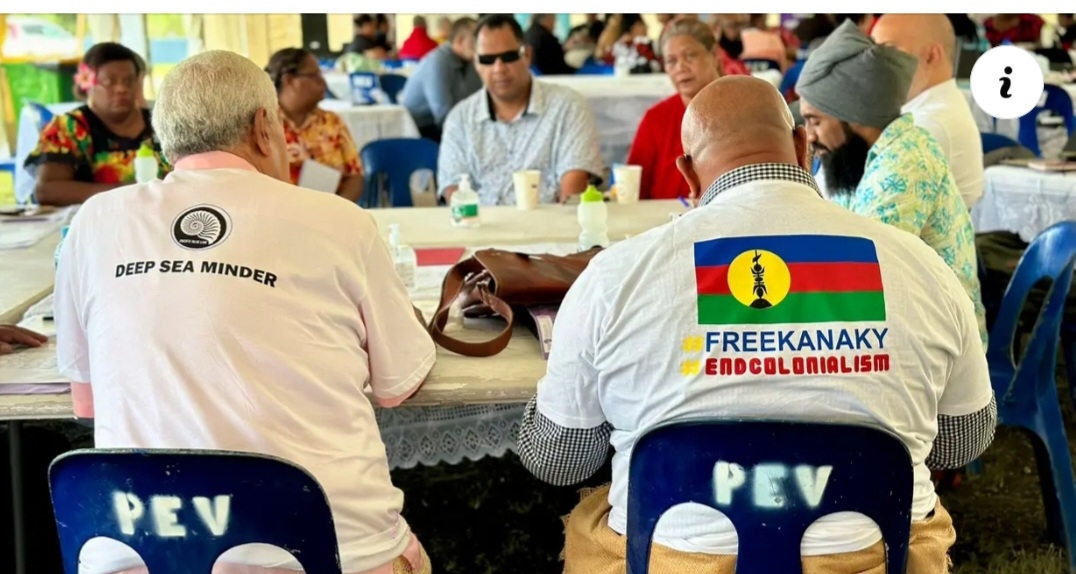
The PIF communiqué only noted, in passing, the struggles for self-determination in West Papua and Kanaky/New Caledonia. However, it said that forum states are participating in a “high-level Forum Troika Plus Mission to New Caledonia” to work towards a “long-lasting resolution to the ongoing political situation”.

Meanwhile, a parallel gathering of Pacific activist groups devoted a full day, in a “Civil Society Village”, to discussing the struggles in West Papua and Kanaky and were unanimous in their support for decolonisation and self-determination.

Lesuma said that in the lead up to next year’s PIF in the Solomon Islands, activists from these groups will be working hard to ensure that the real threats to the region — climate change and advancing the struggle for a truly nuclear-free and independent Pacific — are front and centre of the discussions.

USA VS PNG RELATIONSHIP

It's good that the powerful country on earth has respected a tiny island nation like PNG in the way it did. 

This is a great achievement for our country and a little bit of respect towards our citizens after what happened when Mr. Biden labeled us as cannibals.

Even though the president has not issued an official apology to date, this improvement in the regulation of visa is a significant upgrade in their foreign policy position towards us.

I think they have now realized how a bad and ruptured relation with PNG would be like for them in their quest for geopolitical hegemony in the region.

The good president's unwise action towards the most strategic country in the Indo-Pacific would do more harm than good; and the potential ripple effect it would have caused in its brand name as a champion advocate for acceptance, tolerance, peace, and democracy; and its leadership as the number one world supper power. 

The PNG government must now put its feet down and try to reconsider its own foreign policy assertion towards the US and the West.

This situation, on the other hand, is good for PNG. It creates a leverage for us when it comes to negotiation. 

We have the bargaining power due to that infamous "Biden slur." The US Embasy here in Port Moresby has not wasted time. The protest would paint a very negative picture of the US in the greater Pacific, and it would be very catastrophic for the West.

It is clearly inferred here from their press release being circulated and posted on their website that they wanted to make up for what Biden has done to our country. 

They indirectly acknowledged it even though they can not issue an apology on behalf of their president.

 In that way, they wanted to dilute the tension that was already brewing up here in the streets of Port Moresby for a possible protest.

The PM should be advised that he ought to know he's in an advantageous position to ask the US and the West to do something more than they have done to us.

O'Neill failed the Manus Asylum deal in 2013 because he didn't get anything tangible in return for PNG. 

Australia was at a very disadvantaged position due to internal political pressure from Australian citizens to vote out the government had they not kept the refugees out of Australian shores. 

So, the Australian government was forced to resettle the boat people in a third-party country, defying the wish of the refugees to resettle in Australia.

If the PM was then properly advised, he would have bargained for something more since Australia had no option. 

He would ask to seal the Highlands Highway from Lae City all the way to Kopiago in Hela Province, for instance.

May be he got a personal handshake under the table, we don't know.

But if it was because of ill-advice, it is definitely a win for PMJM now if he could negotiate for the same infrastructure development of Highlands Highway. 

It is a sad scenario that we do not get the end of our bargain when we are on the diplomatic negotiation table. We have given them way too much leeway. 

The US defense pact given on a golden platter without asking them in return something tangible is a big concern, for example. 

They have now realized their flaws, particularly when our citizens threatened for a protest. Do you know what that would trigger for the Pacific? It would have been catastrophic. 

It's an insult to all our black people. It's very degrading coming from the world's powerful leader. Our fellow Pacific Island people would certainly buy into it. They aren't happy at the moment, and they sympathize with us.

It's one of those mistakes a living president would have done without properly giving himslelf much thought on the values the powerful country was built upon in the first place, so to speak.

Jen Biden's Uncle Eaten By Cannibals in New Guinea in WWII ?

US President Joe Biden claims that his uncle, 2nd Lieutenant Ambrose J Finnegan was eaten by 'cannibals' in Papua New Guinea (PNG) during World War 2.

MSNBC reported that Mr. Biden made the statement during a campaign stop in Pittsburgh, making a clear distinction between his family's military service and Donald Trump's reported criticisms of military members, as detailed in The Atlantic in 2020.

The statement has sparked debate about the appropriateness of using the word "cannibal" and its potential impact on U.S. reputation in the Pacific region, especially amid efforts to strengthen relationships with Pacific island economies amidst rising Chinese influence in geopolitics.

According to The Telegraph, Mr. Biden stated;

“He flew single-engine planes, reconnaissance flights over New Guinea,” Mr. Biden said of his maternal uncle, 2nd Lieutenant Ambrose J Finnegan.

“He had volunteered because someone couldn’t make it. He got shot down in an area where there were a lot of cannibals in New Guinea at the time.

“They never recovered his body. But the government went back, when I went down there, and they checked and found some parts of the plane and the like.”

But The Telegraph again revealed that official war records dispute all of Mr. Biden’s assertions about his uncle’s fate during the flight on May 14, 1944. Lt Finnegan was not flying the plane, nor was it shot down.

Firstly, it's crucial to note that Mr. Biden's comment was made in the context of a personal story about his family history. But Mr. Biden is well known for telling exaggerated stories. He once said his house got burnt down and that he got arrested trying to see Nelson Mandela in jail.

However, the use of the term "cannibal" carries historical and cultural weight, particularly in PNG and other Pacific islands.

Historically, Western explorers and colonizers often depicted indigenous peoples as "savages" or "cannibals," perpetuating harmful stereotypes and contributing to the marginalization of these communities.

The Pacific island economies have diverse cultural backgrounds and histories, and they value respect and sensitivity in diplomatic interactions.

The use of a term like "cannibal" by a U.S. President, even in a personal anecdote, can be perceived as culturally insensitive and may undermine efforts to build trust and positive relations.

Moreover, the timing of such statements is critical. As the US seeks to strengthen its engagement with Pacific island nations in the face of increasing Chinese influence, every word and action is scrutinized.

China has been actively expanding its presence in the region through infrastructure projects, economic partnerships, and diplomatic initiatives. In contrast, the U.S. has been working to reassert its commitment to the Indo-Pacific region, including the Pacific islands, as part of its strategic efforts to maintain a balance of power.