PMJM is just trying to take the spot light away from himself. Its just band aid fix
PMJM is the ROOT CAUSE of all this, his corruption, mismanagement, reckless & impulsive spending, stealing from the public purse (to pay the MPs to make sure he stays in power) and zero accountability .
Increasing taxes to cover up & make up for it
He has reduced an island of gold floating in oil & LNG ( not to mention timber, tuna, copper,vanila, coffee, oil plam etc)into a desperate country of beggars
Take Singapore. A country with ZERO natural resources. But they have good leaders .
Making Singapore into an economice supper power unlike PNG.
IF PMJM EVEN HAD THE BALLS TO COME OUT AND ADDRESS THE POLICE IN THE FIRST PLACE.. THE LOOTING WOULD NOT HAVE HAPPEN.
Now the foreign investors will.not dare come to PNG not mention the tourists.
.This high lights an major unemplyment issue which is an EFFECT of a ROOT CAUSE
IN ALL.. PMJM AND 99.9% OF HIS CREW WON THE THE ELECTIONS THRU FRAUD & CORRUPTION. DONT EXPECT THEM TO EXHIBIT LEADERSHIP QUALITIES.
PNG IS FXXKED IF WE HAVE TYPE OF SO CALLED LEADERS.
Two Melanesian Students in Wamena after being shot by Indonesian army declaring independence
A recent digital forensic investigation has revealed that multiple attempts have taken place in the digital world to manipulate the narrative about the protests and riots in the Papua and West Papua provinces in favor of the Indonesian government.
The joint investigation, launched by the British Broadcasting Corporation (BBC) and the Australian Strategic Policy Institute (ASPI), found at least two online influence campaigns had been “disseminating pro-Indonesian government material on the issue of West Papua”.
The Papua issue refers to widespread protests against the racial abuse suffered by Papuans, which eventually led to riots. The first of the recent incidents of abuse occurred in August in Surabaya, East Java, which triggered protests in some cities, including in Jakarta.
The second abuse allegedly occurred in Papua, where a non-native teacher at a local high school reportedly called a native student a “monkey”. The incident sparked protests and violence on Sept. 23 when mobs, reportedly made up of native Papuans, set buildings and vehicles on fire. Thirty-three people, mostly non-natives, were killed during the riots.
The Indonesian authorities claimed they limited internet access in Papua during the riots in the hope of curbing the spread of fake news. However, the digital forensic investigation found otherwise.
The findings about the manipulative narrative were made by BBC open source investigator Benjamin Strick and ASPI’s international cyber-policy center researcher Elise Thomas. The report was also published online by a United Kingdom-based investigative group Bellingcat on Oct. 11.
“The goal of both campaigns was to influence international opinion about the increasingly violent situation in West Papua, as Indonesian security forces crack down on the local pro-independence movement,” Strick and Thomas wrote in the report.
The team revealed the first campaign was operated by InsightID, an Indonesian communications firm. According to the report, the firm had been promoting pro-Indonesian government content on various websites and social media accounts aimed at international audiences.
During the campaign, the firm was also found to have targeted an opposition hashtag to influence its followers with pro-Indonesian and anti-independence content, as well as actively harass people who publicly supported independence or were reporting information that contradicted the government’s narrative on the situation in Papua.
“We have not found evidence to identify the client who has hired InsightID to run this information campaign,” Strick and Thomas wrote.
“However, based on the available facts we can conclude the client is a party which is able to spend hundreds of thousands of dollars to run a ‘fake news’ information operation with the goal of influencing the international community’s political perceptions in favor of the Indonesian government’s actions in West Papua,” they added.
Findings about InsightID had been separately confirmed by Facebook, which issued a statement earlier this month saying it had identified and removed dozens of accounts and pages suspected of committing coordinated inauthentic behavior in Indonesia, primarily sharing content mainly undermining the West Papuan independence movement.
Facebook eventually found links to a local media firm, InsightID, which was said to be spending about US$300,000 on Facebook ads, mostly paid in Indonesian rupiah.
A group claiming to be InsightID later responded to the statement, saying the group worked to counter what it claimed was massive amounts of biased disinformation disseminated by the Papuan separatist movement.
“Our content is focused on messages of Bhinneka Tunggal Ika [Unity in Diversity], the unity of Indonesia and the optimistic efforts of Indonesia to resolve the problems in Papua,” it said in a statement.
The team also found a separate and smaller campaign running on the similar topic of West Papua. This one includes three “brands”, each of which has its own website and social media accounts: Wawawa Journal (WJ), Tell the Truth NZ and Noken Insight.
A notable example of an action undertaken by the campaign was the promotion of a statement attributed to United Nations Secretary-General António Guterres saying he supported the Indonesian government over the brouhaha in Papua. Later, it was found that the statement had been fabricated.
Some content spread in the campaign smeared several international media outlets based in Australia and New Zealand, including the Australian Broadcasting Corporation. Moreover, it also targeted people who spoke out about the Papuan issue, including human rights lawyer Veronica Koman and United Liberation Movement for West Papua (ULMWP) chairman Benny Wenda.
One of the domains used in the second campaign was registered by Muhamad Rosyid Jazuli, who had worked since 2014 in an organization called the Jenggala Center. The organization was originally a supporter of Joko “Jokowi” Widodo and Jusuf Kalla when the pair ran in the 2014 presidential election.
Jazuli admitted to the team his responsibility for the Wawawa Journal and Tell the Truth NZ, while denying knowledge of Noken Insight despite evidence that the WJ Facebook page once used Noken Insight’s brand as its cover photo.
“Jazuli [said] that the sites and profiles were created on his own initiative by himself and friends, using personal money and were not related to his work with the Jenggala Center,” the report said.
It added that he claimed the campaigns were simply attempts to counter negative Western media coverage, rather than being propaganda or “fake news”.
Online influence campaigns are still common in Indonesia, according to a report by Oxford Internet Institute director Philip Howard and researcher Samanta Bradshaw entitled “2019 Global Inventory of Organised Social Media Manipulation”.
The report listed Indonesia as among the 70 countries it found to have organized social media manipulation for shaping public opinions, deeming it a threat to democracy.
The report said the existence of cybertroops and computational propaganda in Indonesia was aimed at spreading pro-government or pro-party propaganda, attacking opposition or mounting smear campaigns, as well as driving division and polarization.
Indonesia has effectively banned foreign diplomats and the United Nations from visiting Papua, as separatist unrest continues to challenge Jakarta’s authority.
The government says security concerns prevent it from allowing access to foreign embassies or its citizens wanting to visit the troubled Papua and West Papua provinces.
Several embassies in Jakarta have sought permission to visit Papua but have been knocked back.Duration: 3min 13secBroadcast: Wed 9 Oct 2019, 5:00pm
Port Moresby, PAPUA NEW GUINEA – October 15, 2019: 10am (NBC NEWS PNG): Papua New Guinea will stand ready to welcome refugees from West Papua if they decide to seek refuge in the country.
Prime Minister James Marape made these remarks in Parliament on Friday when responding to a series of questions by Opposition Leader Belden Namah on the Government’s stance on West Papua’s ongoing conflicts and alleged human rights abuses.
“Let me announce to the world, if refugee situations happen, we are Melanesians we are prepared to burn our last toea to accept refugees into our country.
“That is if they come, we are Melanesians our hospitality remains even to our own cost we will take care of them.
“But in the first instance whatever happens on the other side of the border belongs to the Indonesian government, it is their responsibility we can only advise and we can only raise concerns from this side,” said PM Marape.
Meanwhile, Prime Minister Marape further said PNG will respect Indonesia’s sovereignty and not interfere in its affairs.
He said PNG’s foreign policy has always been ‘Friends to all and enemy to none.’
Marape said apart from supporting the call during the recent Pacific Islands Forum, for an independent investigation into allegations of human rights abuses, he’s personally summoned the Indonesian Ambassador to PNG for a briefing and conveyed his dissatisfaction on the ongoing unrests.
“As far as a responsibility to the greater international neighborhoods that we have, we remitted that concern through the diplomatic channel across the Palace in Jakarta and the Palace has heard our concerns.
“The response we got from Indonesia was that the President is interfacing more with the people in West Papua.
“In fact, he has made one known trip to West Papua since the incident has happened to sit down and start this engagement with the Councils and Chiefs there which is going,” Marape told Parliament…. PACNEWS
Papua Police name 13 suspects for deadly Wamena unrest – National – The Jakarta Post
The Papua Police have named 13 people suspects for allegedly having been behind the recent deadly unrest in Wamena, Jayawijaya regency, which caused tens of thousands of residents to flee their homes.
Ten suspects, whose ages range from 16 to 40 years, were already in the custody, while the remaining three are still at large and being hunted by the police, Papua Police spokesperson Sr. Comr. AM Kamal said on Monday.
“The three wanted [suspects] are categorized as provocateurs and are allegedly involved in the KNPB [National Committee of West Papua] and the ULMWP [United Liberation Movement for West Papua],” Kamal said as quoted by kompas.com.
The Indonesian government has blamed both the ULMWP, led by UK-based Papuan exile Benny Wenda, and the affiliated KNPB for orchestrating the unrest that broke out on Sept. 23.
Police investigators claimed they found indications the three were involved with the groups after collecting the testimony of the arrested suspects and witnesses, he said.
Wamena saw violent unrest on Sept. 23 as a mob, reportedly of native Papuans, set hundreds of buildings, including shophouses and government offices, and cars on fire and attacked other residents with weapons.
The turmoil, which the government estimated to have caused material losses amounting to Rp 479.5 billion (US$33.8 million), claimed the lives of at least 33 people, most of whom were non-native Papuans, and injured at least 76 others, according to authorities.
As of Sunday, about 1,726 residents were still staying at a number of evacuation sites, while another 15,544 had left Wamena for other cities across the country after the riots, the Social Ministry said.
Kamal said the police would possibly name more suspects. (gis)
Papua Police name 13 suspects for deadly Wamena unrest – National – The Jakarta Post
Indonesian Military Patrol along the Indonesian side of the border
AN Indonesian shopping centre frequented by Papua New Guineans at the border with Indonesia has been closed indefinitely after a clash between rebels and Indonesian soldiers.
This was confirmed yesterday by PNG Consular-General Geoffrey Wiri.
“The Operassi Papua Merdeka (OPM) rebels came across the border into PNG and fired shots back targeting the Indonesian military base on Tuesday,” he said. “There were no reports of casualties. The situation has calmed down (but) business activities at the border (remain) closed.”
Wiri, who is based in Jayapura, said the clash occurred near Wutung village in West Sepik.
PNG and Indonesian border authorities plan to meet next week to decide what to do next.
Meanwhile, Morehead Station manager Maninanzang Gantau said the situation along the southern part of the border in Western was normal.
“Indonesian officials will advise us when to stop villagers crossing into the Indonesian border town of Sota when they feel that it is not safe,” he said.
Gantau said the shooting near Wutung was probably a lead-up to the OPM flag-raising ceremony in November.
“Right now there is a heavy buildup of Indonesian military along the southern part of the border.”
He said West Papuans involved in the OPM and living outside West Papua usually return home to take part in the ceremony.
Meanwhile, West Sepik police commander Moses Ibsagi has warned PNG citizens living along the border not cross to Indonesia yet.
“The situation is still tense on the other side of the border (even though) our side is very quiet,” he said.
“We have two PNG Defense Force platoons on the ground and I have a manpower of 32 with me. Our instruction is to ensure the safety of PNG citizens living along the border and that government facilities are protected.”
Victor Mambor and Arie Firdaus = Jayapura, Indonesia and Jakarta
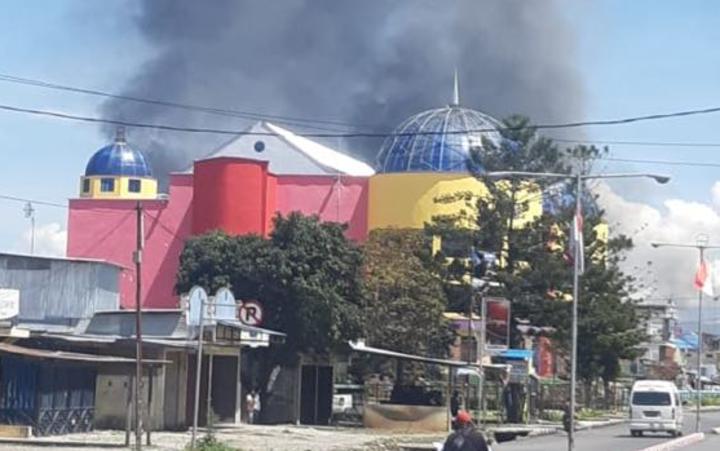
Residents drive past a burning government building in Wamena, in Indonesia’s Papua province, Sept. 23, 2019.
President Joko “Jokowi” Widodo said Monday he was ready to hold talks with separatist leaders to solve the conflict in Indonesia’s Papua region, as thousands of Indonesians who had migrated there were evacuated from Wamena, a highland town where 33 people died in violence last week.
A protest involving hundreds of high school students that was provoked by alleged racist remarks from an instructor descended into chaos in Wamena on Sept. 23, with crowds setting fire to government buildings, shops and homes, authorities said. On the same day, security forces clashed with student protesters in the provincial capital Jayapura, leaving three civilians and a soldier dead, police said.
“I will meet anyone who wants to meet me,” Jokowi told reporters at the Bogor Presidential Palace, when asked if he was ready for dialogue with pro-independence groups such as the United Liberation Movement for West Papua (ULMWP) and the National Committee of West Papua (KNPB).
The government has blamed ULMWP and KNPB for the unrest that has gripped Papua and West Papua provinces since last month, when thousands of protestors took to the streets across the mainly Melanesian region demanding a vote on self-determination. The protests broke out over alleged racist epithets that had been used against Papuan students on Java island.
Authorities said five people were killed during the initial violence in August and early September, but Papuan activists said they recorded at least 13 deaths.
Officials said the unrest was intended to draw international attention to Papuans’ demand for a referendum during the ongoing 74th U.N. General Assembly in New York.
ULMWP chairman Benny Wenda, who is based in Britain, welcomed Jokowi’s gesture.
“We welcome what was conveyed by the government of Indonesia. But we will only hold dialogue if all soldiers and police are withdrawn from the land of Papua without conditions,” Wenda told BenarNews.
The chairman of Indonesia’s National Commission on Human Rights (Komnas HAM) urged Jakarta to engage Papuan leaders in a dialogue.
“In my opinion, this is the best solution. If it is not resolved through dialogue, we are worried there will be greater ramifications, including an international intervention,” Ahmad Taufan Damanik told reporters in Jakarta.
Almost 7,300 people have sought refuge in police and military headquarters, as well in church and government buildings in Wamena after last week’s violence, said John Richard Banua, the administrative head of Jayawijaya regency, of which Wamena is the main town.
Tensions rose in Papua in December after separatist rebels allegedly killed 19 members of a crew building a highway in Nduga regency. Authorities immediately sent more than 750 soldiers and police to the region after the killings.
Five people tagged as suspects
Police have said that most of 33 people who were killed in last week’s violence were migrants from outside Papua. Five people had been named suspects over the riot, officials said.
The military said more than 3,100 migrants who feared they would be targeted had been evacuated to the provincial capital Jayapura.
“They will be helped to return to their home provinces, especially women and children,” armed forces chief Air Marshal Hadi Tjahjanto told reporters, adding that men had been advised to return to Wamena to rebuild the town’s economy.
Security Affairs Minister Wiranto also urged those who fled Wamena to return.
“You can imagine, if they flock out of Wamena, who will drive the economy?” Wiranto told reporters in Jakarta.
The Papua region, which makes up the Indonesian half of New Guinea island, was incorporated formally into Indonesia in 1969 following a U.N.-administered ballot known as the Act of Free Choice. Many Papuans and rights groups said the vote was a sham because it involved only 1,000 people.
Wamena resident Obelom Wakerkwa told BenarNews that the students who took part in the protests did not engage in vandalism and arson attacks.
He said he saw security forces firing warning shots in front of the protesters.
“That enraged the high school students and the situation became out of control,” he said.
Ahmad Syamsudin in Jakarta contributed to this report.
Exclusive: West Papua continues to be rocked by bloody violence as Indonesian security forces and pro-independence protesters clash. And Australia has been urged to do more to end the bloodshed.
BY VIRGINIA LANGEBERG
Australia has been urged to “step up substantially on the issue of West Papua”, with Vanuatu’s leaders taking to the stage of the UN General Assembly to “emphatically condemn” alleged human rights violations in the region.
Following reports of a mass exodus from the town of Wamena, in the Indonesian province of Papua, and increased violence on Monday, Vanuatu urged global leaders to assist West Papuans.
“We condemn, emphatically, violations of human rights of the indigenous people of West Papua,” Vanuatu’s Prime Minister Charlot Salwai Tabimasmas told the UN.
Vanuatu’s Prime Minister Charlot Salwai Tabimasmas at the UN. FR170574 AP
The island nation’s foreign minister declared “history will judge us”, urging Australia to step up.
“We’re very worried because it’s happening right now there is a crisis going on,” Ralph Regenvanu said.
“Some international law experts have called it genocide; I mean it fits the criteria of a genocide. History will judge us and we have to be on the right side of history.
“Australia’s got to step up substantially on the issue of West Papua, particularly because it’s on the Human Rights Council, it is a member of the Pacific Islands Forum.”
Activists said Papuans responded by setting fire to several buildings.
On Saturday, the Indonesian Embassy stated the official death toll was 33 – saying most died in the fires and some 3,500 locals were displaced following the chaos.
Smoke rise from a burning building during a violent rally in Wamena, Papua Province, Indonesia. AP
But a report in The Guardian has suggested the actual death toll was at least 41, with one witness saying he saw up to 20 people shot dead by police, while Papuans tried to fight back with rocks and arrows.
“Papuans are also terrified. They are thinking, ‘if the government is so quick to help settlers leave, what is being planned after that’,” one Wamena local told The Guardian.
Exiled West Papuan independence leader Benny Wenda was among a group of Pacific leaders who met with the UN Secretary-General earlier this week to stress the importance of a UN visit to the region.
“I continue to lobby that in here in the United Nations to send the UN High Commissioners to West Papua but Indonesia (will) not allow,” he told SBS News.
“So I hope that Indonesian government and President Jokowi will allow the UN High Commissioner to visit West Papua because this is a human rights crisis happening right now in West Papua.”
West Papuan independence leader Benny Wenda. Supplied
In recent weeks, Indonesia has deployed more than 6,000 troops into West Papua to quell the growing push for independence and Amnesty International has called Monday’s violence, one of the bloodiest days for Papua in 20 years.
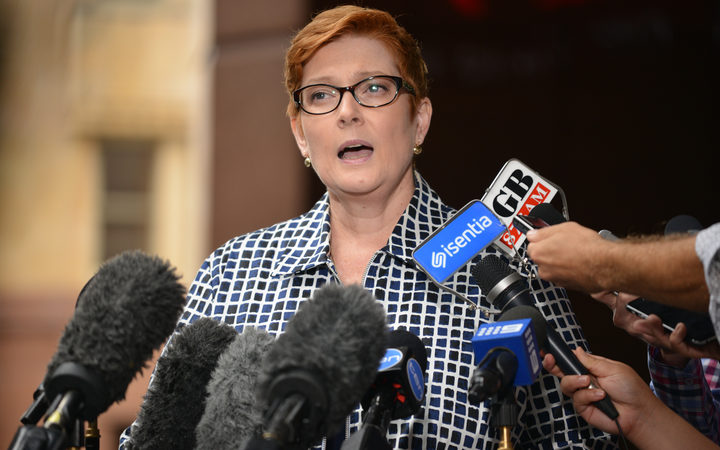
But Australian has urged restraint on both sides, with Foreign Minister Marise Payne urging “absolute restraint” to deescalate the situation.
“We are obviously very concerned about the reports of violence in Papua [and] West Papua,” she told SBS News this week.
“They are matters which our post in Jakarta is following up with authorities there.”
Labor’s foreign affairs spokesperson Penny Wong condemned the violence, but also stayed neutral.
“We have raised concerns about human rights violations in West Papua and we will continue to work to uphold the universal right of all people to peacefully express their political views including in West Papua,” she said in a statement.
“Labor fully respects the territorial integrity of Indonesia; respect for each other’s territorial integrity is enshrined in the Lombok Treaty, which remains the bedrock of security cooperation between our two countries.”
Two Melanesian Students in Wamena after being shot by Indonesian army declaring independence
JAKARTA, Indonesia — Violent protests by hundreds of people on Monday touched off by rumors that a teacher insulted an indigenous student in the restive Indonesian province of Papua have left at least 20 civilians dead, including three who were shot by the police, officials said.
An angry mob torched local government buildings, shops and homes and set fire to cars and motorcycles on several roads leading to the district chief’s office in the city of Wamena, said the Papua police chief, Rudolf Alberth Rodja.
A spokesman for the Papua military, Eko Daryanto, said at least 16 civilians, including 13 from other Indonesian provinces, were killed in Wamena, mostly after they were trapped in burning houses or shops. He said at least one soldier and three civilians had died in another protest in Jayapura, the provincial capital.
About 65 civilians were injured in Wamena and five police officers were critically injured in Jayapura, he said.
Conflicts between indigenous Papuans and Indonesian security forces are common in the impoverished Papua region, a former Dutch colony in the western half of New Guinea that is ethnically and culturally distinct from much of Indonesia.
Television images showed orange flames and black smoke billowing from burning buildings in Wamena, and videos that circulated on the internet showed dozens of people, many armed with machetes, standing in front of shops and homes to protect them from the angry mob.
Chief Rodja said the unrest was precipitated by rumors that a high school teacher in Wamena, who is not from Papua, called an indigenous student a “monkey” last week.
Police officers at a university in Jayapura, the provincial capital. Conflicts between indigenous Papuans and Indonesian security forces are common in the region.CreditMisael Noel/EPA, via Shutterstock
He said a police investigation did not find any evidence of racism against the student, and he added that false rumors have been created and spread in other schools and indigenous communities with the intention of causing violent unrest.
“This is a hoax, and I call on people in Papua not to be provoked by untrue news,” Chief Rodja told reporters in Jayapura, the capital of Papua Province.
Mr. Daryanto said that a mob of angry students attacked a soldier and several police officers in Jayapura with machetes and rocks, and that security forces responded with gunfire, killing three civilians. The soldier died on the way to a hospital. At least five police officers were in critical condition.
Joko Harjani, an airport official, said the protest forced the authorities to close the city’s airport until the situation returns to normal.
The demonstration came days after the Indonesian authorities managed to bring the province under control after weeks of violent protests by thousands of people in Papua and West Papua provinces who had complained of racism toward Papuans. At least one Indonesian soldier and four civilians were killed in that violence.
The previous protests were set off by videos circulated on the internet that showed security forces calling Papuan students “monkeys” and “dogs” in the East Java city of Surabaya, as they stormed a university dormitory where Papuan students were staying after a torn Indonesian flag was found in a sewer.
The videos prompted hundreds of Papuans who study in other Indonesian provinces to return home, forcing a local state university to accommodate them.
Papua was incorporated into Indonesia in 1969 after a United Nations-sponsored ballot that was widely seen as a sham. Since then, a low-level insurgency has simmered in the mineral-rich region, which is divided into two provinces, Papua and West Papua.
In recent years, some Papua students, including those who study in other provinces, have called for self-determination for their region.
New York Times – A version of this article appears in print on Sept. 24, 2019, Section A, Page 8 of the New York edition with the headline: At Least 20 Found Dead Amid Riots In Indonesia. Order Reprints | Today’s Paper | Subscribe
High School Stucents Demonstration Wamena 23 September 2019
Australia’s government has urged restraint by all relevant parties in West Papua amid ongoing unrest in the Indonesian ruled region.
The death toll from violence in the Papuan cities of Jayapura and Wamena on Monday has risen to 26.
Violence erupted in both cities as Indonesian security forces cracked down on student protests.
This follows weeks of unrest triggered by large protests in the region last month.
Outside the UN headquarters in New York, Australia’s Foreign Minister Marise Payne told SBS that her government was seeking updates about the situation.
“Well we are obviously very concerned about the reports of violence in Papua and West Papua. And they are matters which our post in Jakarta is obviously following up with authorities there. We urge absolute restraint from both sides in actions that are happening on the ground there.”
Australia’s Defence Minister Marise Payne Photo: AFP
Monday’s unrest in Jayapura led to the arrest of over 700 Papuan students.
Many of them had recently returned home early from study in Javanese cities, where racist attacks on Papuan students last month prompted widespread protests in the Papuan provinces, and also raised fears for the students’ safety.
An additional 6000 Indonesian police and military personnel were deployed to the heavily restricted region by early September as unrest sparked by the protests left at least ten people dead.
West Papuan students apprehended by police, Waena, Jayapura, 23 September. Photo: Supplied
Since last year, Indonesian security forces in Papua have also been preoccupied in the Highlands region by a protracted armed conflict with a pro-independence guerilla unit named the West Papua Liberation Army.
The ongoing unrest, as well as issues of human rights abuses and self-determination in Papua, is expected to be raised by some Pacific Islands leaders at this week’s UN General Assembly.
The Indonesian military’s Cenderawasih district chief commander Herman Asaribab visiting victims of Puncak shootings in hospital. Photo: TNI
Three civilians, including a 3-year old boy, have died in a shootout with rebels in West Papua, Indonesia’s military says.
The military insisted the people were shot by rebel fighters, while but a Papuan pro-independence military group said Indonesian soldiers were responsible.
A spokesperson for Indonesia’s military said fighting broke out on Tuesday when rebels attacked security forces in Puncak regency’s Ilaga district.
Eko Daryanto said the rebels then retreated into the forest while shooting randomly, killing three civilians and injuring four.
Mr Daryanto had earlier said all seven were injured with gunshot wounds.
The West Papua Liberation Army claimed seven civilians were killed by security forces after they launched an assault on the village.
It’s the latest exchange in a protracted conflict between a military faction of the Papuan independence movement and Indonesian forces in Papua’s remote Highlands region which intensified last year.
Indonesia’s Defence Minister Ryamizard Ryacudu told reporters on Thursday military and police could not be pulled out of Papua in case the region seceded from the republic, the state-news agency Antara reported.
Two Melanesian High School Students Shot by TNI/ Police of Indonesia
The death toll from clashes between protesters and Indonesian forces in West Papua has risen to 26.
Violence erupted in the provincial capital Jayapura and the main Highlands town Wamena on Sunday, an escalation of protests that have gripped the province for weeks.
Indonesia’s military says 22 people were killed during riots in Wamena, where students were protesting over a racism allegation.
Government buildings and businesses were torched by large crowds.
The military says four people – including a soldier – were killed in a separate protest by students there.
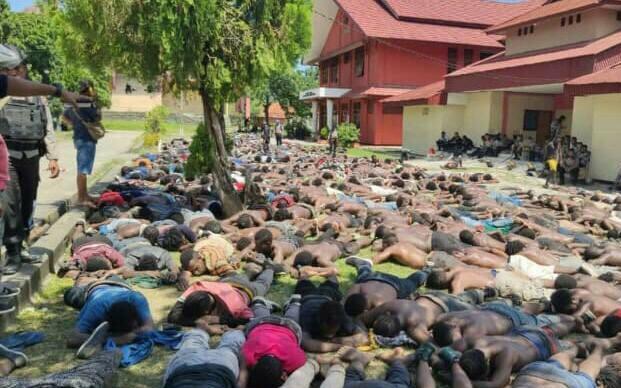
Seven-hundred and thirty-three people are being held at Papua police headquarters in Jayapura.
Burning of Government Regent Office in Wamena, West Papua Highlands
Deadly unrest has broken out again in West Papua, as Indonesian security forces cracked down on more student mobilisations.
Today in the capital of Papua province, Jayapura, as many as four people were killed, including at least one West Papuan university student who was shot dead and an Indonesian soldier fatally stabbed.
The violence was sparked after police rounded on a mass of Papuan university students who recently returned to Papua from cities in other parts of Indonesia, and had converged at Jayapura’s University of Cenderawasih for a solidarity action.
Around 2000 students have returned home early from study in mainly Javanese cities where racist attacks on Papuans last month prompted widespread protests in the Papuan provinces and also raised fears for the students’ safety.
However police disallowed today’s gathering at the university in Jayapura and eventually arrested dozens of students in Waena sub-district. A spokesman for police has pointed the blame at a student group for the ensuing violence.
Although the spokesman only confirmed that a member of the Indonesian military had been stabbed in the chaos, students and a local health official reported that in addition, three Papuan students were killed by gunfire from the security forces.
Meanwhile, today in the main Highlands city of Wamena, another large police contingent reportedly used firearms to disperse hundreds of Papuans after hordes of High School students took to the streets in protest at an alleged racist slur.
Students responded by filtering through the town and torching several buildings, including government and public facilities, as police and military struggled to contain the unrest throughout the day.
Human rights activists in Papua said that 12 people were injured due to gunshot wounds in Wamena, including students.
The police spokesman said the allegation which triggered the protest – regarding a racist slur towards Papuans at a local school – was not true.
West Papuan students apprehended by police, Waena, Jayapura, 23 September. Photo: Supplied
Even before today, tensions were already high in both Wamena and Jayapura, where large mobilisations took place in August as part of a wave of Papuan protests against racism and in support of independence.
The protests spiralled into unrest in various Papuan towns, with dozens arrested and at least ten people killed amid a security forces crackdown together with an internet shutdown through Papua implemented by the national government.
An additional 6000 Indonesian police and military personnel were deployed to the heavily restricted region by early September.
Since last year the security forces have also been preoccupied in the Highlands region by a protracted armed conflict with the pro-independence guerilla unit named the West Papua Liberation Army.
The ongoing unrest, as well as issues of human rights abuses and self-determination in Papua, is expected to be raised by some Pacific Islands leaders at this week’s United Nations General Assembly.
UN Human Rights Commssioner Michelle Bachelet this month again spoke of her hopes that Indonesia would finally permit a team from her office to visit Papua to investigate ongoing rights violations.
Like Timor-Leste, West Papua, commonly subsuming both Papua and West Papua, remains a separate ethnic entity, acknowledged as such by previous colonial powers. Its Dutch colonial masters, in preparing to leave the region in the 1950s, left the ground fertile for a declaration of independence in 1961. Such a move did not sit well with the Indonesian desire to claim control over all Dutch Asia Pacific colonies on departure. There were resources to be had, economic gains to be made. The military duly moved in.
The New York Agreement between Indonesia and the Netherlands, brokered in 1962 with the assistance of the United States, saw West Papua fall under United Nations control for the duration of one year. Once passing into Indonesian control, Jakarta would govern the territory “consistent with the rights and freedoms guaranteed to the inhabitants under the terms of the present agreement.” Education would be a priority; illiteracy would be targeted, and efforts made “to accelerate participation of the people in local government through periodic elections.”
One article stood out: “Indonesia will make arrangements, with the assistance and participation of the United Nation Representative and his staff, to give the people of the territory the opportunity to exercise freedom of choice.” In 1969, a ballot was conducted in line with the provision, though hardly in any true, representative sense. In the rich traditions of doctored representation and selective enfranchisement, 1,026 individuals were selected by Indonesian authorities to participate. Indonesia’s military kept an intimidating watch: the vote could not be left to chance. The result for Indonesian control was unanimous; the UN signed off.
Unlike Timor-Leste, the historically Melanesian territories of Papua and West Papua remains under thumb and screw, an entity that continues to exist under periodic acts of violence and habitual repression from the Indonesian central authorities. A policy of transmigration has been practiced, a point argued by scholars to be tantamount to genocide. This has entailed moving residents from Java and Sulawesi to West Papua, assisted by Jakarta’s hearty sponsorship.
The Indonesian argument here has been ethnic and political: to confect a national identity through assimilation. Under President Joko Widodo (“Jokowi”)), one keen to push the idea of “Indonesia Maju” (“Advanced Indonesia”), renewed stress is being placed on infrastructure investment, economic growth and natural resources, of which Papua features heavily.
The indigenous populace has had to, in turn, surrender land to those transmigrants and appropriating authorities. “The rights of traditional law communities,” notes Clause 17 of Indonesia’s Basic Forestry Act of 1967, “may not be allowed to stand in the way of transmigration sites.”
Appropriations of land, the relocation of residents, and the odd massacre by Indonesian security forces, tend to fly low on the international radar of human rights abuses. West Papua lacks the cinematic appeal or political heft that would encourage around the clock coverage from media networks. Bureaucratic plodders in the various foreign ministries of the world prefer to render such matters benign and of little interest. Geopolitics and natural resources tend to do most of the talking.
In late 2015, for instance, Scott Busby, US deputy assistant secretary of the Bureau of Democracy, Human Rights, and Labor, and James Carouso, acting deputy assistant secretary for Maritime and Mainland Southeast Asian affairs, ducked and evaded anything too compromising in their testimony before the Senate Foreign Relations Committee on East Asia, the Pacific, and International Cybersecurity Policy. The consequences of demographic policies directed by Jakarta were assiduously ignored. Massacres and institutional accountability in the territory were bypassed, as were Indonesian efforts to prevent scrutiny on the part of human rights monitors, the UN Special rapporteur and journalists.
This year, more instances of violence have managed to leach out and gurgle in media circles. It took a few ugly incidents in the Javanese city of Surabaya to engender a new wave of protests which have had a rattling effect on the security forces. Last month, pro-Indonesian nationalist groups, with reported encouragement from security forces, taunted Papuan students with an array of crude insults in East Java. (“Dogs”, “monkeys” and “pigs” were part of the bitter mix.) The fuse was lit, notably as arrests were made of the Papuans themselves. “Papuans are not monkeys”, proclaimed banners being held at a rally in Central Jakarta on August 22.
Government buildings have been torched in Jayapura. Additional forces have been deployed, and internet access cut. There are claims that white phosphorous has been used on civilians; prisons are being filled. There have even been protests in Indonesia’s capital, with the banned Morning Star flag being flown defiantly in front of the state palace. (Doing so is no mild matter: activist Filep Karma spent over a decade of his life in prison for doing so.)
The struggle for independence, at least in the international eye, has been left to such figures as Benny Wenda, who lobbies governments and groups to back the “Free Papua” campaign. He is particularly keen to take the matter of the Free Choice vote of 1969, that nasty instrument that formalised Indonesian control, to the United Nations General Assembly. Last month, he had to settle for taking the matter to the Pacific Islands Forum as a representative of Vanuatu’s delegation. In January, he gifted the UN Human Rights Chief Michelle Bachelet a petition with 1.8 million signatures seeking a new referendum for the territory.
The response from an Indonesian government spokesman was emphatic, curt, and conventional. “Developments in Papua and West Papua province are purely Indonesia’s internal affairs. No other country, organisation or individual has the right to interfere in them. We firmly oppose the intervention of Indonesia’s internal affairs in whatever form.”
The hope for Jokowi and the Indonesian authorities will be simple: ride out the storm, conduct a low-level suppression of protests, and place any talks of secession on the backburner. In this, they can count on regional, if hypocritical support. In the words of a spokesman for the Australian Department of Foreign Affairs and Trade, “Australia recognises Indonesia’s territorial integrity and sovereignty over the Papua provinces. Our position is clearly defined by the Lombok Treaty between Indonesia and Australia.”Join the debate on FacebookMore articles by:BINOY KAMPMARK
Binoy Kampmark was a Commonwealth Scholar at Selwyn College, Cambridge. He lectures at RMIT University, Melbourne. Email:bkampmark@gmail.com
Allow Access to UN, Foreign Journalists, Rights Monitors
(Sydney) – Indonesian authorities should impartially investigate the deaths of at least 10 Papuans during recent unrest in the easternmost provinces of Papua and West Papua, Human Rights Watch said today. Restrictions on access to Papua for foreign journalists and rights monitors and a partial internet shutdown have hindered reporting on the situation.
The Indonesian government should immediately allow unfettered access to the Office of the United Nations High Commissioner for Human Rights to travel to Papua to investigate the situation.
After video circulated of Indonesian militias racially abusing indigenous Papuan students outside their dormitory in Surabaya on August 17, 2019, Papuans demonstrated in at least 30 cities across Indonesia, including Jakarta. Rioting Papuans burned down the local parliament building in Manokwari and prisons in Sorong, West Papua province, and in Jayapura, Papua province.
“Indonesian police have a duty to avoid the use of force in response to Papuans who take their grievances to the streets,” said Elaine Pearson. “Any wrongful use of force needs to be investigated and those responsible held to account.”
The media have reported that Indonesian authorities have detained at least seven people in connection with raising the pro-Papuan independence Morning Star flag in Jakarta and Manokwari. Another 60 have been reportedly detained for allegedly damaging property during unrest in Papua. Those held for the peaceful expression of their political views should be released and any charges dropped, Human Rights Watch said. The rest of those detained should be promptly brought before a judge, charged with a recognizable offense, and have access to lawyers and family members.
Human Rights Watch urged prompt and impartial investigations into the following alleged incidents:
In Deiyai on August 28, video footage shows uniformed police shooting live ammunition into a crowd of Papuan protesters inside the Deiyai Regency office. The Secretariat of Peace and Justice, a Catholic human rights organization located in Paniai, Papua, reported that eight Papuans and one Indonesian soldier were killed and 39 Papuans were injured. The Deiyai regent, Ateng Edowai, said that “people in civilian clothes” were responsible for the shooting. No independent or foreign journalists have access to Deiyai to investigate the incident.
A video taken in Fakfak, West Papua on August 20, shows a Papuan man who had been disemboweled and others were reportedly wounded.
On August 22, the Indonesian government shut down the internet in Papua and West Papua. On September 4, internet services were partially restored. Several places including Deiyai are still partially blocked, meaning it is not possible to share videos or photographs.
Local media reported that Indonesian militias in Jayapura attacked Papuans who had occupied the Papuan governor’s office and replaced the Indonesian flag with the Morning Star. The militia Paguyuban Nusantara(“Archipelago Community”) is a new alliance formed from several Indonesian ethnic groups, mostly from Java Island, who had settled in Papua and West Papua since the late 1970s under the government-sponsored transmigration program.
President Joko “Jokowi” Widodo has condemned racist statements against Papuans and authorities have suspended four army officers for their racist remarks in Surabaya pending investigations. Authorities have charged one militia leader in Surabaya for spreading hate speech.
Since the demonstrations began, the government has granted limited access to several foreign journalists to visit specific Papuan cities, but they have been monitored and unable to travel beyond the cities where they were given entry permits. The Indonesian government has restricted access to foreign journalists since the 1960s because of suspicion of the motives of foreign nationals in a region racked by corruption, environmental degradation, public dissatisfaction with Jakarta, and a small pro-independence insurgency.
On August 31, police arrested six activists, including five Papuan students in Jakarta and Surya Anta Ginting, the coordinator of the Front Rakyat Indonesia on West Papua, a solidarity group among Indonesian activists. They were charged with treason for flying the Morning Star flag outside the State Palace.
On September 3, police arrested an activist, Sayang Mandabayan, at the Manokwari airport for traveling with 1,500 small Morning Star flags. She has been detained at the Manokwari police station.
On September 4, Surabaya police issued an arrest warrant for Veronica Koman, an Indonesian human rights lawyer with “spreading fake news and provoking unrest.” Koman has shared videos on her Twitter account of the recent unrest.
On September 4, the UN High Commissioner for Human Rights, Michelle Bachelet, expressed concern about the violence in Papua and urged the Indonesian government “to engage in dialogue with the people of Papua and West Papua on their aspirations and concerns.” Despite President Jokowi’s invitation to the UN human rights chief to visit Papua in February 2018, government officials have continued to delay the visit.
Concerned governments should call on the Indonesian government to:
Promptly and impartially investigate unrest-related deaths and injuries and appropriately prosecute those responsible for wrongdoing.
Immediately restore full access to the internet, which is vital for emergency communications and basic information in times of crisis.
Lift restrictions on access for foreign journalists and rights monitors in line with previous statements by the Indonesian president.
Allow the UN human rights office immediate unfettered access to Papua.
Drop charges and release all those detained for peaceful acts of free expression including Sayang Mandabayan. Drop the case against Veronica Koman.
Police should cease using unnecessary or excessive force against the protesters, Human Rights Watch said. While some protester action may warrant police use of force, the UN Basic Principles on the Use of Force and Firearms by Law Enforcement Officials provide that all security forces shall, as far as possible, apply nonviolent means before resorting to force. Whenever the lawful use of force is unavoidable, the authorities must use restraint and act in proportion to the seriousness of the offense. Law enforcement officials should not use firearms against people except in self-defense or defense of others against the imminent threat of death or serious injury.
New Zealand’s government says it’s “deeply concerned” by recent violence in Indonesia’s West Papua during protests which have rocked the country.
At least 10 people have been killed in separate clashes between Papuan demonstrators, security forces and vigilante mobs.
Dozens of protestors and activists have been arrested by Indonesian police, which have deployed thousands of extra personnel to the region.
New Zealand’s Foreign Ministry said it was closely monitoring the security situation and has raised concerns with Indonesian authorities.
It said it has encouraged Indonesia to facilitate a visit to Papua by the UN High Commissioner for Human Rights, reiterating a call from the Pacific Islands Forum.
“We have urged Indonesia to respect and protect the human rights of all its citizens,” a Ministry of Foreign Affairs and Trade spokesperson said.
“New Zealand recognises Papua as part of Indonesia’s sovereign territory. We continue to encourage Indonesia to promote peaceful social and economic development in Papua.”
The UN Human Rights Commissioner Michelle Bachelet says her office has so far been unable to secure a trip to Indonesia’s West Papua.
In January, Indonesia agreed in principle to allow a visit by the rights chief, but this has not yet eventuated, despite international backing for it.
Amid violent unrest which has rocked Papua since mid-August, Ms Bachelet last week urged Jakarta to enter a dialogue with Papuans.
Her statement on Wednesday didn’t directly address a visit by her office to the region.
But in previously unreported comments made after a public talk in Geneva, Ms Bachelet said it hadn’t moved forward.
“We have been working with the authorities, but we haven’t been able to progress it. But we will continue to talk to them because they promised to my predecessor the visit to West Papua but afterward we try to make it work and it hasn’t worked yet but I hope it will work.”
“The [Indonesian government] have told me that they’re looking forward to it,” she added.
West Papuans involved in deadly clash named
Meanwhile, Indonesian police have reportedly named more than a dozen West Papuans as suspects in a deadly clash in the central highlands.
Authorities said at least five people and a soldier were killed when security forces were attacked during a riot in Deiyai regency on 28 August.
But rights groups, activists and witnesses said eight civilians were shot dead by soldiers during a peaceful demonstration.
A police spokesperson, Ahmad Mustofa Kamal, said 14 people have been named suspects in connection with the riot in Deiyai.
He told local media the people are suspected of unlawfully possessing firearms, opposing authorities and incitement.
News outlet Suara Papua reported the Papuan suspects are still undergoing treatment at a local hospital after they were injured in the clash.