By BIM Corporate Author
The Vois Blong Yumi network, which comes under Movement Red, wants to support the government through the National Referendum Communications Committee by ensuring that information about the upcoming referendum reaches as many people as possible.
To achieve this, they have created a mobile application or app that will feature all the necessary information.
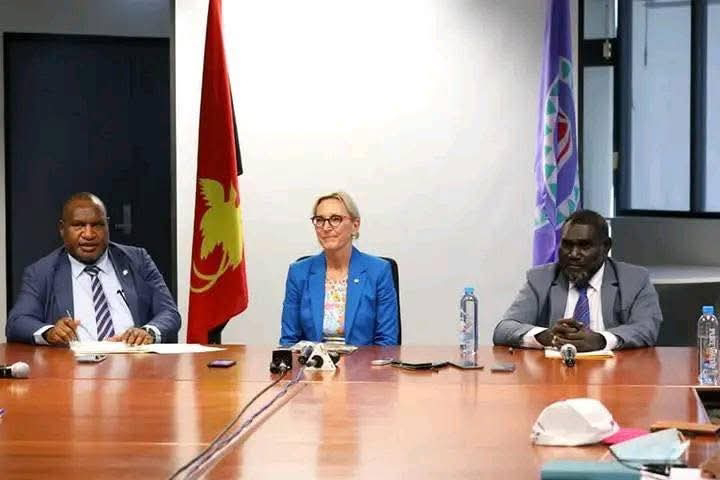
![]() Vois Blong Yumi Spokesperson, Mike Esrom and Jerry Lini |
| By Glenda Willie |
The spokesperson for the Vois Blong Yumi network, Mike Esrom, confirmed that this App will be launched tomorrow.
He explained that all a person needs to do is download the app. Once they click on it, they will be able to access all the information conveyed through statements, videos, analysis, and photos regarding the proposed amendments and referendum.
An advantage of this app is that even if a person is in an area without Internet coverage, they can still access the information.
With just 33 days remaining until polling day, Mr. Esrom stressed that since almost everyone, even in the islands, has a mobile phone, this app can efficiently spread information.
People are ‘in the mood for celebration’ as they choose whether to split from Papua New Guinea
After 20 years, the big day has finally arrived for the people of Bougainville. Large crowds gathered on Saturday at the aptly named Bel Isi (Peace) park in Buka for the first day of a two-week referendum to decide whether the archipelago should become independent from Papua New Guinea.
Amid a significant security presence, hundreds of Bougainvilleans marched through the streets as they followed the autonomous region’s president, John Momis, as he arrived at a polling booth to cast his vote.
Momis, accompanied by his minister for Bougainville affairs, Sir Puka Temu, and the referendum commissioner, Ruby Mirinka, was the first to cast his vote.
The jubilant crowd cheered on as groups danced to the beat of bamboo pipes, singing songs of freedom that described the crisis of the past and a peace process that started at the end of the civil war 20 years ago and which paved the way for the referendum.
As he exited the polling booth after casting his vote, Momis waved to the crowd who replied with shouts of support as they waited for their turn to vote.
“It’s obvious that the people are now in the mood for celebration and I join them as they have every right to celebrate,” Momis told a media conference. “This is a forecast or beginning of good things to come if we collaborate and work as trusted partners to implement something that both parties have contributed to.”
With tears in her eyes, Justina Panu, a voter from Arawa, said that it was thrilling to watch her president vote. “We are excited and emotional,” she said.
Janet Chigoto, from Buin, waved her large Bougainville flag and said: “I am proud and happy. The time has come for us to vote for what we’ve been waiting for. Blood has poured on our island. We want our own powers to run our country so I am going for Box Two.”
“It’s a great moment for me,” said Barnabas Matanu from Buka. “It’s been long overdue and we’ve been waiting for years. We are enthusiastic and on cloud nine.”
Over the next two weeks, everyone over the age of 18 will have the option of requesting greater autonomy within Papua New Guinea, or full independence. Voting will take place in select towns and stations around the island of Buka and mainland Bougainville.
A young voter, Tanya Okia from Kieta, hoped that her generation would see a free and independent Bougainville. “Bougainville will rise. Myself and the other 365 youths here, we are all heading for number 2 box.”
“I will be putting my ballot in box 2,” said Moses Seropa from Arawa. “I want to see Bougainville become our own country, in my lifetime. I want to see us producing our own products. We have tons of natural resources, good lands and great farmers so we need to take ownership starting with this vote.”
Source: https://www.theguardian.com/
Source: Facebook.com
Bougainville has impacted our country in so many ways. Whether it was contributing to the economy, shaping of the constitution and system of governance, or the tragic years of conflict in 1988 to 1997 and in many other ways, Bougainville remains an integral part of PNG.
Today we enter another historical day for Bougainville and the rest of PNG. Whatever happens from here on will be historical, as it will impact our country and the history we shared. Despite the outcome, let us be comfortable with the fact that this nation of a thousand tribes is strong and it’s future is stronger because of this diversity. This is our strength and not our weakness. Diversity makes us stronger and we become better people and a better nation. It is not an easy Union but it’s an opportunity for us to build a greater nation and future.
Remember without Goliath, a mere Shepard boy with no skills and knowledge other than being a sherpard, could never be the King of Israel.
This massive fusion of our diverse nation of a thousand tribes and 860 languages into one prosperous nation is a mammoth task and our own Goliath. But it is also an opportunity for us to challenge ourselves to foster a respectful, tolerant and grateful country where we can all thrive together to build a prosperous future.
How wonderful it would be when we overcome all our stereotypes and inhibitions that we have against each other. It will be like David has slain Goliath who had been tormenting the Israelites for so long. So here, we have an opportunity to show equality, to allow freedom, and show true democracy where all tribes and languages have a stake at the table. It has been painful, tragic and a long journey, but let us be confident that we will prosper after today and we will secure a greater future with Bougainville still having a strong place and role in our stride to prosperity.
Congratulations to Sir Puka Temu and all the leaders who have shaped this journey since the Peace Agreement, up to this historical day. Let us be confident about the future, as a unique rainbow nation of a thousand tribes and 860 plus languages. Together, we are stronger!
The Pacific islands of Bougainville are voting in a historic referendum to decide if it will become the world’s newest nation by gaining independence from Papua New Guinea.
The vote will run over two weeks and is a key part of a 2001 peace agreement that ended a civil war in which at least 15,000 people died in the cluster of islands to the east of the Papua New Guinea mainland.
Experts believe the 250,000 people of Bougainville will vote overwhelming in favour of independence ahead of the other option, which is greater autonomy, but the vote will not be the final word.
The referendum is non-binding and a vote for independence would need to be negotiated by leaders from Bougainville and Papua New Guinea. The final say would go to legislators in the Papua New Guinea parliament.
Gianluca Rampolla, the UN resident co-ordinator in Papua New Guinea, said the world body has been working hard to ensure the vote is peaceful, transparent, inclusive and credible. He said there are 40 UN staffers on the ground and more than 100 international observers.
He said it is unlikely there will be violence during voting.
“They’ve been waiting 19 years for this historic moment,” he said. “I think they will be left with joy.”
Just over 200,000 people are eligible to vote in the referendum, with the results due in mid-December. Mr Rampolla said the extended voting period of two weeks is due to the region’s rugged terrain.
“There are people coming on boats, there are people walking,” he said. “It’s the rainy season. There are rough seas. Flexibility is needed to adjust on the ground.”
John Momis, president of the Autonomous Region of Bougainville, told reporters on Friday the region stood on the verge of a new socio-economic and political order.
“We are trailblazers forging a new path into the unknown with the sheer determination to face any challenge that comes our way,” he said. “We will face this together as one people and one voice to decide our ultimate political future.”
In his weekly column in the Post-Courier newspaper, Papua New Guinea prime minister James Marape said complex discussions and negotiations would be needed after the referendum before a political settlement could be reached.
The violence in Bougainville began in the late 1980s, triggered by conflict over an enormous open cast copper mine at Panguna.
The mine was a huge export earner for Papua New Guinea but many in Bougainville felt they got no benefit and resented the pollution and disruption to their traditional way of living.
The mine has remained shut since the conflict. Some believe it could provide a future revenue source for Bougainville should it become independent.
The civil war lasted for a decade before the peace agreement was signed. The other key aspects of the agreement were a weapons disposal plan and greater autonomy for the region.
Mr Rampolla said the peace agreement had been one of the few in the world that had lasted so long. He said it could end as a success story if the referendum and subsequent negotiations resulted in an outcome that everybody could support.
Press Association
Papua New Guinea’s former prime minister Peter O’Neill has sounded a note of warning on the eve of Bougainville’s independence referendum.

Photo: AFP or licensors
People from the autonomous PNG region are this Saturday to begin a two-week polling period for a non-binding vote on whether Bougainville should be independent or have greater autonomy.
The result of the referendum is subject to ratification by PNG’s national Parliament.
Mr O’Neill, who was replaced as prime minister by James Marape in May, said people needed to make an informed decision in the vote.
Referring to the Bougainville civil war, he said PNG could not go back to the crisis and loss of life.
“We have to all work together to ensure the peace and unity of our people,” Mr O’Neill said in a statement.
“Now the vote must be undertaken in a peaceful manner, properly supported by our security forces to ensure transparency and public confidence.”
Recently, numerous past and present PNG prime ministers have been advocating togetherness and urging Bougainville to stay with the nation.
But a grandmother from Bougainville’s Guava village, atop the Panguna mine which sparked the civil war, said the overtures had come too late in the piece.
Maggie Voring said the trauma of devastated families lingered on decades after the civil war, and that Bougainvilleans had largely made up their minds.
“That is too late. Long time ago, [PNG] they step on us. I’m thinking that after this next move, we’re just going independent… because of our bloodshed.”
Source: RNZ
Bougainvilleans will begin voting tomorrow in an historic referendum to decide if they want independence from Papua New Guinea.
Over a two week period they will be taking part in vote on whether to become independent or to settle for a greater degree of autonomy.
While it is a non-binding vote, it is seen as the culmination of the peace process that ended a bloody civil war in Bougainville.
The Post Courier reports that while the world waits in anticipation for the result national leaders have issued strong statements.
PNG Prime Minister James Marape was very apologetic about PNG not recognising the will and desire of Bougainvilleans in the past but said they now had the right to be heard.
To allow for the referendum to proceed was a commitment he made when he became prime minister, he said.
He is quoted in the newspaper saying the referendum is “the means by which the voices of the people of Bougainville will be heard. It is the basis on which the two governments will consult after the referendum has taken place.’
But Mr Marape has repeated earlier statements that political independence is meaningless without economic independence.
He said complex discussions and negotiations would take place after the referendum before any proposed political settlement is reached.
The man known as the Father of the Nation and three time prime minister, Sir Michael Somare, said he has a “heavy heart” about the referendum.
He has called for a united PNG for which he had always led and stood for as prime minister.
Sir Michael told the paper that, “as Bougainvilleans make their voices heard in the referendum, it is my hope that PNG remains ‘united and free’ in the aftermath of this historic poll.”
He said “our country has remained united for more than 40 years, which is an achievement in itself. So it with heavy hearts that the rest of our country awaits the decision that the people of Bougainville will be taking in the next couple of days.
Recent former Prime Minister Peter O’Neill described it as one of the most important public votes in the nation’s history and called for care in the decision-making by Bougainvilleans.

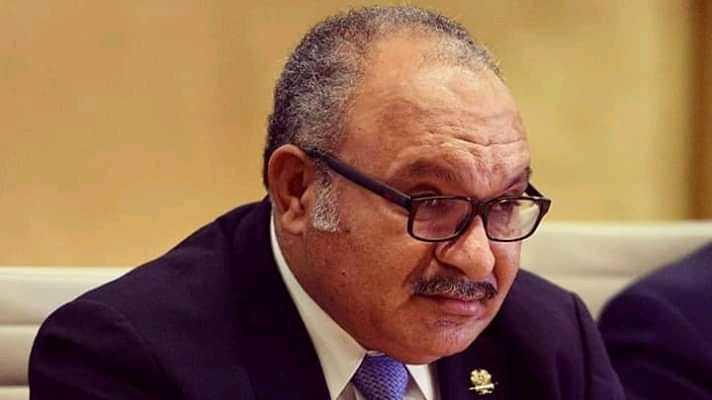
Peter O’Neill Photo: Supplied
Bougainville President John Momis appealed for people to respect the rule of law.

Bougainville President John Momis Photo: supplied
He said they had worked hard to abide by and effectively implement the three pillars of the Bougainville Peace Agreement; autonomy, weapons disposal and referendum.
The Secretary General of the Pacific Islands Forum Dame Meg Taylor, who is Papua New Guinean, has sent best wishes.
She said she commends both governments on their commitment to lasting peace, and all the work done to ensure a free and fair vote.
The secretary general of the Pacific Islands Forum, Dame Meg Taylor. Photo: RNZ / Jamie Tahana
The Forum has an observer mission in Bougainville throughout polling and vote counting.
Source: RNZ
Johnny Blades, RNZ Pacific Journalistjohnny.blades@rnz.co.nz
Polling for Bougainville’s independence referendum gets underway today.
The autonomous Papua New Guinea region’s non-binding referendum is the ultimate provision of 2001’s Peace Agreement which formally ended hostilities in Bougainville’s civil war.
Bougainvilleans have entered into celebratory mode for this historic occasion. Bougainville flags are everywhere, festivities have broken out, and the mood around the region indicates that the favourite option on the ballot is number two: for independence, rather than greater autonomy within PNG.
The two week polling period starts in the main centres of Buka and Arawa as well as numerous remote locations and then will move around Bougainville progressively.
In coming days polling also gets underway in other parts of PNG and two locales in neighbouring countries – in Brisbane, Australia and Gizo in Solomon Islands.
Bad weather is threatening to delay the start of polling in Bougainville’s atolls. But at this stage nothing will dampen the spirits of a people who are clearly expectant that this is the next step towards the birth of a new nation.
Cultural groups have been performing in anticipation of the start of polling in parts such as Tinputz district.
A ward representative in Tinputz, Peter Aromet, said Bougainvilleans had been eagerly awaiting this moment since the end of the crisis about two decades ago.
According to him, the experience of going through civil war had shaped the region’s aspirations for independence.
“During the crisis people went through a lot of traumas. If we can turn those traumas into something good, from pain to something positive… I believe that all these traumas that we’ve come through, that we went through, we can use them for something positive.”
“People are very excited about what is expected especially the process between now an December,” said Theresa Jaintong, an Arawa-based social worker and reconciliation leader.
In terms of how the vote may pan out, Ms Jaintong said the ball was firmly in the court of Bougainvilleans.
“It’s up to us Bougainvilleans really to embrace the outcome and then what government will go into, and then drive it together. We have to be really united – the whole Bougainville – at all cost.”
Like many people in Bougainville, Mr Aromet is anticipating a period of transition following the outcome of the referendum, although a time frame is yet to be mapped out by the PNG and autonomous Bougainville governments.
Expectations placed in the referendum by Bougainvilleans are high, although the vote result requires ratification by PNG’s parliament before being implemented.
“If the outcome is positive or in favour of the Bougainvilleans, it might not turn out as people expect,” Mr Aromet admitted.
“But I believe it’s going to take a process. We’ll go to a transitional period – it might take five or ten years, then we’ll go to independence.”
Results in Bougainville’s upcoming referendum on independence from Papua New Guinea will be delivered in just one announcement.
The two-week polling period for the non-binding referendum begins on 23 November.
The verification, scrutiny and count process is to begin at the Count Centre in Buka once polling closes on 7 December.
The Bougainville Referendum Commission’s chairman Bertie Ahern said the vote would be delivered to the highest of international electoral standards.
He said that given the need to deliver a clear and credible process, a running tally of votes would not be provided, in order to avoid confusion.
“We are sure that the process will be safe, secure and will enable us to deliver an accurate and credible result,” he said.
“We are also following internationally recognised steps to ensure that the process is open to scrutineers, observers and the media.”
Mr Ahern said that the commission hoped to conclude counting well before the final date for the return of the writ – 20 December.
“Given the emotions of the vote, we will announce just one set of results, which will be the final one so as not to confuse people.
“The BRC will announce the final number of votes cast for greater autonomy and independence, plus the number of informal ballot papers. No more, and no less.”
Meanwhile, hundreds of scrutineers and observers have received accreditation to monitor Bougainville’s upcoming independence referendum.
Briefings were held yesterday in Bougainville’s three main centres, Buka, Arawa and Buin, for 95 observers and 554 scrutineers.
The Bougainville Referendum Commission said the briefings were to ensure the observers and scrutineers understood their role in supporting a transparent and credible referendum.
As well as dozens of domestic observers, several teams of international referendum observers will be converging on Bougainville in the next week ahead of the vote.
Source: RNZ
Bougainvilleans are being encouraged to consult with teams holding transitional dialogue on what happens after the upcoming referendum.
People from the autonomous Papua New Guinea region begin a two-week polling period tomorrow for a non-binding vote on whether Bougainville should be independent or have greater autonomy.
The result of the referendum is subject to ratification by PNG’s national Parliament.
The co-ordinator of the Bougainville Transitional Dialogue for the region’s central district, Agatha Banako, said they were helping people prepare for the period following the vote.
It was an ongoing process that was overseen by the PNG and Autonomous Bougainville governments.
“Whatever the result is, we still have to let the people speak their minds out – what they think on how Bougainville should be run. What are the things, the priorities and how they should be set up, for example areas of economy, education, health,”
she said.
Ms Banako has also been helping disabled people in her ward to get papers to participate in the referendum by postal vote.
As the deadline for obtaining papers for postal voting approached, Ms Banako said it was important for disabled people and others who might struggle to reach a polling station to get papers with the correct information.
Source: RNZ
Former Bougainville president James Tanis is calling for people to vote for independence from Papua New Guinea in the referendum which begins on Saturday.
Mr Tanis said he did not want people to listen to those who said Bougainville lacked the capacity to manage as an independent nation.
Bougainville is a resourceful region with resourceful people and a lack of capacity is not a permanent order in society, he said.
“But rather it is something that changes and it grows.
“The lack of capacity should not be used as an argument to discourage people from choosing independence because, from a personal level, what I know is that, yes, we do not have the capacity at the moment, but that should not stop the people from choosing independence.”
James Tanis, who was president from 2008 to 2010, has recently been working in various roles preparing Bougainville for the vote.
Souce: RNZ
Bougainville is about to enter a two week polling period for a non-binding referendum on independence from PNG.
The devastation to infrastructure from a civil war over two decades ago is still evident, but today Arawa is upbeat and a hive of activity.
Polling officers are completing their training, polling material is ready to go, and scrutineers and observers are converging on the region.
Locals say they have been waiting for this moment for a long time and they’ll grab the opportunity to place their vote with over 200,000 Bougainvilleans enrolled for polling which begins this Saturday.
Bougainville’s president has told Parliament the post-referendum period will be critical to the end of the peace process.
John Momis said whatever the outcome, the negotiations and consultations would be complex.
It would require careful and strategic thinking about what Bougainvilleans wanted the region to look like in the future.
But Mr Momis added that he was confident they were united and ready for hard negotiations.
Bougainville President John Momis Photo: supplied
He has called for the best team of negotiators for Bougainville, one that includes women, churches, business people, veterans and Bougainvilleans living outside of Bougainville.
Mr Momis has called on the people of Bougainville to ensure peace is maintained before, during, and after the referendum.
“Whatever the outcome, it must be both peaceful and mutually acceptable,” he said.
The president, who is nearing the end of his second and last term in office, said 2019 would go down in history as the year where Bougainvilleans finally got to express their views about their future political status.
It was a year where Bougainvilleans could demonstrate to the world that they were a mature and democratic people, he said.
Source; RNZ
Police in Solomon Islands have beefed up security along the shared maritime border with Papua New Guinea, ahead of the Bougainville independence referendum this weekend.
The non-binding referendum, which begins on Saturday, is the final expression of the Bougainville Peace Agreement, signed in 2001 to formally end the decade long civil conflict.
Fighting during the war often spilled into Western Solomons.
Officers from the Royal Solomon Islands Police Force have this week been visiting communities in the Shortland Islands, which are only a few hours by boat from Bougainville, to reassure them that they will be maintaining an increased presence in the region while the referendum is being conducted.
Communities on Bougainville’s atolls hope the upcoming independence referendum is an impetus for improved services to the remote islands.
A two-week polling period begins this Saturday for Bougainville’s referendum on independence from Papua New Guinea.
The non-binding referendum is a provision of 2001’s Bougainville Peace Agreement, which formally ended hostilities from a civil war which raged through the 1990s.
Sione Paasia, an aviation consultant who hails from Takuu atoll (also known as Mortlock), says all of Bougainville has suffered from neglect of public services since the civil war.
He says that for people of Bougainville’s atolls, their biggest need is for more frequent shipping services.
On average a ship comes by only about five or six times a year, he says.
“And that makes it hard for a lot of things, including economic activities, including health and education services especially.
“So as a result there’s been a huge urban drift from the atolls to Buka and a lot of other parts of PNG.”
According to Mr Paasia, he is one of about 1600 Takuus who left their atoll in search of opportunity and are now scattered around PNG and other parts of the world.
He’s been told there’s less than 400 people left on Takuu itself.

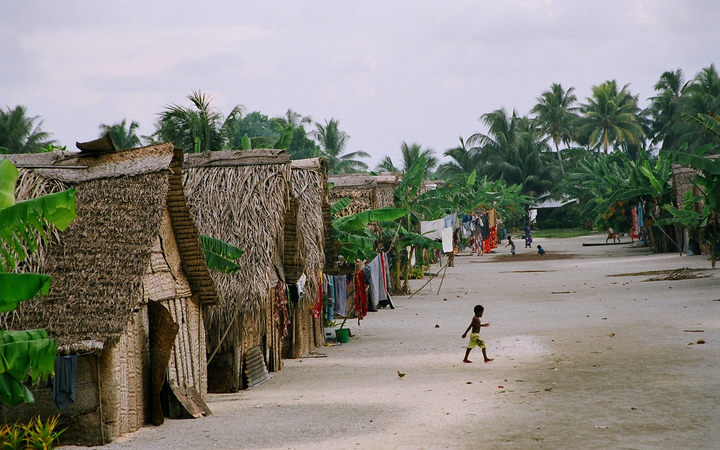
Nukutoa village, Takuu. Photo: Briar March
The Bougainville Referendum Commission has gone to significant lengths to enrol people of Bougainville’s atolls to participate in the vote.
The islanders see the referendum as a potential step towards restoring some of the cohesiveness that Bougainville’s economy and public services had before the civil war.
Apart from the Panguna copper mine, which was central to sparking the crisis, the Bougainville economy had been been under-pinned by agriculture, especially based on thriving cocoa and coconut plantations which have still not recovered.
And Mr Paasia says that Bougvainville has another valuable resource – good leaders.
“I believe the reason why we did so well back then was that we had leaders who had convictions and who were not involved in self-interest. They were focussed on what we need to do for Bougainville,” he says.
“Natural resources don’t necessarily make a country prosper, unless you have good leaders.
“Suffering tends to change people,” Mr Paasia says, adding that he feels there are now more people who seek benefit without putting in the hard work.
It didn’t help Bougainville that widespread destruction of its public infrastructure, and the lasting trauma of armed conflict, robbed multiple generations of access to education.
“Today there’s a lot of opportunists out there, and I think it’s been driven by this mindset – which we have probably borrowed from the rest of PNG of handouts,” Mr Paasia says.
In his view, the upcoming vote for independence or greater autonomy offers a chance to change this.
“PNG will be a better country if Bougainville becomes independent.”
He believes Bougainville and PNG can co-exist harmoniously and prosper in partnership.
“As long as we identify the right leaders who are progressive and have that mindset and integrity to lead Bougainville post-2020.
“There’s a lot of good Bougainvillean leaders out there who are yet to step up onto that platform of leadership. And if we can get those leaders in there, we’ll turn Bougainville around and we’ll turn the services to the atolls around as well.”
Source: RNZ