Search This Blog

Total Pageviews

Advertisement

Labels

Blog Archive

Vanuatu calls for action on human right's visit to West Papua

Vanuatu has renewed a call by Pacific Islands Forum (PIF) leaders for Indonesia to allow the United Nations (UN) High Commissioner for Human Rights to visit West Papua to assess claims of widespread rights abuses.


In his address to the UN General Assembly, Vanuatu’s Permanent Representative to the UN, Odo Tevi, urged action on the call made by PIF countries in 2019, which remains unheeded.

No visit has taken place, causing frustration for various Pacific governments. Solomon Islands Prime Minister also made an emotional plea to Indonesia to allow the UN Rights Commissioner access to West Papua.

“Mr. President, peace and security cannot be separated from human rights. Vanuatu remains deeply concerned about reports of serious human rights violations affecting indigenous Papuans in West Papua,” said Tevi.

“UN special procedures have also raised concerns regarding indigenous rights, displacement, cultural rights, environmental impacts and the treatment of human rights defenders in Papua.

“The call from the Pacific Forum leaders for the UN Human Rights Commissioner visit to West Papua remains unheeded and needs to be acted on.”

Mr. Tevi also reaffirmed Vanuatu’s unwavering support for the decolonisation of Kanaky people in New Caledonia, which remains a non-self-governing territory under the purview of the UN.

He stated that Vanuatu supports the Kanak people’s right to decide their own political future and calls for a peaceful, fair and transparent process that follows UN rules.

Vanuatu is concerned that Kanak people continue to face inequalities in jobs, education, income and economic opportunities, despite New Caledonia’s considerable natural resources and economic potential, he stressed.

He called for the full implementation of relevant UN resolutions on the question of New Caledonia and encouraged continued engagement and constructive dialogue among all stakeholders, including the administering power and the representatives of the people,” he said.

“We further reaffirm the important role of the Special Committee on Decolonization and the Fourth Committee in advancing the realization of self-determination and ensuring that the rights, aspirations and interests of the Kanak people remain at the centre of the decolonisation process.”

Vanuatu’s Permanent Representative also raised the country’s maritime dispute over Matthew and Hunter at the UNGA.

The Government has initiated proceedings against France before the International Court of Justice concerning sovereignty over the two islands and the maritime boundaries between Vanuatu and New Caledonia.

Mr. Tevi told the UNGA: “These islands are an integral part of Vanuatu’s territory. Grounded in customary governance, long standing historical connections, indigenous ownership and is seen as part of our duty as ancestral custodians to protect and preserve.

“We recognise France as a steadfast champion of the international rules based order and under the leadership of President Macron, a strong supporter of international judicial institutions, France has stood alongside Vanuatu in advancing global climate action, including through its support for initiatives before the International Court of Justice.

“We greatly value this partnership and France’s leadership on issues of international importance. It is in the same spirit of mutual respect and commitment to international law that we respectfully invite France to consent to the jurisdiction of the court.”

Solomon Islands, Marshall Islands and Vanuatu Speak for West Papua at the UNGA81


At the 81st Session of the United Nations General Assembly #UNGA81, Pacific leaders placed the unfinished business of decolonisation firmly on the international agenda. Their interventions reflected a shared concern for the rights and aspirations of peoples across our Blue Pacific, including the people of #KanakyNewCaledonia and #WestPapua

These voices did not emerge in isolation.
They build on regional discussions held in Koror, Palau, where Melanesian Spearhead Group #MSG
leaders reaffirmed their support for the aspirations of the Kanak people and addressed the continuing call for meaningful international engagement on the human rights situation in West Papua.
Calls from #Vanuatu, #Solomon Islands and the #RepublicofMarshallIslands for transparency, respect for human rights, and an unhindered United Nations Human Rights visit to West Papua further reflect this continued regional engagement.
For Kanaky New Caledonia, the MSG Caucus called for a renewed process shaped by the principle of “Kanaky in design and Melanesian in spirit,” while also supporting renewed regional efforts to help prevent further conflict.
For West Papua, Pacific leaders reiterated the importance of an unhindered visit by the Office of the United Nations High Commissioner for Human Rights #OHCHR, alongside continued regional engagement.
Together, these statements form part of a broader Pacific conversation about the unfinished work of self-determination, human rights, decolonisation, and the right of Pacific peoples to shape their own futures.
One ocean. Shared histories. Unfinished questions and a continuing call for dignity, justice, and self-determination.

Blessings from the Elders are the Keys to Victory: Sample Case PM James Marape and Michael Somare


Michael Somare told his son to stand down in Angoram after Ludwig Schulze died and blessed Salio Waipo to contest the by-election and win it. Salio Waipo won the 2013 election and has remained the MP for Angoram to this day.

Somare also blessed Allen Bird to become the next Governor of East Sepik, and Allen has remained the Governor of East Sepik.

In 2011, when Somare was in China for medical treatment, Jeffrey Nape changed the Prime Minister and handed the position to Peter O’Neill. All the ministers and National Alliance members moved to stay with O’Neill, but Marape did not move. He was the only one who remained a member of the National Alliance and went to Wewak to visit Somare after he returned from China.

You know what? Somare blessed James Marape and told him that he would become the next long-serving Prime Minister of PNG. Currently, James Marape is the Prime Minister.

Kerenga Kua was Somare’s private lawyer and had no intention of contesting the SineSine-Yongomugl seat. However, after Jeffrey Nape backstabbed Somare, Somare personally went to Kundiawa and announced Kerenga Kua as his next candidate for SineSine-Yongomugl, and Kerenga Kua won the SSY seat.

The point here is that all those Members of Parliament who received blessings from Somare never lost their seats, and I don’t think James Marape will loose the Prime Minister’s seat either.

In my own opinion, he could become one of the longest-serving Prime Ministers in the history of PNG.

DAULO MP EKIME MEK GOROSAHU PASSES ON


PORT MORESBY | Wednesday, 30 September 2026

It is with great sadness that the nation mourns the passing of Daulo MP Hon. Ekime Mek Gorosahu, who passed away today at Paradise Private Hospital in Port Moresby.
United Resources Party Leader William Duma confirmed the death of his party colleague, describing the news as “heartbreaking.”
The cause of death has not yet been released by official sources or the family.
Gorosahu was a first-term Member of Parliament and served on the Parliamentary Permanent Committee on Culture and Tourism.
His passing brings to nine the number of Members of Parliament who have died during the 11th National Parliament.
🇵🇬 Our thoughts and prayers are with the late MP’s family, loved ones, constituents of Daulo and colleagues in Parliament during this difficult time.
RIP Hon. Ekime Mek Gorosahu.

Total of 20 PNG MPs who have died from 2019 - 2025


This is an amazing story, but rarely considered serious by all of us

1. Thomas Pelika- Menyamya
2. Sir Mekere Morauta- PoMNW
3. Richard Mendani- Kerema
4. Roy Biyama - Middle Fly
5. Jonny Alonk- Middle Ramu
6. Sam Akoita- Central Bougainville
7. William Sam- Goilala
8. Sam Basil- Bulolo
9. Chris Nangol- Sumkar
10. William Nakin- North Bougainville
11. Kevin Isufu- Wewak
12. Gabriel Kapris- Maprik
13. Steven Pim- Dei
14. Maso Karipe- Pogera Paiyala
15. Jimmy Uguro- Usino Bundi Gama
16. Simon Dumarinu
17. Sir Julius Chan - New Ireland
18. Luther Wenge- Morobe Regional
19. Hon.Simon Dumarinu - Central Bougainville
20. ⁠Solan Mirisim- Telefomin

PAPUAN MOVEMENT FOR FEDERALISM – STATE SYSTEM

A CALL FOR PEACEFUL AND CONSTITUTIONAL REFORM

Papua New Guinea has reached a point where we must seriously examine whether the present unitary system of government is still the most effective system for governing our diverse country.

We are a nation of more than 800 languages, hundreds of cultural groups and communities spread across a vast and geographically difficult country. Our provinces and regions have different needs, resources, challenges and development priorities.

It is therefore time for Papua New Guineans to have a national conversation about Federalism and a State System of Government.

🇵🇬 A PEACEFUL CALL TO GOVERNMENT

I call upon Papuan New Guineans and people from all regions of Papua New Guinea to consider forming a peaceful and lawful civic movement advocating for constitutional reform towards a federal system.

This must not be a movement based on violence, intimidation, tribal division or hatred.

It must be a movement based on:

• Peace and national unity
• Democracy and constitutionalism
• Provincial and regional autonomy
• Accountable government
• Equal distribution of national resources
• Better public services
• Stronger local decision-making
• Law and order
• Transparency and anti-corruption measures
• Protection of fundamental rights and freedoms

WHY FEDERALISM?

A federal system could provide greater constitutional recognition and authority to states or regions to manage matters that directly affect their people, while the Federal Government would retain responsibility for matters of national importance.

Such a system could provide a clearer division of responsibilities between:

Federal Government → States/Regions → Local Governments

This could bring government closer to the people and allow regions to develop policies and institutions suited to their own circumstances, while remaining part of one united Papua New Guinea.

🇵🇬 THIS IS NOT A CALL FOR SECESSION

Federalism does not necessarily mean breaking Papua New Guinea apart.

The objective should be one nation, but with stronger states and regions.

We can remain:

ONE COUNTRY 🇵🇬
ONE CONSTITUTION
ONE NATIONAL IDENTITY
BUT WITH STRONGER STATES AND REGIONS.

IT IS TIME FOR A NATIONAL DEBATE

The Government should establish an independent national constitutional reform process involving:

Government + Parliament + Provinces + Local-Level Governments + Traditional Leaders + Churches + Civil Society + Business + Academia + Youth + Communities.

The people should be given the opportunity to openly discuss whether Papua New Guinea should continue under the present unitary system or transition to a federal/state system.

Any proposed change must ultimately follow the Constitution and the democratic constitutional processes of Papua New Guinea.

🇵🇬 OUR MESSAGE

Papua New Guinea does not need another conflict.

We need a constitutional conversation.

We do not need violence.

We need peaceful democratic action.

We do not need tribal division.

We need a stronger national framework that respects our diversity.

The time has come for Papua New Guineans to seriously ask:

Is the present system working for our people?

And if the answer is no, then we must have the courage to reform it.

🇵🇬 PAPUAN MOVEMENT FOR FEDERALISM – STATE SYSTEM

A peaceful movement for constitutional reform.

Stronger States.
Stronger Regions.
Stronger Local Government.
Stronger Papua New Guinea.

ONE PNG — FEDERAL PNG. 🇵🇬

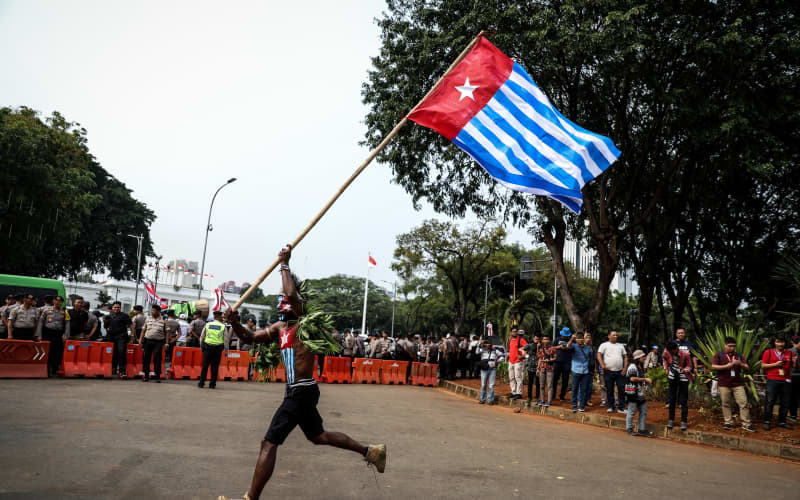
Pacific leaders urge Jakarta to allow UN visit to West Papua

A Papuan student waves the West Papua flag, the Morning Star during a rally in Jakarta, Indonesia, on 28 August, 2019.
Caption:Pacific Islands Forum countries in 2019 requested that Indonesia allow the UN High Commissioner for Human Rights to visit Papua to assess claims of widespread rights abuses.Photo credit:AFP/Andrew Gal

Pacific Islands leaders have used their addresses to the United Nations General Assembly to urge Indonesia to allow the UN human rights chief access to West Papua.

Pacific Islands Forum countries in 2019 requested that Indonesia allow the UN High Commissioner for Human Rights to visit Papua to assess claims of widespread rights abuses.

No visit has resulted, leading to frustration for various Pacific governments.

Solomon Islands Prime Minister Matthew Wale made an emotional plea to Indonesia at the UN, urging it to allow the UN human rights chief to have access to West Papua.

"Solomon Islands respects the sovereignty and territorial integrity of the Republic of Indonesia, and we value our friendship with its government and people," Wale said at the UNGA.

"It is precisely because of that friendship that we speak with candour. Reports of human rights violations in West Papua have persisted for far too long. They must be independently verified, not left in dispute."

Earlier this month, Solomon Islands and other countries in the Melanesian Spearhead Group said if the UN rights chief's visit was not facilitated by Indonesia in order for a report on human rights issues in West Papua to be produced by their next summit in 2027, then Indonesia's associate member status in the MSG will be reviewed.

"We therefore renew the call of Pacific Islands Forum Leaders for the Government of Indonesia to facilitate, without further delay, the long awaited visit of the United Nations High Commissioner for Human Rights to West Papua.

"Such a visit is an act of confidence between friends, and an affirmation that there is nothing to fear from the light."

Indonesian diversity

Marshall Islands President Hilda Heine added her country's voice to the push for action on West Papua.

"The Marshall Islands affirms the region's Pacific Islands Forum communiqué position regarding West Papua, including the 2018 invitation by Indonesia to the UN Human Rights Commissioner," she said

A response of sorts was given by Indonesia's Minister for Foreign Affairs Sugiono: "As a nation of more than 280 million people, Indonesia has learned that diversity is not something to overcome; it is something to manage, respect and turn into strength to democratic participation, dialogue, and respect for differences," he said.

"We preserve our unity from Aceh to Papua, from Miangus to Roti. Indonesia is one people, Indonesia is one nation."

Decolonisation

Meanwhile, Wale also called for the international community to complete the work of decolonisation in parts of the world including the Pacific.

"Solomon Islands reaffirms its longstanding support for the right to self-determination of the Kanak people of New Caledonia and the Maohi Nui people of French Polynesia," he said.

Wale said the UN decolonisation process must offer more than hope.

"It must provide practical pathways to the full emancipation of peoples in Non-Self-Governing Territories, and to their freedom to determine their own political future and development aspirations."

PAPUAN MOVEMENT FOR FEDERALISM – STATE SYSTEM

A CALL FOR PEACEFUL AND CONSTITUTIONAL REFORM

Papua New Guinea has reached a point where we must seriously examine whether the present unitary system of government is still the most effective system for governing our diverse country.

We are a nation of more than 800 languages, hundreds of cultural groups and communities spread across a vast and geographically difficult country. Our provinces and regions have different needs, resources, challenges and development priorities.

It is therefore time for Papua New Guineans to have a national conversation about Federalism and a State System of Government.

🇵🇬 A PEACEFUL CALL TO GOVERNMENT

I call upon Papuan New Guineans and people from all regions of Papua New Guinea to consider forming a peaceful and lawful civic movement advocating for constitutional reform towards a federal system.

This must not be a movement based on violence, intimidation, tribal division or hatred.

It must be a movement based on:

• Peace and national unity
• Democracy and constitutionalism
• Provincial and regional autonomy
• Accountable government
• Equal distribution of national resources
• Better public services
• Stronger local decision-making
• Law and order
• Transparency and anti-corruption measures
• Protection of fundamental rights and freedoms

WHY FEDERALISM?

A federal system could provide greater constitutional recognition and authority to states or regions to manage matters that directly affect their people, while the Federal Government would retain responsibility for matters of national importance.

Such a system could provide a clearer division of responsibilities between:

Federal Government → States/Regions → Local Governments

This could bring government closer to the people and allow regions to develop policies and institutions suited to their own circumstances, while remaining part of one united Papua New Guinea.

🇵🇬 THIS IS NOT A CALL FOR SECESSION

Federalism does not necessarily mean breaking Papua New Guinea apart.

The objective should be one nation, but with stronger states and regions.

We can remain:

ONE COUNTRY 🇵🇬
ONE CONSTITUTION
ONE NATIONAL IDENTITY
BUT WITH STRONGER STATES AND REGIONS.

IT IS TIME FOR A NATIONAL DEBATE

The Government should establish an independent national constitutional reform process involving:

Government + Parliament + Provinces + Local-Level Governments + Traditional Leaders + Churches + Civil Society + Business + Academia + Youth + Communities.

The people should be given the opportunity to openly discuss whether Papua New Guinea should continue under the present unitary system or transition to a federal/state system.

Any proposed change must ultimately follow the Constitution and the democratic constitutional processes of Papua New Guinea.

🇵🇬 OUR MESSAGE

Papua New Guinea does not need another conflict.

We need a constitutional conversation.

We do not need violence.

We need peaceful democratic action.

We do not need tribal division.

We need a stronger national framework that respects our diversity.

The time has come for Papua New Guineans to seriously ask:

Is the present system working for our people?

And if the answer is no, then we must have the courage to reform it.

🇵🇬 PAPUAN MOVEMENT FOR FEDERALISM – STATE SYSTEM

A peaceful movement for constitutional reform.

Stronger States.
Stronger Regions.
Stronger Local Government.
Stronger Papua New Guinea.

ONE PNG — FEDERAL PNG. 🇵🇬

Here is the story about the two great Leaders of the county 🇵🇬

Good morning Papua New Guinea 🇵🇬 

1. The Two East Sepik Brothers
Sir Michael Somare was born on 9 April 1936 in Rabaul, East New Britain, where his father was a policeman. He grew up in Murik and Wewak, East Sepik.  

Sir Pita Lus was born much earlier in the bush, on 16 September 1935 in Lehinga village, Maprik District, East Sepik Province. He did not learn to read and write until he was 24. He worked as a plantation labourer and cook in Rabaul, Kavieng and Manus, where he got the name "Lus" and became a spokesman for workers.  

Lus went into politics first. He won a seat in the first democratic election in 1964 under the Australian colonial government.
2. Lus convinces Somare to stand
In 1967, together with Albert Maori Kiki, Barry Holloway, Cecil Abel and others, Lus was a founding member of the Pangu Pati.  

Pangu's mission was clear: to advocate for an independent Papua New Guinea, free from colonial oversight.

Lus thought the best man to lead the country was his fellow Sepik man, Michael Somare, who was then a teacher and radio broadcaster. Somare was shy and doubted he could win. History records that Lus is credited with having persuaded Michael Somare to run for parliament. Lus transferred from Dreikikir to Maprik and spent his own time campaigning for Somare in Wewak for the 1968 House of Assembly election.  

That partnership worked. Somare became Chief Minister in 1972, led the country to Self-Government on 1 December 1973, and then pushed for full independence.
3. Why Independence is on 16 September
In 1975, Somare, Lus and a few other leaders were sitting together deciding on the date for independence from Australia.

Australia had agreed to grant independence, and the Constitution was ammended. 
   Happy birthday PNG 🇵🇬✋

AUSTRALIA NOT DOING ENOUGH’ – RALPH REGENVANU - VANUATU

“VANUATU has delivered a blunt message to Australia, calling on the major fossil fuel producer to stop expanding fossil fuel production and urgently begin its transition away from fossil fuels as Pacific nations face growing climate impacts.

Vanuatu’s Minister for Climate Change Ralph Regenvanu made the call during a Climate Change Action Briefing in Koror, warning that the world was moving towards an overshoot of the critical 1.5°C global warming threshold.
Regenvanu said the latest United Nations Environment Programme (UNEP) report made clear that urgent action was required to reduce greenhouse gas emissions and keep the 1.5°C pathway within reach.
He said fossil fuels remained the major source of greenhouse gas emissions and that the international community could not delay the transition away from them.
“We must urgently accelerate the transition away from fossil fuels,” Regenvanu said.
He said countries had only a limited window to act, warning that failure to reduce emissions in the next four years rapidly would make any overshoot of 1.5°C longer and more severe.
For Pacific Island countries, he said, the consequences would be particularly devastating, with increasing climate impacts, loss and damage, reduced effectiveness of adaptation measures and greater demands for climate finance.
“Loss and damage are a reality that currently exists in my country, in the countries represented here,” he said.
“It will only accelerate with any overshoot, encompassing economic and non-economic losses that no finance can fully restore.”
Regenvanu said those losses extended beyond financial costs, pointing to the loss of Pacific lands, heritage and identity.
“Our lands, our ancestral lands, our heritage, our identity,” he said.
The strongest criticism came during the question-and-answer session when Regenvanu was asked what message he had for larger countries, particularly Australia, on fossil fuels and whether Australia was doing enough.
His response was unequivocal.
“Australia is not doing enough,” he said.
Regenvanu described Australia as a major producer of fossil fuels and said it should stop expanding fossil fuel production and start transitioning away from it.
“So, the very least a country like Australia should be doing is stopping future expansion, and it’s not doing that,” he said.
“You need to stop expansion, and you need to start transitioning away.”
Regenvanu said the transition was consistent with commitments made through the United Nations Framework Convention on Climate Change (UNFCCC) process and regional climate commitments.
He also reminded countries of the International Court of Justice’s advisory opinion, which recognised the collective temperature goal of holding global average temperatures to 1.5°C above pre-industrial levels.
Despite the warnings, Regenvanu said the 1.5°C pathway remained possible if countries adopted the highest possible level of ambition.
He said this required immediate global commitments to keep any overshoot extremely limited in both magnitude and duration.
For the Pacific, he said, that ambition included a transition towards a 100 per cent renewable energy future for Pacific small island developing states.
Regenvanu said recent floods, heatwaves, sea-level rise and increasingly severe cyclones were all pointing to the same reality. “The need for urgent action,” he said.”
Source & Image: Island Business
Date of Publication: 03/09/2026

MSG Secretariat told that climate change, women and youth empowerment must be priorities for subregional collaboration

Climate change continues to be a major challenge for the members of the Melanesian Spearhead Group (MSG), affecting food, water and health security, as well as driving loss, damage and displacement for many Melanesian communities.

This is a concern that has been repeatedly emphasized throughout a series of MSG country consultations held from 2025 to 2026, as views were sought about the development of subregional initiatives to be managed through the MSG Secretariat’s Project Coordination and Management Unit (PCMU).

The country consultations take forward the decisions of the 23rd MSG Leaders’ Summit held in Suva, Fiji in June 2025, which called for greater collaboration between the MSG Secretariat, development partners and regional organizations and also welcomed the advancement of a Yut4Melanesia project.

In the latest Member consultations, held in Noumea, New Caledonia in August 2026, the PCMU team, led by Mr Johnston Riven, engaged closely with community-based organisations, the Noumea city council and the FLNKS to discuss priorities for a subregional initiative.

Discussions highlighted significant socio-economic challenges for the indigenous Melanesian population, and explored opportunities for inclusive approaches to support women and youth empowerment. Upskilling youth, economic empowerment for women in small business, training and employment pathways were key messages heard, alongside many examples shared about the negative impacts of climate change on life in Kanaky New Caledonia.

The MSG Secretariat sincerely acknowledges all participating ministries, departments, city councils and the FLNKS Bureau for their unwavering commitment, collaboration and continued support throughout this important process.

An advanced subregional strategy design for collaborative sustainable development initiatives will be tabled to Members in subsequent MSG governing board meetings.

Together, we are strengthening subregional cooperation and shaping programmes that reflect the priorities of our Melanesian communities.

\\\\\\\\\\\\\\\\\\\\\\\\\\\\\\\\\\\\\\\\\\\\\\\\\\\\\\\\\\\\\\\\\\\\\\\\\\\\\

Le Secrétariat du GFLM a déclaré que le changement climatique, ainsi que l’autonomisation des femmes et des jeunes, devaient constituer des priorités pour la collaboration sous-régionale
Le changement climatique reste un défi majeur pour les membres du Le Group Fer de Lance Melanesien (GFLM) : il affecte la sécurité alimentaire, l’accès à l’eau et la santé, et est à l’origine de pertes, de dégâts et de déplacements pour de nombreuses communautés mélanésiennes.
Cette préoccupation a été soulignée à maintes reprises au cours d’une série de consultations nationales du MSG organisées de 2025 à 2026, dans le cadre desquelles les points de vue ont été sollicités...

Il s'agit là d'une préoccupation qui a été soulignée à maintes reprises au cours d'une série de consultations nationales du GFLM organisées entre 2025 et 2026, dans le cadre desquelles les avis ont été sollicités concernant le développement d'initiatives sous-régionales devant être gérées par l'Unité de coordination et de gestion des projets (PCMU) du Secrétariat du GFLM.
Ces consultations nationales s'inscrivent dans le prolongement des décisions prises lors du 23e sommet des dirigeants du GFLM, qui s'est tenu à Suva, aux Fidji, en juin 2025. Ce sommet avait appelé à une collaboration renforcée entre le secrétariat du GFLM, les partenaires de développement et les organisations régionales, et s'était également félicité de l'avancement du projet « Yut4Melanesia».


Lors des dernières consultations avec les membres, qui se sont tenues à Nouméa, en Nouvelle-Calédonie, en août 2026, l'équipe du PCMU, dirigée par M. Johnston Riven, a travaillé en étroite collaboration avec les organisations associatives, le conseil municipal de Nouméa et le FLNKS afin de discuter des priorités d'une initiative sous-régionale.

Les discussions ont mis en évidence les défis socio-économiques importants auxquels est confrontée la population autochtone mélanésienne et ont exploré les possibilités d’adopter des approches inclusives pour favoriser l’autonomisation des femmes et des jeunes. L’amélioration des compétences des jeunes, l’autonomisation économique des femmes dans le cadre de la petite entreprise, ainsi que les parcours de formation et d’insertion professionnelle ont constitué les messages clés qui se sont dégagés, parallèlement à de nombreux exemples cités concernant les impacts négatifs du changement climatique sur la vie en Kanaky (Nouvelle-Calédonie).

Le Secrétariat du GFLM tient à remercier sincèrement l'ensemble des ministères, départements, conseils municipaux et le Bureau du FLNKS participants pour leur engagement sans faille, leur collaboration et leur soutien constant tout au long de ce processus important.

Une ébauche de stratégie sous-régionale avancée pour des initiatives de développement durable collaboratives sera présentée aux membres lors des prochaines réunions du conseil d'administration du GFLM.

Ensemble, nous renforçons la coopération sous-régionale et élaborons des programmes qui reflètent les priorités de nos communautés mélanésiennes.
#SecrétariatDuGFLM #Mélanésie #CoopérationRégionale #Partenariats #DéveloppementDurable