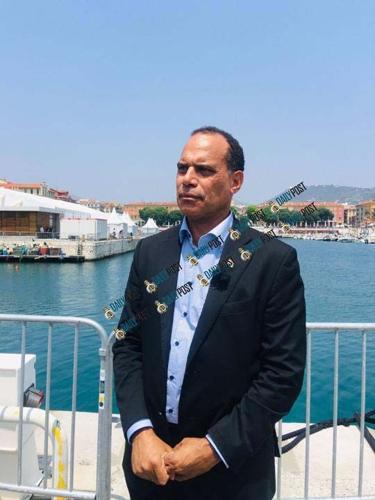
“I definitely feel much more positive being at this United Nations Ocean Conference than I ever have at any COP,” he said. “This is because we have seen important commitments—such as French Polynesia announcing the world’s largest marine protected area, and our neighbour, the Solomon Islands, declaring a moratorium on deep-sea mining within their jurisdiction.”
The Minister added that while these pledges are voluntary, the fact that national leaders made them personally inspires confidence they will be upheld. “It feels like these are not just words. These are real commitments that leaders intend to keep,” he said.
Regenvanu also acknowledged the leadership of small island nations, particularly the Presidents of Palau and the Marshall Islands. “They have been champions in environmental protection, climate action, and safeguarding our oceans. These are not only policy statements—they are actions already underway. I believe we are beginning to see a shift in global efforts,” he said.
The Minister reflected on his role in an event marking the formal depositing of instruments of ratification for the Agreement on the Conservation and Sustainable Use of Marine Biological Diversity of Areas Beyond National Jurisdiction (BBNJ Agreement). “At least 20 countries, including six from the Pacific, deposited their instruments at this conference. This shows legal protections for the ocean are taking shape,” Regenvanu said.
He stressed the need for legal approaches to climate challenges, noting frustration with the slow progress of UN climate negotiations over the past 30 years. “We believe legal measures are necessary because the United Nations Framework Convention on Climate Change (UNFCCC) process has not delivered enough. Despite the Paris Agreement’s goal to keep temperature rise below 1.5°C and cut global emissions, we are seeing record emission levels and temperatures above that limit,” the Climate Change Minister added.
Regenvanu also criticised the lack of follow-through on climate finance promises. “We keep hearing about climate finance, but it has not materialised as promised,” he added.
Source VDPost
Sorong, Jubi – Masyarakat adat suku Abun di Kabupaten Tambrauw menolak kehadiran Yayasan Konservasi Alam Nusantara (YKAN) untuk melakukan segala jenis kegiatan di atas tanah adat marga Yeblo Sah dan Yeblo Sir.
Dalam aksi penolakannya, Masyarakat adat Suku Abun dari distrik Sausapor, Bikar dan Kwor bersama marga Yeblo Sah dan Yeblo Sir selaku pemilik hak ulayat di distrik Bikar dan Pulau Dua melakukan pemalangan Kantor Unit Pelaksana Teknis Daerah (UPTD) Tour Informasi Center (TIC) yang digunakan Yayasan Konservasi Alam Nusantara sebagai kantor pada Senin, (3/6/2025).
Perwakilan marga Yeblo Sah, Welmus mengatakan kehadiran YKAN di wilayah adat mereka tanpa sosialisasi atau pertemuan dengan pemilik hak ulayat.
“Kami tidak tahu apa tujuan dari YKAN. [mereka] tidak pernah ada pertemuan dengan kami selaku pemilik hak ulayat. Kami pemilik hak ulayat kaget juga kalau ada YKAN setelah beberapa kegiatan yang dilakukan di distrik Bikar,” katanya.
Welmus mengaku, kehadiran YKAN tidak memberikan dampak yang baik pemilik hak ulayat. Menurutnya YKAN hanya memanfaatkan potensi sumber daya alam di wilayah adat mereka untuk kepentingan YKAN bukan masyarakat setempat dan pemilik hak ulayat.
“Kami dengar banyak turis yang didatangkan selama ini untuk menikmati keindahan alam maupun terumbu karang di Pulau Dua. Tapi hasilnya kami pemilik hak ulayat tidak mengetahui,” ujarnya.
Cosmas Yeblo, perwakilan marga Yeblo Sir menegaskan sejak pemasangan papan bertuliskan penolakan, Yayasan Konservasi Alam Nusantara harus keluar dan berhenti beraktivitas di wilayah adat Suku Abun, khusunya marga Yeblo Sah dan Yeblo Sir.
Jika Yayasan Konservasi Alam Nusantara mengabaikan penolakan Masyarakat adat, jika terjadi sesuatu YKAN yang bertanggung jawab.
“Kami sudah tolak YKAN. jika terus melakukan aktivitas maka kami pemilik hak ulayat akan tindak tegas dan resiko yang akan terjadi ditanggung YKAN,” tegasnya.
Yustina Yesnath, perwakilan tokoh perempuan suku Abun menambahkan aksi yang dilakukan masyarakat adat suku Abun dan pemilik hak ulayat hanya menegaskan dua poin penting.
Yustina menegaskan poin tuntutan mereka itu lahir berdasarkan hasil kesepakatan dalam beberapa pertemuan internal yang dilakukan masyarakat adat suku Abun dan pemilik hak ulayat.
“Poin tuntutan kami cuma dua. Yang pertama menolak tegas YKAN beraktivitas di wilayah adat suku Abun terutama tanah adat marga Yeblo Sah dan Yeblo Sir. Sedangkan poin kedua itu, stop lakukan sasi (larangan) di Pulau Dua tanpa izin dari kami pemilik hak ulayat,” tegas.
Yayasan Konservasi Alam Nusantara (YKAN) adalah organisasi nirlaba berbasis ilmiah yang hadir di Indonesia sejak 2014. Bekerja di 600 desa dan 9 provinsi termasuk provinsi Papua Barat dan Papua Barat daya. YKAN bekerja di isu lingkungan seperti kehutanan, dan kelautan. (*)
Customary story-lines are a form of traditional knowledge
that encapsulates the history, myths, legends, and spiritual beliefs of the
indigenous people of West Papua. These narratives provide a rich tapestry of
cultural heritage that informs the identity and sense of belonging of the
community. By documenting and mapping out these story-lines, SAPA aims to
preserve and protect this cultural heritage for future generations.
One of the key aspects of customary story-lines is their
connection to the land. For the indigenous people of West Papua, the land is
not just a physical space but a sacred entity that is imbued with spiritual
significance. The story-lines serve as a guide for understanding the
relationship between humans and the natural world, emphasizing the importance
of respect, harmony, and reciprocity with the environment.
Moreover, customary story-lines also inform social
relationships within the community. They provide a framework for governance,
conflict resolution, and decision-making, as well as guidance on moral and
ethical behaviour. By documenting these story-lines, SAPA is not only
preserving cultural traditions but also promoting social cohesion and
solidarity within the community.
Economically, customary story-lines play a significant role
in the management of natural resources. They contain customary laws and
practices that regulate the use of land, water, and forests, ensuring
sustainable resource management and environmental conservation. By recognizing
and institutionalizing customary social organizations within modern frameworks,
there is potential to leverage this traditional knowledge for sustainable
development and economic empowerment of the indigenous communities.
Legalizing customary laws and institutionalizing customary
social organizations can have far-reaching implications for the governance of
natural resources and land rights in West Papua. It can provide a legal
framework for the recognition and protection of customary land tenure rights,
as well as facilitate community participation in decision-making processes
related to resource management. However, it is essential to ensure that these
institutional practices are inclusive, transparent, and accountable to the
community.
One example of the significance of preserving and protecting
customary traditions is the case of the Arfak community in West Papua. The
Arfak people have a rich oral tradition that narrates their history, customs,
and spiritual beliefs. By documenting these story-lines, SAPA has been able to
support the community in asserting their land rights and cultural heritage
against external threats, such as deforestation and mining activities. This has
led to the establishment of community-based conservation initiatives that have
helped protect the environment and enhance the livelihoods of the Arfak people.
In conclusion, the efforts of SAPA in documenting and
mapping out the customary story-lines in West Papua are crucial for preserving
and protecting the cultural heritage of the indigenous people. Recognizing the
spiritual connection to the land embedded in these narratives is essential for
promoting sustainable development, social cohesion, and environmental
conservation in the region. By legalizing customary laws and institutionalizing
customary social organizations, there is potential to leverage traditional
knowledge for the benefit of the community and ensure the empowerment and
self-determination of the indigenous people of West Papua.