Search This Blog

Total Pageviews

Advertisement

Labels

Blog Archive

How ‘Blackbirders’ Forced Tens of Thousands of Pacific Islanders Into Slavery After the Civil War

Estimates of the number of Pacific Islanders captured by blackbirders and forced to work on cotton and sugar plantations in Fiji and Australia range from 61,610 to more than 100,000. Public domain via Wikimedia Commons

The decline of the American South’s cotton and sugar industries paved the way for plantations in British-controlled Fiji and Australia, where victims of “blackbirding” endured horrific working conditions

No Pacific Islander was safe from the “blackbirders,” slave traders who lured, coerced or outright kidnapped tens of thousands of people for forced labor in Australia and Fiji in the late 19th and early 20th centuries.

Some blackbirders disguised themselves as missionaries, going ashore with their collars reversed, books under their arms and the word of God on their tongues. Others enticed islanders to their ships with the promise of traded goods from far-off lands.

One man dressed in the costume of the Ku Klux Klan, a waterproof bag hidden under his robes, writes historian Gerald Horne in The White Pacific: U.S. Imperialism and Black Slavery in the South Seas After the Civil War. He would mesmerize a crowd by seemingly sucking saltwater into his growing belly. Then, when the man appeared to be on the brink of exploding, he’d tear off his costume, revealing the sleight of hand. The audience, so disarmed by the performance and startled by its finale, was said to be easy to snatch.

At times, slavers bypassed tricks altogether, arriving under the cover of night to ambush a village and kidnap its inhabitants. Locals referred to the raids as “blackbirding” because the perpetrators wore dark clothing when they crept ashore; the term also referenced a derogatory slang name for Pacific Islanders.

At the height of blackbirding, European powers occupied much of Oceania, the collective name for the islands scattered across the Pacific Ocean. With limited resources deployed over the vast distances between Vanuatu, the Solomon Islands, Papua New Guinea and other islands in the subregion of Melanesia (the main target of blackbirding), colonial governments found it virtually impossible to keep up with the slave trade. On one of the last frontiers of European and American expansion, blackbirders had little fear of being caught in the act.

“The [Pacific Islands’] relative isolation made it easier for unscrupulous frontier individuals to conduct themselves and their various operations in ways that were contrary to the laws of their own countries,” says Robert Nicole, a historian at the University of Canterbury in New Zealand. “Reports of abuses were slow to reach the governments and newspapers of these countries, and the criminal activities often went unpunished.”

Scholars’ estimates of the number of Indigenous people captured by blackbirders and forced to work on cotton and sugar plantations in Fiji and Australia vary widely. Horne cites figures ranging from 61,610 men, women and children to more than 100,000, all taken from their Pacific Island homes between 1863 and 1904. Young men and boys were especially prized: Sturdy and strong, they were the most likely to survive the backbreaking work, meager rations and physical abuse. But attractive women fetched the highest prices, due to their scarcity in mid- to late 19th-century settler communities.

While some individuals captured by blackbirders were promised a minimum annual wage of £3 and a return to their homeland after three years of labor, others were sold directly to planters or forced to continue working after their term was up. Such distinctions have historically cast doubt on whether this form of human trafficking was slavery or indentured servitude, in which individuals work for little or no pay for a set period of time as a way of repaying a debt.

The vast majority of those taken by blackbirders, however, had no debts to repay. Before being removed from their homes, they’d likely had little to no contact with foreign settlers. Blackbirding ships were commonly equipped with shackles and other means of preventing passengers from escaping, and they rarely had enough space or supplies to transport their human cargo—evidence that supports the argument that blackbirding was slavery rather than indentured servitude. If the islanders had signed contracts in good faith and received the necessary provisions, restraints wouldn’t have been necessary to keep them from jumping ship.

“This was employment enforced through the barrel of a gun or the crack of a whip,” says Nicole. “In this economy, foreign individuals and their associates create wealth for themselves on the backs of islanders who were given little or no choice in the matter.”


The fact that the South Pacific slave trade arose just as the United States became embroiled in a conflict over slavery is no coincidence. Perhaps the biggest irony of the Civil War is that the December 6, 1865, ratification of the 13th Amendment, which abolished slavery (except for convicted criminals) in the U.S., did not put a nail in the coffin of the global slave trade. Instead, its locus was simply transplanted to a new region.

The South Pacific slave trade grew out of cotton, or rather a lack thereof. In the early 1860s, plantations in the American South produced 75 percent of the cotton used around the globe. The outbreak of the Civil War in 1861 ground textile manufacturing to a halt but did not diminish demand for its output. In Great Britain and Europe, the price of cotton exploded.


Global powers had already started discussing the diversification of the cotton industry, especially as the U.S. slipped further and further toward conflict. As early as the 1850s, the British government experimented with Fiji and Australia as cotton-friendly alternatives to the American South. The results were promising, but the crop was labor intensive. Its production was only profitable in the U.S. because those who worked on plantations were enslaved, and the enslaved did not earn salaries.

Only by replicating the conditions pioneered in the U.S. could a South Pacific cotton industry be as lucrative as the one it was replacing. Unsurprisingly, white European settlers and Confederate refugees who sought respite from the Civil War in the South Pacific played a pivotal role in the new plantations’ development.

“The obvious source of labor to turn to was local Fijian labor, but very few Fijians were available or willing to work for planters under the exploitative conditions that often prevailed on these plantations,” says Nicole. “In 1864 and 1865, the first ships carrying laborers from Vanuatu arrived in Fiji, [and] before long, an entire labor trade emerged to service Fiji’s new plantations.”

Beyond Fiji, the British colonies of Queensland and New South Wales in Australia offered similarly attractive ecosystems for re-establishing the cotton industry. Sugar cane, another labor-intensive good whose production was disrupted by the Civil War, soon followed.

The blackbird trade was disjointed. Independent operators controlled the ships and set their routes without coordinating with one another or local authorities. Most blackbirders were citizens of the U.S. and Britain who’d come to the region as traders or settlers and found a lucrative business in trafficking human beings.

Although British law technically outlawed slavery in the empire’s colonies in the South Pacific, only a handful of Royal Navy ships patrolled the area. Even if a ship was suspected of blackbirding, the law could only be enforced against those of British origins, and even then, enslavers were rarely convicted due to the fine line between the definitions of indentured labor and enslavement.

In 1869, a Royal Navy ship seized the schooner Daphne on the suspicion that it was transporting enslaved laborers. Authorities found that the Daphne was carrying twice as many Pacific Islanders as it had been licensed to contract, in terrible conditions without sufficient supplies. The schooner’s South Australian owner escaped conviction on slavery charges because the prosecution didn’t have enough evidence to prove that working conditions at the ship’s destination of Fiji constituted slavery.

In truth, the Indigenous islanders blackbirded for plantation work in Fiji and Australia endured living conditions that, in many ways, mirrored the ones enslaved Americans had just escaped. Shelter was inadequate, food was limited and of poor quality, and hours were long. Workers faced violence and coercion from plantation owners and managers, and they had little access to medical care. Deaths from diseases to which they had no immunity were extremely frequent.

The South Pacific slave trade had an equally devastating effect on the communities targeted by blackbirders. “Robbed of their able-bodied men, the trade caused massive challenges for social cohesion on [enslaved people’s] home islands [that] took decades to rectify,” says Nicole. “Those who lost men had to rely on the elderly, on women and on the young to survive.” Familial relationships and cultural traditions practiced for centuries, like strategically arranged marriages between clans, disintegrated in the span of just a few decades.

Fiji’s cotton plantations rapidly declined in the early 1870s due to the industry’s resurgence in the American South. But both cotton and sugar cane remained significant industries in Queensland and New South Wales through the early 20th century, even after the fledgling Australian government passed federal legislation in 1901 requiring the deportation of Pacific Island laborers, including those who’d been blackbirded and their descendants, as part of a push to keep the country’s population white.

Deportations began in 1906, but not everyone who was given the choice trusted that they would be returned to their communities. In the past, individuals who’d been told they’d be brought home after their labor ended were dropped nowhere near the places from which they’d been taken—a situation that, due to conflict or a lack of resources, could result in death. At the same time, many wanted to remain in the country where they’d been forced to build new lives. Around 2,500 Pacific Islanders received exemptions or defied the order and stayed behind in Australia. Another 2,700 reportedly remained in Fiji in 1908.

After the mass deportations, Australia’s plantation workers were replaced by fairly paid white workers. Between 1919 and 1964, it was actually illegal for people of color to work in Queensland’s sugar industry.


 Reas complete story here

PRIME MINISTER MARAPE DISMISSES RESIGNATION CALLS, AMID LAW-AND-ORDER CHALLENGES

Tuesday, 4th March 2025
News Release 

Prime Minister James Marape has firmly dismissed calls for his resignation, characterizing them as politically motivated and a dangerous attempt to capitalize on social unrest for personal gain.

“From my perspective, it’s clear that Deputy Opposition Leader James Nomane and others in the opposition are trying to leverage social issues to gain political power. This pattern is becoming increasingly evident,” Prime Minister Marape stated.

He shared that shortly before January 10, 2024, a senior member of parliament approached him—alongside the Deputy Prime Minister and a provincial governor—urging him to resign due to perceived losses in public support and worsening lawlessness.

“Days after that conversation, the unrest on January 10 occurred, escalating the calls for my resignation. History seems to be repeating itself,” he remarked.

The Prime Minister emphasized that resigning is not a viable solution to the complex challenges facing Papua New Guinea.

“The role of a Prime Minister is not to step down during every crisis; it’s about providing leadership, coordinating efforts, and allocating resources to tackle national issues. That’s precisely what we are doing.”

He highlighted that in 2024, the government allocated unprecedented funding to law enforcement, taking proactive measures to address the problems rather than shifting blame.

Prime Minister Marape noted the Pangu Pati received a Section 63 invitation to form a government after winning 39 out of 118 seats—the most significant mandate since the Organic Law on Political Parties and Candidates was enacted in 2002.

“The law-and-order crisis in PNG is not a recent development; it stems from years of neglect. We inherited a police force in a state of disarray, lacking capability at all levels. Even the commissioner’s office had no resources or trained personnel,” he stated, assuring that he is actively working to restore discipline, resources, and leadership within the police. His efforts include:

Increased police recruitment and training, which had been neglected for over a decade.
Major reforms aimed at fortifying the police force through retraining officers and enhancing command structures.
Improved collaboration among security agencies, including Defense and the National Intelligence Office.
“Despite significant challenges, we are in the process of rebuilding our system. These changes will take time, and simply replacing the Prime Minister, Minister, or Police Commissioner will not yield overnight results.”

On Monday Prime Minister Marape convened a meeting with critical security agencies—including the Police, Defence, Attorney General, National Intelligence Office (NIO), and Correctional Services—and delivered a clear directive:

“It is time for these agencies to rise to the occasion and deliver results. Our government is providing more resources than any previous administration, and we expect reciprocal outcomes. It is not my role as Prime Minister to micromanage their responsibilities; they must work diligently to restore law and order. If anyone should be putting in 20-hour days, it is the police and heads of all security agencies.

“I’ve given explicit instructions regarding the restoration of fundamental police discipline and effectiveness, which include:

Evaluating police salaries and allowances, including risk compensation, ensuring that the state—not the community—bears the responsibility of compensating the families of officers who lose their lives in the line of duty.
Stopping unnecessary roadblocks and compensation demands, which obstruct the country’s operations and impede progress.
Strengthening police enforcement while ensuring the Police Minister, Police Commissioner, Defence Minister, and Commander take full accountability for enhancing discipline and efficiency.
“I have also tasked the Attorney General and Justice Secretary with reviewing and strengthening laws as part of PNG’s 50th anniversary reforms. This will include harsher penalties for those who harbor criminals or permit crimes on private property, holding communities accountable for criminal activities in their areas.

“As we advance with our Police Development and Capacity Programme, we are focused on increasing arrests and enhancing law enforcement efficacy. No one is above the law, and all offenders must face justice.”

Prime Minister Marape criticized certain opposition figures, including Nomane, for not using their influence to foster order in their respective communities.

“Nomane spends a lot of time in Goroka and is privy to who is behind the disruptions. Instead of leveraging his leadership to quell the unrest, he is further inciting it, demonstrating a lack of responsible leadership,” he stated.

He praised the tribal members in Eastern Highlands for their cooperation in reopening roads despite their grievances.

“The people of Eastern Highlands have shown commendable wisdom and responsibility by agreeing to the highway’s reopening. I want to personally thank them for heeding the authorities and prioritizing the greater good. Eastern Highlanders are inherently good people, and I am encouraged by their readiness to help restore order.”

Prime Minister Marape urged all political leaders to collaborate in addressing crime and instability instead of engaging in political maneuvers.

He reflected on how similar political tactics led to instability and economic decline in 2011, when opposition leaders campaigned for the removal of Sir Michael Somare.

“The same voices that sought Somare’s ousting in 2011 ultimately contributed to years of economic downturn and weakened governance. Now, similar rhetoric is being directed at me, detracting from the critical work being done to resolve long-standing issues.”

While acknowledging the persistent challenges related to law and order, Prime Minister Marape reaffirmed his dedication to pursuing long-term solutions rather than temporary political distractions.

“I don’t claim to be perfect, but we have initiated substantial reforms aimed at restoring law and order. Instead of inciting instability, I encourage emerging leaders like Nomane to take ownership of their roles and promote peace and the rule of law.

“Demanding the Prime Minister’s resignation is not a solution; it’s merely a distraction from the essential work at hand.”

NCD Governor Parkop on the Anniversary of the Passing of PNG Founding Father

Today on the anniversary of the passing of Grand Chief Sir Michael Thomas Somare we will join the rest of the country to celebrate his life and pay him highest respects for the journey he started for our people into nationhood 50 years ago.

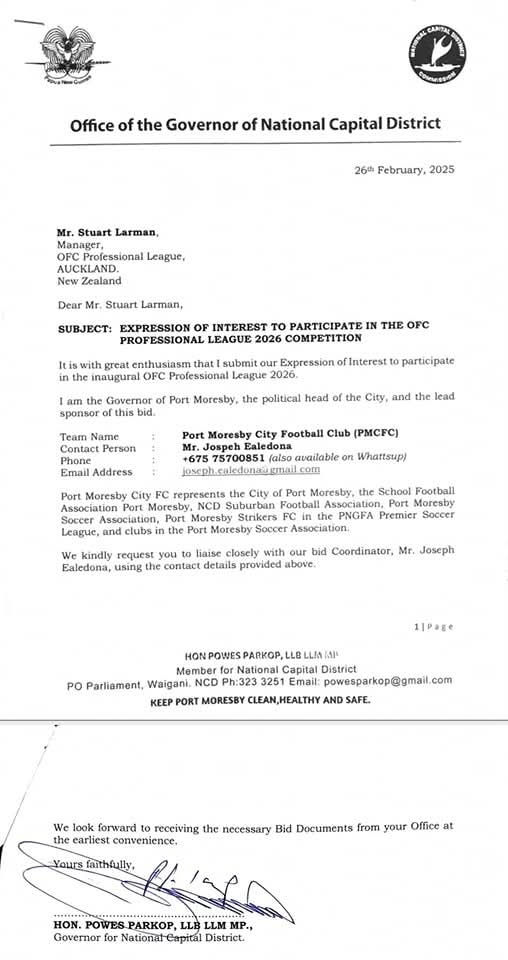
 Today we honour his life and conviction too for our people and our country by starting another chapter in this journey Grand Chief and his peers started by making this bid on behalf of our capital city Port Moresby to have a professional football Team in the new Oceania Professional League set up by the Oceania Football Confederation. 

It is no coincidence that we submitted the bid on this day the Anniversary of the passing of the great architect of our nation PNG.

When Grand Chief Somare was asked how will be run and managed a country at and after independence without the professional technocrats etc. 

He replied that my economists, engineers, doctors, accountants, lawyers, etc are in their mothers womb. They will be born after independence and they run and manage the country. 

We in our capital city will not just celebrate his life but truly honour him by manifesting his dreams, this time in Sports. Today we start a new chapter in the great dream Somare had in 1968, an independent state capable of being as good or better than anyone else. 

We wish to make this great dream a reality in Football or Soccer. 

OFC has given deadline for bids by Friday the 28th of February, 2025 but we have submitted today in honour of our founding father of our nation Grand Chief Sir Michael Thomas Somare.

 He had great faith and belief in our people. We are confident Port Moresby City FC will be highly competitive and successful if we are granted a license by Oceania Football Confederation. The Somare journey continues.

Transnational Highway from Morobe to Port Moresby Near Completion

The transnational highway connecting Morobe Province to Papua New Guinea’s capital, Port Moresby, via Gulf Province is nearing completion, with just 40 more kilometers left to be constructed.

According to a source from the Department of Works and Highways, the project is expected to be finalized by June.

The highway, spanning a total of 158.9 kilometers, aims to bridge the missing link between Oiwa Junction in Aseki, Menyamya, and Epo Junction in Gulf Province. 

Significant progress has been made, with more than 100 kilometers of the road already constructed.

The source confirmed that two teams from the Department of Works and Highways are actively working on different sections of the project to expedite its completion.

Works Secretary Gibson Holemba recently stated in a local print media report that approximately 40 kilometers of the highway, extending from Oiwa Junction to Bema and then to Kotidanga in Gulf Province, is on track for completion by June.

Following the completion of this segment, Holemba noted that construction teams will shift their focus to the section connecting Kerema to Menyamya, further enhancing accessibility and connectivity in the region.

This report was filed by WANPIS AKO

#pngsun #news #ruralpng #pangu #gibsonholemba #menyamya #gulf #portmoresby #transnational #highway #50year #independence #migration #lawandorder #urbandrift

Story Worth the Wait: The Barike Band and Matalau Nakikus

LFor years, as a journalist, I have searched for the untold story behind the legendary Barike Band of Rabaul—a band whose music became the heartbeat of a nation. I longed to speak with Matalau Nakikus, one of the last surviving members of the original Barike, to hear firsthand the journey of this musical powerhouse that shaped Papua New Guinea’s cultural identity.

Yet, despite my many attempts, the story always seemed just out of reach.

But today, as our nation stands on the brink of its 50th Independence Day celebrations, the moment I had been waiting for finally arrived. Matalau Nakikus himself graciously gave me the opportunity to sit with him and dive deep into the history of Barike—a story of music, resilience, and the unbreakable spirit of Rabaul, once the true “Pearl of the Pacific”, until that fateful day in September 1994.

I grew up with the music of Barike during my high school years in the 1980s. Their songs were more than just melodies; they were anthems of identity, unity, and pride. Today, as Matalau spoke of Barike’s love for Rabaul and Papua New Guinea, their unwavering devotion to their people and their homeland, I felt an overwhelming sense of gratitude and admiration.

This is more than an interview. It is a chance to preserve the legacy of a band that united generations through their music—especially the timeless anthem “Wan Kantri”, a song that has done more to bring Papua New Guinea together than words ever could.

I can’t wait to share this extraordinary journey with you all.

Stay tuned as we unveil the story of a true Papua New Guinea musical gem. 🇵🇬🎶✨

#BarikeBand #WanKantri #PapuaNewGuinea #MusicalLegacy #Independence50

Great Grand Chief Michael Somare Remembrance Day 26 February 2025

National Capital District Commission led by NCD Governor Hon. Powes Parkop will be hosting a candle light vigil to remember Late Grand Chief Sir Michael Thomas Somare including past leaders of our great nation.

The organizing team wishes to advise city residents that due to the current weather condition, this memorial event planned for tomorrow evening at Sir Hubert Murray Stadium has now been moved to the Sir John Guise Indoor Stadium. 

Please take note and looking forward to seeing you all there.

Date: Wednesday 26th, February 2025

Time: 5:00pm- 8:00pm

Venue: Sir John Guise Stadium 

This special occasion is open to the general public.

NO ENTRY FEE!

Finally Getting an All Weather Road after 50 Years of Independence

After 50 years of Independence, our people in some of the most remote parts of the Sepik Plains are finally getting their roads and seeing cars and PMV trucks in their villages for the first time. Now they can jump on a PMV and go to Wewak instead of walking 6 hours to catch a PMV truck. 

We, the Yangoru-Saussia DDA, just competed an 18-kilometre road from Kiniambo to Sengera covering all the villages in between like Makambu and all the way down to Sengera Community School, which I use to reach by helicopter and by planes. I visited the completed road last week and told the contractor to build one more permanent bridge over the wet crossing between Kiniambo and Makambu. A lot of work has gone into this important road which will, when completed on the Wosera District section, will link us to Yenchen village on the mighty Sepik River. 

I was so happy to see the excitement of our people to finally receive an all weather road after 50 years of Independence. 
Yes, in Yangoru-Saussia we must not leave anyone behind. Wok Must Go Yet, there is no stopping. 

We will have the grand opening of the road at Sengera Primary School on Monday, April 7, 2025.