Search This Blog

Total Pageviews

Advertisement

Labels

Blog Archive

NATIONAL HIGHWAY DETORIORATING BEYOND EXPECTATION. (LAE-MADANG)

The portion of the national highway between Usino-Bundi Junction and Tapo Checkpoint is at its worst state. Weather and negligence have contributed to the degradation of the road and its unwelming condition.

Swift action has not been implemented into upgrading this section of road where erosion and rain have caused potholes to form on the road with loose gravel and mud occupying every section.

The road condition has given rise to hold-ups, mechanical faults in vehicles, and uneasy travel by the public.

While Connect PNG Program is going on, all national roads should be maintained. 

 The picture shows a 25-seater bus getting stuck in a pothole in the middle of the road and the fleets of the vehicles lined up to travel once the bounded vehicle is freed.

Rapid attention will be foremost to get this mentioned component of the national highway upgraded.

#worthsharing 🙏

FOREIGN CARD SKIMMERS ARRESTED FOR STEALING FROM PAPUA NEW GUINEAN ACCOUNTS

Approved for Release: 26th January 2025 - Office of the Commissioner of Police 

Police Commissioner David Manning has announced the arrest of two foreign nationals involved in a sophisticated scheme of data espionage, fraud, and financial crime targeting Papua New Guinea. The suspects, aged 40 and 26, hold Romanian passports and were apprehended on January 21st in Port Moresby.

“International criminals cross borders and use technology to exploit vulnerabilities in our communities. The victims of these crimes are hardworking Papua New Guineans,” Commissioner Manning stated.

The Royal Papua New Guinea Constabulary (RPNGC) Transnational Crime Unit meticulously tracked the activities of this criminal enterprise, gathering substantial evidence to facilitate their arrest.

“Thanks to the hard work of our investigators, we have secured enough evidence to ensure these criminals can expect extended prison terms in PNG,” Manning added.

While details are limited due to the ongoing court proceedings, it has been reported that the suspects allegedly employed credit and debit card skimming devices, cloned cards, and stole significant sums of money, with estimates exceeding 10 million Kina. The police have initiated efforts to trace every toea of the misappropriated funds.

The arrests occurred in Kennedy Estate in the National Capital District (NCD) after police identified the suspects through CCTV footage. During the arrest, law enforcement seized several items, including:

 • Passports
 • Cash
 • Card skimming and cloning devices
 • Blank and reprogrammed cards
 • A computer

Commissioner Manning emphasized the growing challenge posed by international organized crime networks, which exploit technology and collaborate with local criminals, abusing the hospitality of communities.

“The money stolen by these criminals came from the accounts of hardworking Papua New Guineans, and they will be held accountable for their actions,” he asserted.

“This is a solid example of the diligent work of our investigators. We remain vigilant against the threat of transnational criminal syndicates. Those who seek to enter our country and steal from our people will find there is no place to hide. These criminals will do hard time in our prisons.”

End//:

Prime Minister Marape Calls for Support in Sustaining Natural Resources

Sunday, 26th January 2025

PRIME Minister James Marape has called for stronger international efforts in the sustainable management of natural resources worldwide. During a recent panel discussion hosted by Conservation International, he emphasized the urgent need for global cooperation to address the challenges of sustainability and conservation.

Highlighting Papua New Guinea’s “mega richness,” Mr. Marape pointed out that the country is home to up to seven percent of the world’s biodiversity, shares the title of the world’s third-largest tropical rainforest (jointly with Indonesia), and possesses a substantial portion of the world’s marine resources. This unique position underscores the importance of protecting and managing these natural assets.

Patricia Zurita, a spokesperson for Conservation International, introduced Mr. Marape at the meeting and noted a significant financing gap of between $700 million to $1.3 billion annually that needs to be addressed to effectively support nature conservation efforts globally.

Mr. Marape led a panel discussion focused on the necessity of securing financing to protect and conserve nature worldwide. His address underscored the critical importance of safeguarding our planet’s natural wealth and urged the international community to unite in investing in these essential efforts.

Accorded the prime spot on the panel to open the meeting, Mr. Marape introduced Papua New Guinea and highlighted its leadership role in biodiversity, tropical rainforests, and marine resources. The panel discussion was part of the series of meetings held on Day 2 of the World Economic Forum Annual Meeting in Davos.

In his remarks, Mr. Marape stated, “We have created a global financing system that is rewarding anything but nature, yet we depend on nature for everything.” He called for stronger global efforts in the sustainable management of natural resources, emphasizing the need to rally financial support from investors toward nature conservation, food sustainability, and marine resource protection.

Panelists acknowledged Papua New Guinea’s biodiversity and marine richness, sharing their various endeavors in conservation and the financing mechanisms they have developed to channel resources toward these causes. “We (PNG) hold a lot of stakes in the conversation on conservation. A lot of people showed respect to PNG today because of what we have in nature—our biodiversity, rainforests, and marine resources,” Mr. Marape remarked after the meeting.

He expressed gratitude to Conservation International and the World Economic Forum for providing a platform to advance discussions on financing nature conservation. “It was a good turnout of private and public sector partner engagement, where we all share the view that we belong to one planet that hosts finite resources, and these resources need to be sustainably managed,” he added.

Looking ahead, Mr. Marape has invited Conservation International to Papua New Guinea to continue these important conversations, proposing a meeting to be held later this year or in 2026.

GOVERNOR PARKOP: CITY WILL CONTINUE TO TRANSFORM UNDER MY WATCH

As the nation prepares to celebrate its 50 years anniversary of being an independence state, the city of Port Moresby wasted no time in its transformation journey in terms of infrastructure development and service delivery to the people.

Right after the launch of the of the 3.2 Kilometers  Hohola to Tokarara rehabilitation works last Friday, the National Capital District Commission again announced the construction of the new two-lane road stretching from Waigani Pitpit street through Wildlife and Kennedy Estate up  to Eight Mile and exiting at MacGregor Police Barracks.

The new 3.3 Kilometers road at the cost of K9 Million is fully funded by NCDC and been awarded to the nationally owned road construction company Mobile Works Limited.

With no time to waste, NCD Governor Powes Parkop said infrastructure development in the city is vital for the city residents and he will continue his effort to lift and transform the capital city.
“We must continue our journey in securing better life for our people, lift their standard of living and also giving them the best that we can give to them as the mandated leaders,” Governor Parkop said.

He said, the city has continued to transform and progress in terms of infrastructure development because the municipal authority under his leadership have set goals and have been working every year to deliver greater outcomes for the city and its people.

“This new road will not only benefit residents along it but ease traffic and reduce travel time during peak hours along the Hubert Murray Highway,” said Governor Parkop.

Member for Moresby North East Hon. John Kaupa commended Governor Parkop,  for his leadership at the national level in the development of the city during his four term, as the governor for this amazing city.

“As mandated leaders of NCD, We have been working together to deliver quality infrastructure and services to our people,” Kaupa said.

He said the transformation in the city and service delivery to the people are their priorities in making this city a great city in the Pacific region.
 
City Manager Ravu Frank expressed his gratitude to the NCDC Board led by Governor Parkop as the chairman for the steadfast commitment in the transformation of the city over the years.

“This project represents a significant step forward in the collective efforts to develop infrastructure to meet the growing demands of our city,” Mr. Frank said.

He stated that this new road will not only ease traffic congestion but also provide a convenient alternate route for access to nearby areas, making travel more efficient and less stressful for our residents.

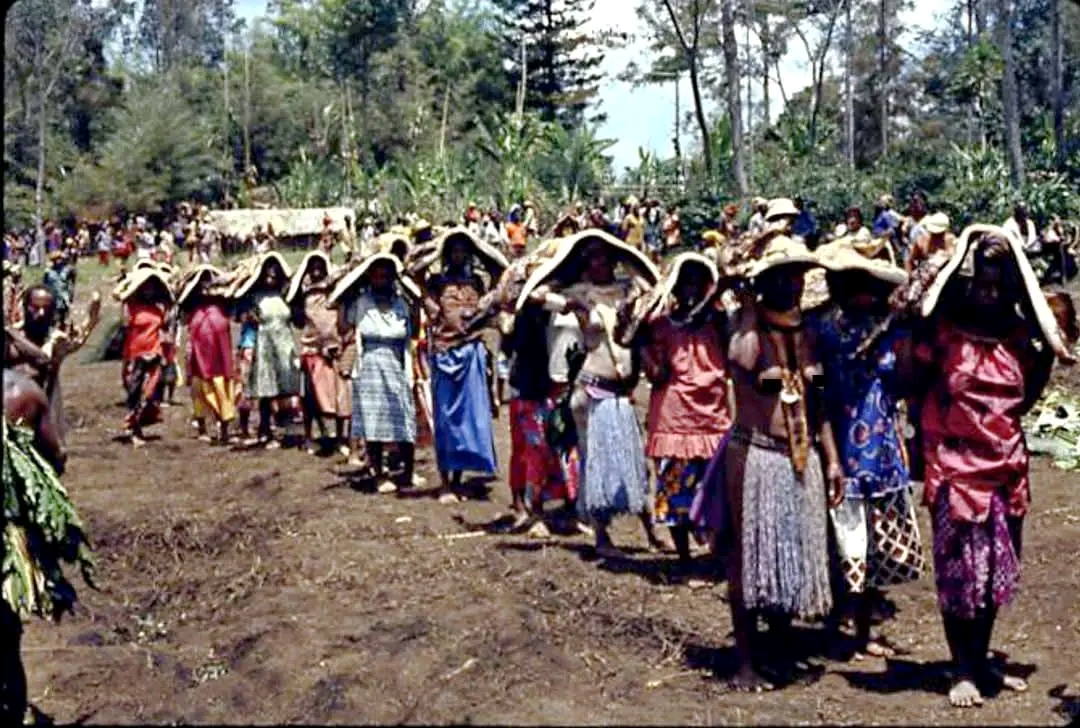
Women carrying sides of pig meat at the conclusion of a Wahgi Valley pig festival

Women carrying sides of pig meat at the conclusion of a Wahgi Valley pig festival, 1980. Photo by Michael O'Hanlon, British Museum.

Special thanks to Peter Russel Kranz for sharing this information and photo

#WahgiValley #PigFestival #MichaelOHanlon #BritishMuseum #PapuaNewGuinea #1980 #HighlandsCulture #CulturalHeritage #MelanesianTraditions #PNGPhotography #FestivalCulture #WomenInCulture #Anthropology #PNGHistory #WesternHighlands #TraditionalFestivals

Chimbu tribal leader, Chuave, 1958

Chimbu tribal leader, Chuave, 1958. Photo by Kathleen Vellacott-Jones, University of Queensland.

Special thanks to Peter Russel Kranz for sharing this information and photo

#Chuave #ChimbuTribalLeader #KathleenVellacottJones #UniversityOfQueensland #PNGHistory #SimbuProvince #PapuaNewGuinea #TribalLeaders #HighlandsPNG #CulturalHeritage #VintagePNG #1950sMemories #TraditionalLeadership #HeritagePhotography #PacificHistory

Sarah Rector Black American in 1913 Goven Baren Land that made Her.Rich

In 1913, a 10-year-old African American girl named Sarah Rector was granted a 160-acre parcel of land in Oklahoma as part of a land allocation program for Native Americans. 

The land she received was considered barren and unproductive, as the best farmland was typically reserved for white settlers. Because of her race, Sarah was given land that was deemed less valuable, with little expectation of it ever producing wealth. 

However, the course of history took an unexpected turn when oil was discovered beneath her land. What was once thought to be useless turned out to be a significant resource, making Sarah Rector one of the first African American millionaires in the United States. 

The discovery of oil on her land transformed her life, lifting her out of poverty and changing her family''s fortunes forever. Sarah Rector''s story is a remarkable example of how unforeseen opportunities can arise, even in circumstances of racial inequality. Despite being given land that was overlooked by others, she became a symbol of resilience and success. 

Her newfound wealth allowed her to secure a better future for herself and her family, challenging the prejudices of the time and becoming a trailblazer for African American success in the early 20th century.