Search This Blog

Total Pageviews

Advertisement

Labels

Blog Archive

How old is the climate crisis?

Published: September 4, 2024 6.05pm BST

I was born in 1994, when the concentration of CO₂ in the atmosphere was measured at 360 parts per million; today it is close to 420. Furnaces, engines and former forests emitted 23 billion tonnes of this planet-warming gas in 1994; today they spew more than 37 billion tonnes. With some exceptions (economic downturns, the pandemic), humanity has released more CO₂ into the atmosphere each year than the one before it for at least two centuries.

Earth is not only hotter as a result of all this additional greenhouse gas, it is also getting hotter at a faster and faster rate. Where did it all begin? Figuring that out can tell us who or what is responsible – and what a possible solution looks like.

This roundup of The Conversation’s climate coverage comes from our award-winning weekly climate action newsletter. Every Wednesday, The Conversation’s environment editor writes Imagine, a short email that goes a little deeper into just one climate issue. Join the 35,000+ readers who’ve subscribed.

One way to answer the question at the start of this newsletter is to identify when people first noticed that the planet was warming. This happened during the mid-20th century. Tragically, it did so among scientists whose funders preferred that the world remain ignorant.

The 1970s: a critical decade
One company intimately involved with the emerging science of climate change was Exxon (now ExxonMobil). Scientists working for this oil and gas giant were modelling Earth’s climate in the 1970s to understand how the increasing carbon content of the atmosphere would affect temperatures – and Exxon’s future as a business.

According to a study published in 2017 that involved scouring the company’s internal documents, Exxon scientists acknowledged back then that climate change was real and overwhelmingly caused by burning the same fossil fuels Exxon sold.

“Yet over 80% of Exxon’s editorial-style paid advertisements over the same period specifically focused on uncertainty and doubt, the study found,” says Katharine Hayhoe, professor and director of the Climate Science Center at Texas Tech University.

Exxon knew better – a lot better. An investigation published last year showed that forecasts of the future climate made by Exxon scientists in the 1970s were remarkably accurate. The company knew where the world was headed by continuing to burn coal, oil and gas and instead endeavoured to cover it up.

fiction and non-fiction books on colonialism and other topics, locates in this story the seeds of the climate crisis.

“Colonialism, genocide and structures of organised violence were the foundations on which industrial modernity was built,” he writes. By making such destruction economically rational, capitalism encouraged activities that gradually degraded Earth’s living systems, say Julia Taylor and Imraan Valodia, climate and inequality researchers familiar with Ghosh’s work.

For a sense of how this legacy still frustrates efforts to solve climate change, look no further than the international negotiations convened by the United Nations.

The COP27 summit in Sharm El-Sheikh, Egypt was the fifth to be held in Africa. One debate at COP27 asked whether African countries had the right to exploit their natural gas reserves, as many richer countries had already done. Those same “developed countries”, in UN parlance, may owe their wealth to past plunder in Africa. And despite promises to the contrary, few countries are meeting their pledges to finance renewable energy in Africa.


Read more: China is already paying substantial climate finance, while US is global laggard – new analysis


“Calls to cease all gas exploration in Africa that fail to account for where historical responsibility for climate change lies and the need to close the current finance gap are the most audacious kind of climate imperialism,” say Chukwumerije Okereke and Youba Sokona, environment and development experts at the University of Bristol and UCL respectively.

“On this basis, it is argued that developed countries are enacting a renewed form of colonialism – what some might call climate colonialism.”


As the Pope heads to Papua New Guinea, who is PNG's saint-in-waiting, Peter To Rot?

Papua New Guinea will receive its first visit from the Pope in almost 30 years this week, and some are hoping for some development on the country's first saint-in-waiting, Peter To Rot

His Holiness Pope Francis will travel to Port Moresby and Vanimo, a remote town in Sandaun Province on the border with Indonesia.

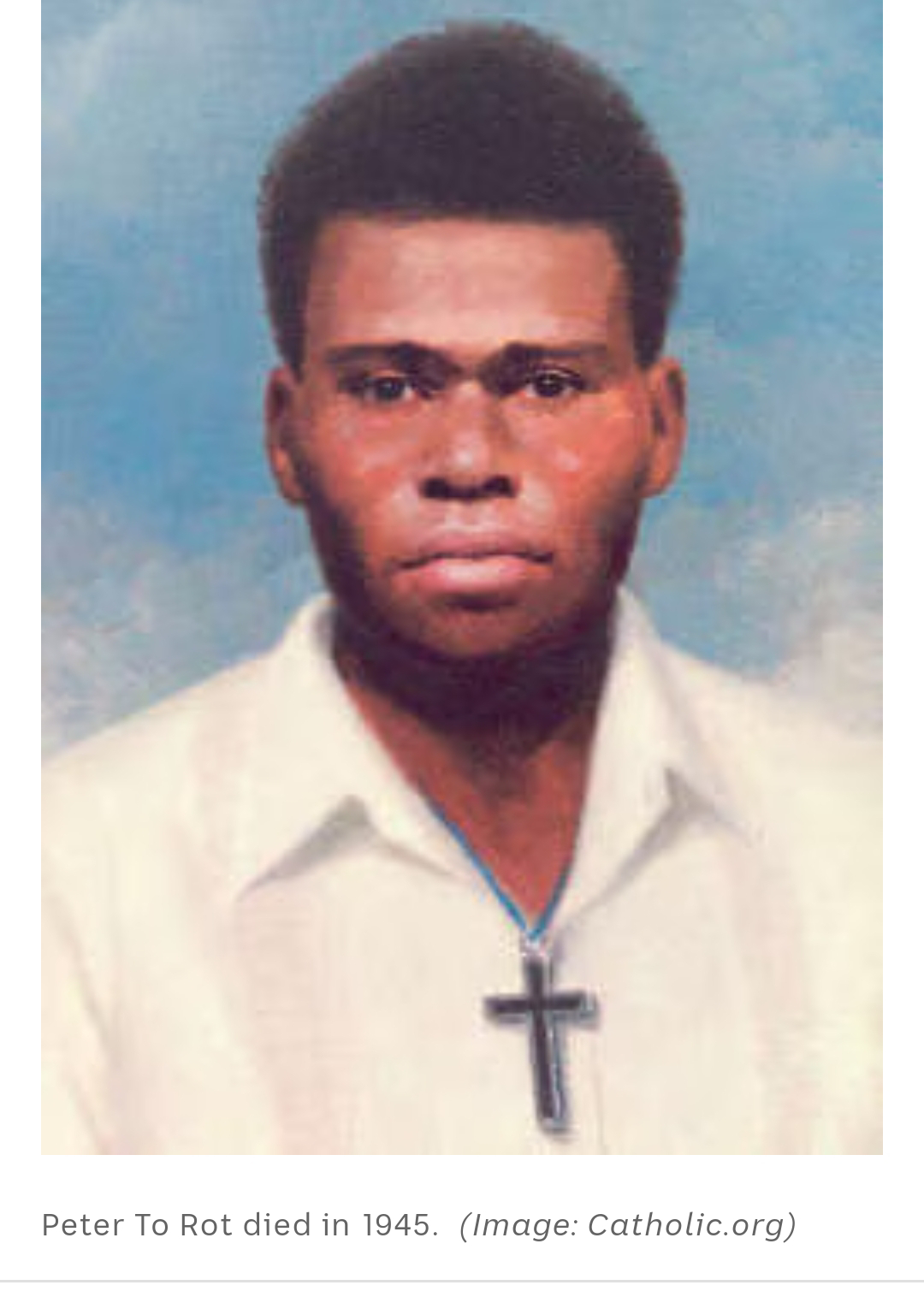
The last visit of a Pope to Papua New Guinea was John Paul II in 1995, who celebrated the beatification of Peter To Rot — the first PNG man to be raised to beatification, the step before sainthood. 

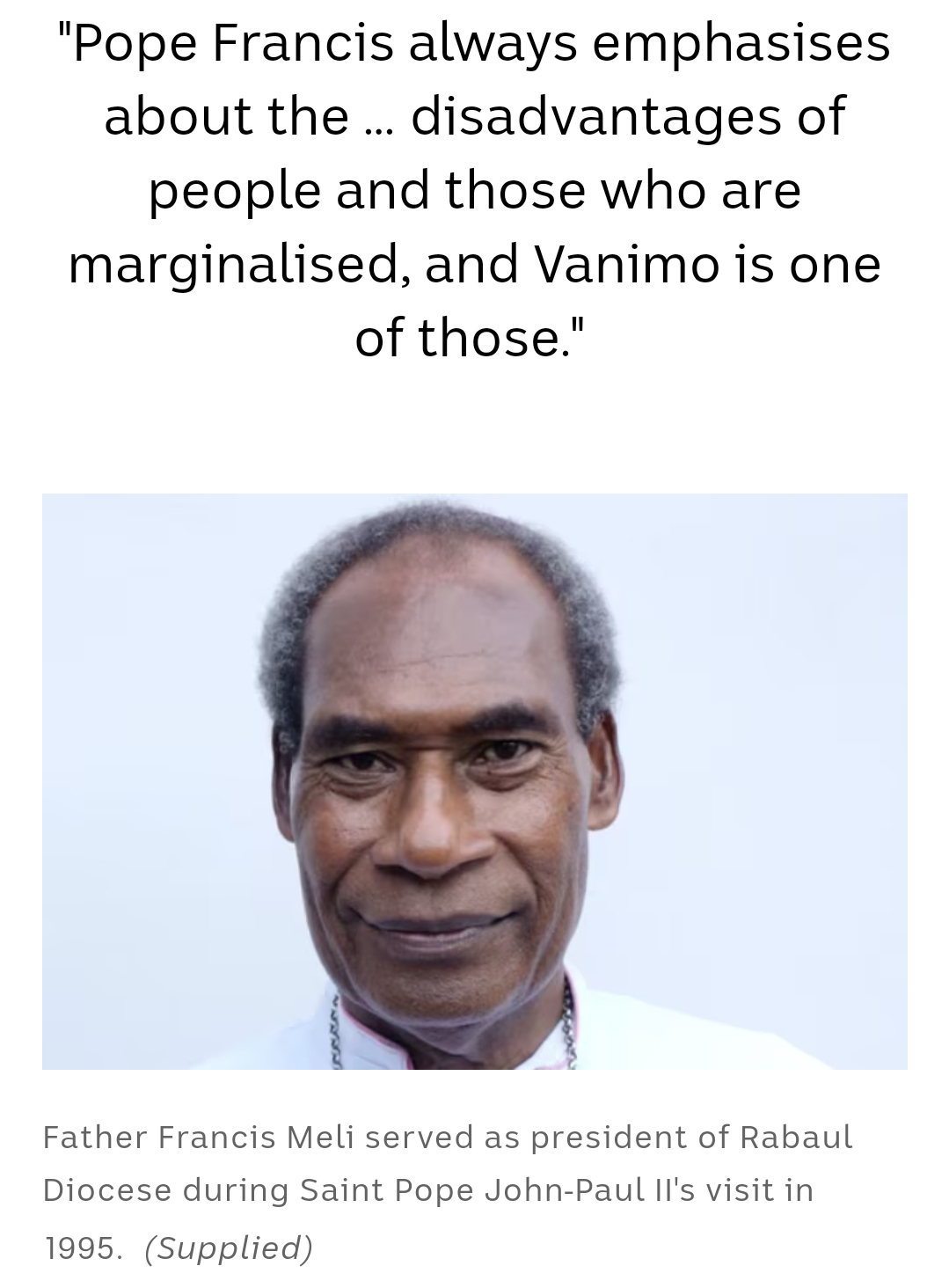
Father Francis Meli, the Bishop of the Diocese of Vanimo, was also there.  

"I was able to consecrate that mass of the beatification of Blessed Peter To Rot," he told Pacific Soul.

Who was Peter To Rot?
Peter To Rot was a Catholic catechist from Rakunai village in the East New Britain Province.
Son of a village chief, Angelo To Puia, To Rot was entrusted with the Rukunai parish during World War II. 

He became a martyr when he was killed by the Japanese while in prison during the war. 

Many Catholics have anticipated the late catechist’s canonisation to full Sainthood since Pope John Paul's visit.

"If he is going to be a Saint, he will be the first person from PNG," To Rot's niece Angie Kolita-Payne told Pacific Soul. 

She described him as "a simple man in the village" and a "gentle person, dedicated to the Catholic faith".

"He died being so dedicated to his faith, and died a martyr for what he believed in," she said. 

"Death didn't scare him. And he ... stayed true to the very end. It's not just for Rakunai village, but the whole of PNG. He's a man that died for his faith."

So where is it in the process? 
In May this year, a Cardinal mentioned the possibility of canonising Blessed Peter To Rot during the Pope's PNG visit.

The canonisation is the final step in declaring a deceased person a saint.

But there's a bit of a process when it comes to being considered for sainthood, and it's still not quite there.

In July, Rabaul Archbishop Rochus Tatamai sent a letter to the people, explaining the need for proof of miracles attributed to Blessed Peter To Rot.

In it, he said the saint process was in "the final stage of the cause".

But to complete the process, it's necessary to prepare a series of documents for Rome, including a "long list of favours and graces received through the intercession of Blessed Peter To Rot".

"At this moment, there are three people working on this: two in Rome, and one here, in Papua New Guinea," he wrote.

"Without this, it is impossible for Peter To Rot to be canonised … It is not enough to tell the story orally; it must be put in writing."

What brings the Pope to Vanimo?

Vanimo is a small logging town on PNG's coast, 1,000 kilometres from Port Moresby, and sits close to the Indonesian border. 

Pope Francis will travel to Vanimo on Sunday, September 8. There, he has a private meeting with a group of missionaries from the Holy Trinity Humanities School in Baro that afternoon.

Pope Francis always emphasises about the … disadvantages of people and those who are marginalised, and Vanimo is one of those." 

The Pope's four days in PNG

The Pope's itinerary includes:


Friday, September 6: Pope Francis will arrive and stay at the Vatican Embassy in PNG.

Saturday, September 7: He will visit the Governor General of PNG and meet with state leaders at APEC Haus. Along with a meeting with the bishops of Papua New Guinea and Solomon Islands in the Shrine of Mary Help of Christians.

Sunday, September 8: Morning, Holy mass in the Sir John Guise Stadium. Afternoon: The Pope will travel to Vanimo, and return to Port Moresby that evening.

Monday, September 9: Meet with young people in the Sir John Guise Stadium. Farewell ceremony at 11:10am at Port Moresby Jacksons International Airport.


KRAMER QUITS MARAPE LED GOVERNMENT 1 September 2024

Press Release by the office of Madang Open Member of Parliament, Honourable Bryan Kramer.

RESIGNATION FROM MARAPE-ROSSO GOVERNMENT

1 September 2024, Today, I am announcing my resignation as a member of the Marape-Rosso Coalition government. I extend my sincere thanks to Prime Minister Hon. James Marape and Deputy Prime Minister Hon. John Rosso for the opportunity to serve and contribute to our nation under their leadership.

This decision was not made lightly. My initial support for Hon. James Marape in 2019 was based solely on his being a man of strong Christian faith. However, upon careful reflection and in light of the current state of affairs in our country, I have made the decision to resign with a heavy heart but a clear conscience. Having returned to the office after two years, I have witnessed first hand the pressing challenges our nation faces.

During my time in government, I held various ministerial portfolios under the Marape-Steven, Marape-Basil, and now Marape-Rosso Government: Minister for Police (June 2019 to December 2020), Minister for Justice & Attorney General (December 2020 to April 2022), and Minister for Immigration & Labour (April 2022 to September 2022).These roles provided me with invaluable insights into the inner workings of the National Executive Council (NEC) and the broader government machinery. Through this experience, I gained a deep understanding and appreciation of our young nation's challenges, as well as the opportunities available to steer the nation in the right direction.

Transparency and good governance must be the cornerstones of our efforts to rebuild our nation, which necessitates a firm stand against corruption. However, in my view, after 49 years of independence, corruption has become so deeply entrenched in our government machinery, to the point where it has been normalised.

I spent most of my time in the NEC fighting to block countless harmful submissions that were being pushed on the Prime Minister, who could not risk losing coalition numbers in cabinet. I firmly believe that it was these very factions that orchestrated my being moved from ministry to ministry and ultimately excluded me from the cabinet.

Regrettably, since my dismissal, the opportunity to fight bad decisions from within the government has been lost, enabling the widespread misuse of public funds with impunity. This has increasingly placed our nation at risk, contributing to our current state of affairs.

I firmly believe that everyone, especially our Prime Minister and my fellow Members of Parliament, can still do the right thing by putting our people’s interests first, as we are duty-bound to do. If we continue to allow the systematic degradation of our people's well-being, our nation’s finances, and overall welfare, there will be no future for our country. Our faith should compel us to do what is right, not merely to survive politically.

I entered politics to fight corruption and to ensure that all Papua New Guineans have access to the services we, as Members of Parliament, are mandated to provide. My mission has been to combat and stop corrupt practices that rob our people and businesses of their hard-earned contributions and, most importantly, to protect the future of our nation's children. I will continue this fight from outside the government with integrity, as expected by the people of Madang who voted for me and the people of Papua New Guinea who placed their trust in me.

Consequently, I no longer have confidence in the leadership of Hon. James Marape to lead as Prime Minister.

KRAMER QUITS MARAPE LED GOVERNMENT 1 September 2024

Press Release by the office of Madang Open Member of Parliament, Honourable Bryan Kramer.

RESIGNATION FROM MARAPE-ROSSO GOVERNMENT

1 September 2024, Today, I am announcing my resignation as a member of the Marape-Rosso Coalition government. I extend my sincere thanks to Prime Minister Hon. James Marape and Deputy Prime Minister Hon. John Rosso for the opportunity to serve and contribute to our nation under their leadership.

This decision was not made lightly. My initial support for Hon. James Marape in 2019 was based solely on his being a man of strong Christian faith. However, upon careful reflection and in light of the current state of affairs in our country, I have made the decision to resign with a heavy heart but a clear conscience. Having returned to the office after two years, I have witnessed first hand the pressing challenges our nation faces.

During my time in government, I held various ministerial portfolios under the Marape-Steven, Marape-Basil, and now Marape-Rosso Government: Minister for Police (June 2019 to December 2020), Minister for Justice & Attorney General (December 2020 to April 2022), and Minister for Immigration & Labour (April 2022 to September 2022).These roles provided me with invaluable insights into the inner workings of the National Executive Council (NEC) and the broader government machinery. Through this experience, I gained a deep understanding and appreciation of our young nation's challenges, as well as the opportunities available to steer the nation in the right direction.

Transparency and good governance must be the cornerstones of our efforts to rebuild our nation, which necessitates a firm stand against corruption. However, in my view, after 49 years of independence, corruption has become so deeply entrenched in our government machinery, to the point where it has been normalised.

I spent most of my time in the NEC fighting to block countless harmful submissions that were being pushed on the Prime Minister, who could not risk losing coalition numbers in cabinet. I firmly believe that it was these very factions that orchestrated my being moved from ministry to ministry and ultimately excluded me from the cabinet.

Regrettably, since my dismissal, the opportunity to fight bad decisions from within the government has been lost, enabling the widespread misuse of public funds with impunity. This has increasingly placed our nation at risk, contributing to our current state of affairs.

I firmly believe that everyone, especially our Prime Minister and my fellow Members of Parliament, can still do the right thing by putting our people’s interests first, as we are duty-bound to do. If we continue to allow the systematic degradation of our people's well-being, our nation’s finances, and overall welfare, there will be no future for our country. Our faith should compel us to do what is right, not merely to survive politically.

I entered politics to fight corruption and to ensure that all Papua New Guineans have access to the services we, as Members of Parliament, are mandated to provide. My mission has been to combat and stop corrupt practices that rob our people and businesses of their hard-earned contributions and, most importantly, to protect the future of our nation's children. I will continue this fight from outside the government with integrity, as expected by the people of Madang who voted for me and the people of Papua New Guinea who placed their trust in me.

Consequently, I no longer have confidence in the leadership of Hon. James Marape to lead as Prime Minister.

Creditor Claims Government Involved in Air Vanuatu's Liquidation

Charles Perry, a former pilot and creditor of Air Vanuatu, has raised serious concerns about the recent developments surrounding the liquidation of the national airline.

Perry’s statement criticises what he describes as a “morally bankrupt” strategy employed by the government and the liquidators, which he believes could lead to major legal repercussions.

On July 18, Perry noted, Ernst & Young (EY), the firm overseeing the liquidation process, incorporated a new company under the name “Air Vanuatu.” Andrew Hanson, one of the liquidators, is allegedly the director of this newly formed entity. Perry argues that this move is part of a scheme to transfer ownership of Air Vanuatu Operations Limited (AVOL) while leaving creditors and employees unpaid.

“Well, it allows the government to do what is called a phoenix—morally bankrupt and potentially illegal,” Perry stated. He criticised the liquidators for creating the new Air Vanuatu company, alleging their intent to strip the original airline of its liabilities and debts, despite a government-issued written assurance guaranteeing payment of all liabilities.

“This written assurance allowed them to continue operating AVOL as a ‘going concern’ despite its insolvency, as per the iCount audit reports,” Perry continued. “The ‘new’ Air Vanuatu domestic operation will arise, phoenix-like, from the ashes of the old—debt-free.”

Perry also expressed frustration over the lack of transparency during the creditors’ meeting. He mentioned that when he and other creditors questioned EY about the audit reports and the government’s written assurance, the liquidators “seemed most uncomfortable and essentially fobbed us off with non-answers.”

The most recent development in this ongoing saga is the approval of a deed of compromise, which passed with a vote of 306 to 18. The dissenters included all the Boeing pilots and a handful of local businesspeople and creditors. Perry disclosed that one of the opposing creditors, a well-known figure in Vanuatu, contacted him after the meeting. Another was a tourist who reached out before the meeting to express gratitude for the coverage provided by the Daily Post.

Perry cautioned that the government’s actions could result in “a tidal wave of lawsuits” as affected parties seek legal recourse for what they perceive as an unfair and potentially illegal process.

Some government officials have been contacted for comments but have yet to respond.

doddy@dailypost.vu

Facebook
Twitter
WhatsApp

MSG LEADERS CONVERGED FOR CAUCUS MEETING AHEAD OF 53rd PIFLM

PORT VILA, VANUATU (2 September 2024): The Melanesian Spearhead Group (MSG) Leaders' Caucus was successfully convened in Nukua’Alofa, Tonga, within the margins of the 53rd Pacific Islands Forum Leaders Meeting to develop joint positions on issues of specific relevance and of particular concern to the Group.

In his opening remarks, the MSG Chair and Prime Minister of Vanuatu, Hon. Charlot Salwai Tabimasmas, welcomed and thanked his colleague MSG Leaders for availing themselves to participate in the Caucus. 

He emphasised that side meetings as such, on the margins of the PIF meetings, provide valuable opportunities to discuss issues of specific interest to the MSG Group, enabling the development of common approaches and positions to take to the PIF. 

“Collectively we can prosecute and advance our interests and issues more effectively when we are seated at the PIF table. As we are all aware, PIF is made up of diverse groups of members whose views on issues, that we want to push, are often not the same as ours. Together we are stronger,” he stated. 

Referring to the caucus agenda, the Chair said that while many issues will be brought up for discussions at the PIF, some of them are specific to the MSG alone, like New Caledonia for instance, a foundational issue for the MSG. 

“No other grouping in the PIF has invested so much time, effort and resources on this issue than the MSG. MSG must continue to be in the driver’s seat on this issue as the effected indigenous people, the non-self-governing peoples of that non-self-governing territory are the KANAKS, and they are members of the MSG,” he stated. 

“The Ocean of Peace is an initiative of one of our members, Fiji, and we need to ensure that we all collectively support it at the PIF. The Ocean of Peace concept builds on the Efate Declaration on Mutual Respect, Responsibility, Cooperation, and Amity (The Efate Declaration on Security) that we signed on 24 August 2023. In many respects, the Udaune Declaration on Climate Change that we adopted last year also complements the broad concept captured in the Ocean of Peace initiative,” the Chair commented. 

On the Pacific Policing Initiative (PPI), the Chair said that while it is another important initiative that is going to be discussed at the PIF meetings, this collective approach to policing is ironically not a new concept to the MSG. 

“We have been pushing for self-help collective policing agreement/arrangements for a long time. Our 2016 MSG Security Strategy contains this, our 2013 MOA to Enhance Police Cooperation calls for this and the 2015 Framework Agreement for the MSG Formed Police Unit tries to operationalize the idea of collective approach to policing. 

“I make these points to remind us that we need to make sure that this PPI is framed to fit our purposes and not developed to suit the geo-strategic interests and geo-strategic denial security postures of our big partners,” he said.

As well, the Chair reiterated the importance of the welfare of the interests of Melanesians in West Papua and the other Papuan Provinces in Indonesia, as an ongoing concern for the peoples of the region. 

“In this regard, the MSG Leaders Dialogue with the President of Indonesia is a project of great importance that must be pursued,” he added. 

The Director General of the MSG Secretariat, Leonard Louma, in his introductory remarks provided further clarification on the agenda items including highlighting some of the salient features and background on the issues.  

Given the time constraints, the MSG Chair sought the understanding of the Leaders to amend the provisional agenda so more focus could be spent on the New Caledonia issue, which would entail more time to be given to the FLNKS to provide a comprehensive brief on the New Caledonia dossier to the MSG Leaders.  

The Chair suggested that other issues on the provisional agenda could be dealt with in more detail in the next MSG Leaders’ Summit proper.

ONLY IN BOUGAINVILLE: Top Six (6) things you’ll find only in AROB

Bougainvilleans are not only hardworking people but are also most lovely and creative people on the planet. If you have never visited the pearl of the Pacific, you would not know until you do. Here are some unique things you might want to know about this special breed of people and their emerging nation. 

1. Luxury Vehicles; Land Cruzer, Ten Seaters, and Five Doors are used as Public Motor Vehicle. Trust me, it will give you the most timely and comfortable ride. 

2. There is no PNG Power in the villages, but people do not know blackout like we do in Port Moresby. They have 24/7 sustainable electricity that is built by village electrical engineers who never attended any engineering school. 

3. The vehicles that were used in the 1980s are still running in towns like Arawa. That means they have some top mechanics in the world who never went to any mechanical nor engineering school. 

4. All the businesses are owned by the locals, as said in detail in the earlier post. 

5. There are no thieves and pickpockets in their towns. Girls and women roam free whole day and night confidently even in front of drunkards. People mind their own business. 

6. Although they have the biggest and surplus betelnut in the S/Pacific, their towns are very clean. Even cleaner than Alotau (I’ve been there).

-If you have some apart from the six listed, do kindly add in the comment section below.-

Finally, this land of the brave and free is truly the land of Land Cruizers. What you see in the image is not an Ela Motors Dealership nor PNG Parliament Hause car park neither BSP Car park. It's Awara town in the central AROB. 
 
Post By Marshall’s Views
📸 BIM