Search This Blog

Total Pageviews

Advertisement

Labels

Blog Archive

FIJI AND PNG TAKE STEPS TO STRENGTHEN DIPLOMATIC PRESENCE

Fiji has been offered a 99-year land lease in the Central Business District in Port Moresby for the construction of its chancery  in Papua New Guinea (PNG).

This was revealed by the PNG Prime Minister Hon. James Marape during a bilateral meeting with Prime Minister Hon. Sitiveni Rabuka today.

The Fiji Government will also reciprocate through making land available in Suva for the construction of the PNG chancery.

The establishment of the Fiji-PNG Missions will not only strengthen traditional ties and people-to-people links but also socio-economic development between the two countries.

Prime Minister Rabuka reaffirmed Fiji’s commitment in working together with PNG and to further improve and strengthen our bilateral relations.

He said both the countries "are united in our resolve to build a more prosperous and resilient Pacific region".

The leaders also discussed prospects for more collaboration on higher education, security cooperation, agriculture, climate change, trade and investment and promoting regional solidarity.

On the upcoming 3rd Forum for India-Pacific Islands Cooperation (FIPIC), Prime Minister Rabuka commended India and PNG for their timely collaboration in bringing together the Pacific leaders to further discussion and dialogue on matters affecting the region as a whole.  

In response, Prime Minister Marape welcomed Prime Minister Rabuka for his first official visit to PNG which demonstrated the significance of our diplomatic relations.

He further reiterated that the discussions would certainly build stronger cooperation between the two nations in the face of the current geo-political environment. 

Hon.Marape also announced at the meeting that Fiji will now be able to obtain visa on arrival while travelling to PNG.
Prime Minister Marape, at the same time, expressed his heartfelt appreciation to Prime Minister Rabuka for his commitment to regional solidarity. 

Hon.Rabuka is expected to meet 
with the Fijian community in PNG tomorrow.

#Fiji #FijiGovernment #governmentnews #Fiji2023 #TeamFiji

PORT MORESBY SHINES AS GATEWAY TO PNG AND REGION: HOSTING WORLD LEADERS WITH PRIDE!

#PNGSUNnews: #AmazingPortMoresby is thrilled to host world leaders arriving for the Forum for India-Pacific Islands Cooperation and the US-Pacific meetings, reaffirming its position as the gateway to Papua New Guinea and the region.

 Building on the success of the 2018 APEC Leaders' Summit, the city has become a dynamic hub for global events.

NCD Governor, Powes Parkop and City Manager, Mr Ravu Frank, are leaving no stone unturned to ensure the city is ready. Roads are being fixed, the city is being spruced up, and cultural activities are being organized to showcase our diverse culture.

Governor Parkop stressed the importance of showing respect and good behaviour to the visiting leaders. With the global spotlight on Port Moresby and the entire country, this is a valuable opportunity to showcase the best of our nation to the world.

With 13 leaders arriving, including the Fijian Prime Minister and India's Modi, this historic visit will garner international attention. President Biden has reportedly cancelled his visit to PNG and Australia.

 Governor Parkop emphasized the need to seize this window of opportunity and actively engage city residents, including students, in extending a warm welcome to the leaders.

Let's embrace this moment with immense pride as Port Moresby shines brightly, putting Papua New Guinea on the global map!

Concern in Indonesia over illegal arms supply to Papuan rebels

There were 27 cases of buying and selling of weapons and ammunition by members of the military to rebel groups, says army chief 

The Commander-in-Chief of the Indonesian National Army, Admiral Yudo Margono (middle) said there had been 27 cases of buying and selling weapons and ammunition in 2022 by members of the military to Papuan rebels. (Photo: Indonesian National Army)

There were 27 cases of buying and selling of weapons and ammunition by members of the military to rebel groups, says army chief

Concern in Indonesia over illegal arms supply to Papuan rebels

There were 27 cases of buying and selling of weapons and ammunition by members of the military to rebel groups, says army chief

Concern in Indonesia over illegal arms supply to Papuan rebels

The Commander-in-Chief of the Indonesian National Army, Admiral Yudo Margono (middle) said there had been 27 cases of buying and selling weapons and ammunition in 2022 by members of the military to Papuan rebels. (Photo: Indonesian National Army)


UCA News reporter

Published: May 16, 2023 11:15 AM GMT

An Indonesian Catholic lawmaker has called on the army chief to explain the alleged sales of arms and ammunition to rebel groups by military forces in the restive Christian-majority Papua region.  

"This matter is very serious and we in parliament certainly want to hear a full explanation from the Commander of the Indonesian Armed Forces," said Christina Aryani, a lawmaker on the parliamentary commission related to defense, foreign affairs, communications, informatics, and intelligence.

During a media briefing on May 16, Aryani said the case of arms sales to rebels deserves attention so that effective prevention and action steps could be taken immediately.8

More universal than Catholicism?

Mary among Asian religions

She responded after military chief Admiral Yudo Margono made public a report on May 6 that says there had been 27 cases of buying and selling of weapons and ammunition in 2022 by members of the military to Papuan rebels, a drastic increase from one case reported in 2021.


"We appreciate the openness from the military on this matter which certainly makes it easier to stop this practice immediately," Aryani said, adding that she wants to discuss the issue in detail to find out patterns, actors, and locations of such practices.


"We don't want this very crucial matter to go away without a clear resolution," she said.


She stated that this kind of practice is "very inhumane because it is the same as giving way to killing fellow soldiers and terrorizing civilians."

Jones Douw, a Papua-based human rights activist and chairman of the Justice and Peace Department at Kingmi Church told UCA News that this is not a new problem but has been going on for a long time, both individually and in groups.

"It's just a shame that it really isn't being taken seriously. Even though this is an embarrassing matter that should be a serious record for the Indonesian government," he said.

Jones cited several previous cases, including three soldiers who were fired and jailed for life in February 2020 for selling weapons and thousands of rounds of ammunition to pro-independence groups and another case on March 12, 2020, where a soldier was also jailed for life for selling firearms and 1,300 ammunition.

"When things like this recur, it's hard not to say that the conflict in Papua is sort of being allowed to," he said.

"On the one hand, the Indonesian apparatus has always claimed to be carrying out various forms of operations to crush pro-independence groups, but is instead arming them," he said.

Made Supriatma, a research fellow at the Institute of Southeast Asian Studies in Singapore who specializes in Indonesian security and military issues, said that this practice continues because of economic factors.

Soldiers or police "want to take risks because the economic value is large," he said.

"One SS-21 gun costs 250 million rupiah (US$ 16,866) and the guerrillas are more than willing to get it," said.

In a July 2022 report entitled Escalating Armed Conflict and a New Security Approach in Papua, the Institute for Policy Analysis of Conflict (IPAC) stated that the West Papua National Liberation Army (TPN-PB), labeled as an armed criminal group by the Indonesian government, is one of the rebel groups that received an increasing number of manufactured firearms.

The report stated that the TPN-PB is estimated to have 400-450 manufactured firearms of various types, from SS-1, M4, and M16, obtained by seizing or buying them from the military and police.

TPNPB gets money to buy weapons in various ways, ranging from ransoms for hostages, extorting local business owners, donations from sympathizers, and misappropriation of village funds provided by the government, it stated.


Papua declared independence in 1961 after the Dutch colonial rule ended. However, Indonesia annexed the territory within two years, promising to have an independence referendum. The subsequent voting in favor of staying as part of Indonesia was widely considered a sham.

Indonesia’s occupation of Papua triggered an armed struggle for independence. The government responded with a heavy military presence to suppress the insurgency. The conflict left thousands dead and tens of thousands displaced.

Currently, about 16,900 military soldiers with combat skills are stationed in Papua, according to the advocacy group, Imparsial.

Last month, the military beefed up combat operations in the region following the killings of five soldiers by the TPN-PB. The soldiers were killed during the efforts to free New Zealand pilot Phillip Mehrtens, who has been held hostage since February.

Papua rebels ambush Indonesian troops looking for kidnapped pilot

Armed separatists say they attacked soldiers as army was searching for a captured New Zealand pilot

Papua rebels ambush Indonesian troops looking for kidnapped pilot

Armed separatists say they attacked soldiers as army was searching for a captured New Zealand pilot.

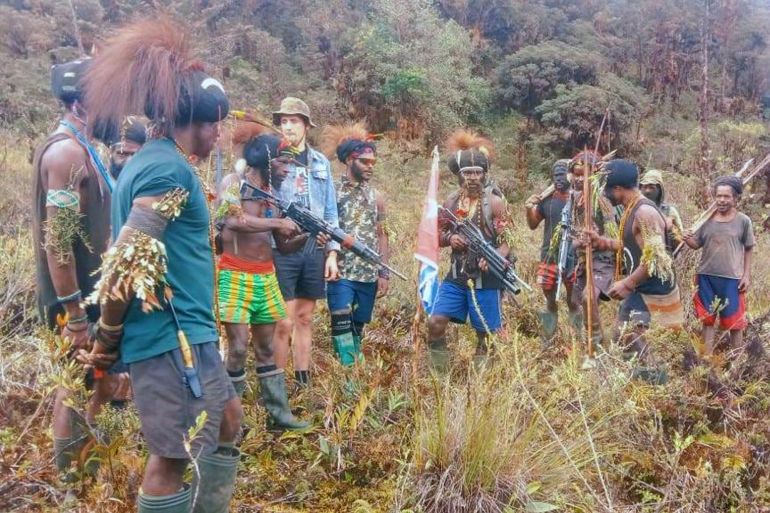
In this undated photo released by West Papua Liberation Army, the armed wing of the Free Papua Movement, Papuan separatist rebels pose for a photo with a man they said is New Zealander pilot Phillip Mark Mehrtens, third right, who they took hostage last week, at an undisclosed location in Papua province, Indonesia. Mehrtens, a pilot for Indonesian aviation company Susi Air, was abducted by the independence fighters who stormed his single-engine plane shortly after it landed on a small runway in Paro in remote Nduga district. (West Papua Liberation Army via AP)
In this undated photo released by the West Papua National Liberation Army, the armed wing of the Free Papua Movement, Papuan separatist rebels are shown with a man they said is New Zealand pilot Phillip Mehrtens, third from right [File: West Papua National Liberation Army via AP]

Separatists in Indonesia’s Papua region say they have killed nine soldiers in an ambush, but the military says one soldier was killed during search operations to find a kidnapped New Zealand pilot.

Indonesian military spokesman Julius Widjojono said on Sunday that soldiers were dispersed to several sites in the search for captured Susi Air pilot Phillip Mehrtens and they were having communication difficulties due to bad weather.

Mehrtens was kidnapped by the rebels at an airport in the remote Nduga district in February.

“As of 2:03pm local time [05:03 GMT Sunday], the information we have is one died,” Widjojono said when asked about the higher casualty numbers. “We have not received any other information because it is difficult to reach the area, especially with the uncertain weather.”

Widjojono said the military will intensify the operation to rescue Mehrtens because they have identified the pilot’s location.

Erratic weather has made the effort challenging, he said.

The West Papua National Liberation Army, the military wing of Papua’s main separatist group, claimed responsibility for an attack on Saturday that they said killed nine soldiers.

The rebels had previously demanded that Indonesia recognise Papuan independence in return for the pilot’s release as well as a meeting with President Joko Widodo facilitated by the international community.

The separatists said Saturday’s attack was an act of defence against military activity in the region and demanded the government instead negotiate for Mehrtens’ release.

“The United Nations and the New Zealand government have an obligation to push Indonesia to stop the military operation,” rebel spokesman Sebby Sambom said on Sunday.

Flying is the only way to reach mountainous areas in Papua, where rebel attacks have risen in recent years.

Papua’s Melanesian population shares few cultural connections with the rest of Indonesia, and the military has long been accused of human rights abuses there.

A former Dutch colony, Papua declared itself independent in 1961, but neighbouring Indonesia took control two years later, promising an independence referendum.

The subsequent vote in favour of staying part of Indonesia was widely considered a sham.

The UK House of Lords Parliamentary Debate: West Papua: UN Access


Question 14:48:00, Source HERE


Asked by

Lord Harries of Pentregarth

To ask His Majesty’s Government what progress has been made in obtaining access to West Papua for the United Nations’ High Commissioner for Human Rights.

The Minister of State, Foreign, Commonwealth and Development Office (Lord Ahmad of Wimbledon) (Con)

My Lords, the United Kingdom welcomes recent engagement between Indonesia and the UN, as part of Indonesia’s universal periodic review in November 2022. We continue to support a visit by the United Nations High Commissioner for Human Rights to the region of Papua. We recognise that a significant amount of time has passed since the visit was first proposed, but we hope that both parties can come together to agree dates very soon.


Lord Harries of Pentregarth (CB)

I thank the Minister for his Answer. He mentioned the universal periodic review of Indonesia. He will know that, at that review, a number of major countries, including the United States, Australia and Canada, called for an intervention from the UN in Indonesia and an immediate visit by the UN High Commissioner for Human Rights. It is not at all clear that the United Kingdom was among those supporting that call. Perhaps the Minister will be able to enlighten us.


Lord Ahmad of Wimbledon (Con)

I hope the Answer I have given in the House today reassures the noble and right reverend Lord that we support an early visit. I am cognisant that this visit was first proposed under High Commissioner Zeid, who has since been succeeded by High Commissioner Bachelet and subsequently by High Commissioner Türk. The visit has been pending for a long time, and it is important that it takes place at the earliest opportunity.


Lord Lexden (Con)

Is it not clear that this small country is suffering grievously under a colonial oppressor, Indonesia, which is busily exploiting the country’s rich mineral resources and extensive forests in its own interests? Will the Government do all in their power, in conjunction with Commonwealth partners in the region, to get the UN to act and to act decisively?


Lord Ahmad of Wimbledon (Con)

My Lords, what is important is that we highlight the human rights issues as they arise, as we do with key partners. Ultimately, I agree with my noble friend that we need the UN, and the next step is very much for the high commissioner to undertake this important visit.


Lord Kennedy of Southwark (Lab Co-op)

My Lords, it is over a year since the UN special rapporteur’s allegations of extrajudicial killings, enforced disappearances, and the forced displacement of thousands of indigenous Papuans. Have the Minister, his ministerial colleagues or our ambassador in Jakarta made representations to their Indonesian counterparts about the contents of the report?


Lord Ahmad of Wimbledon (Con)

My Lords, I assure the noble Lord that we engage with them quite regularly. We recently had a visit from our team on the ground in Papua. We use our bilateral engagement, which is very strong with the Indonesian Government, to raise issues, including the situation in Papua and a broader range of human rights issues.


Lord Hannay of Chiswick (CB)

My Lords, could the Minister go a little further to explain why the UK does not seem to have been part of that group of eight countries that pressed for an early visit by the High Commissioner for Human Rights? It is surely reasonable to ask a democratic country such as Indonesia to admit the high commissioner to look into abuses of human rights. That is what it should do, and I hope that we will press that strongly.


Lord Ahmad of Wimbledon (Con)

My Lords, that is exactly what we are doing. As I indicated in one of my earlier responses, the visit was first proposed in 2018; I remember having a conversation about it with the then High Commissioner for Human Rights. It is important that such a visit goes ahead, and I assure the noble Lord of our full support for it.


Lord Purvis of Tweed (LD)

My Lords, human rights concerns were rightly highlighted by the Foreign, Commonwealth and Development Office’s human rights report published last autumn for 2021. It made a specific point of highlighting the UK Government’s policy of seeking equitable and fair development within Papua and West Papua. However, in the Government’s strategic partnership road map for Indonesia published last year, there is reference only to terrorism in Papua and no reference to any equitable development or to human rights. What is the point of the Foreign Office highlighting human rights concerns if it does nothing about them in its negotiations with the country in question?


Lord Ahmad of Wimbledon (Con)

My Lords, the noble Lord understates the importance of the human rights report, which I am very proud that the Foreign, Commonwealth and Development Office continues to produce. It is focused not just on those countries with the worst records when it comes to human rights. Importantly, a condition in that report is where we can bring influence. As I said earlier, Indonesia is an important bilateral and regional partner with which we engage widely on a range of issues of peace, conflict and stability in and across the region; it is a key partner. In all our meetings, we raise human rights in the broad range of issues, and we are seeing some progress in Indonesia, including on freedom of religion or belief.


Oscar Temaru's Tavini Huiraatira party wins round one of French Polynesia's territorial elections

For the first time, the Tavini came first in several large towns in Tahiti and dominated in Moorea. Photo: Tahiti Infos / Antoine Samoyeau

French Polynesia's pro-independence Tavini Huiraatira party has come out on top in the first round of the territorial elections.

The party led by Oscar Temaru won almost 35 percent of the votes, beating the ruling Tapura Huiraatira party of Edouard Fritch, which obtained 30 percent.

The recently formed A Here Ia Porinetia was the only other party to clear the 12.5 percent threshold to make it to the run-off round in two weeks.

The other four lists are eliminated, including Amuitahiraa O Te Nunaa Maohi, which is the renamed Tahoeraa Huiraatira party founded by the veteran politician Gaston Flosse.

For the first time, the Tavini came first in several large towns in Tahiti and dominated in Moorea.

With 35 percent of the votes, it substantially improved its first-round result from the elections in 2018 when it won 20 percent.

The results show a sharp drop in support for the Tapura, which in the first round in 2018 won 43 percent of the votes.

The Tahoeraa, which then won 29 percent, plummeted to less than 12 percent and will no longer be in the assembly.

The party had dominated French Polynesian politics for decades but was gradually weakened by internal rifts after Flosse was forced to relinquish power over corruption convictions in 2014.

Expulsions and defections led to the formation of a slew of new parties, most notably the Tapura.

Observers said the Tavini gains this year could in part be attributed to its campaign to repeal a recently adopted additional tax.

They also said there was displeasure with the government's response to the pandemic.

Last year, Fritch and the former vice-president Tearii Alpha were both been fined for flouting Covid-19 rules they put in place.

Alpha, who was the vice-president at the time, invited 300 people, including all cabinet members, to his wedding at the height of restrictions.

The leaders' inconsistency prompted the resignation of the tourism minister Nicole Bouteau who formed a new party together with a former vice-president Teva Rohfritsch.

While they failed to get their party to the second round, another former vice-president Nuihau Laurey led the A Here Ia Porinetia to win enough votes to contest the runoff round.

In a reaction on election night, Fritch said he still believed most voters preferred autonomy over independence.

Also on election night, Tavini's Tematai Le Gayic said the territorial elections were not to be viewed as some sort of independence referendum.

Observers said Tavini might get the support of those who voted for eliminated parties opposed to Tapura and retake power.

In what was a surprise last year, the Tavini candidates beat the Tapura candidates to win all three of French Polynesia's seats in the French National Assembly.

Fritch described that outcome as catastrophic, given the dominance of the Tapura in the territorial assembly.

A Here Ia Porinetia also hopes to get support from voters of the eliminated lists.

Laurey and party founder Nicole Sanquer have been campaigning for a renewal of the territory's leadership.

The party proposed a maximum of two terms for elected officials to prevent people entering office for life.

In the second round, on April 30, the list winning most votes will get a third of all seats as a bonus, which assures it securing an absolute majority.

The remaining two thirds of the seats will then be distributed according to the lists' relative strength.

The system was reintroduced by France in 2011 after nearly a decade of political instability.

In 2018, the Tapura won less than half of the votes but because of the bonus clause it obtained two thirds of the 57 seats.

While Fritch has said he will seek re-election as president in May, Tavini's Oscar Temaru will not contest the top job despite heading the Tavini list.

The party has said it will nominate as its candidate Moetai Brotherson, who is a member of both the French Polynesian Assembly and the French National Assembly.

avini Huiraatira party's Oscar Temaru will not contest the top job despite heading the Tavini list Photo: RNZ / Johnny Blades

Lukas Enembe Becomes A Suspect In Alleged Money Laundering

 JAKARTA - The Corruption Eradication Commission (KPK) has named the inactive Papua Governor Lukas Enembe as a suspect in the alleged money laundering crime (TPPU). This determination is the development of the bribery and gratification case that ensnared him.


"The investigative team then developed further and found other alleged criminal acts so that currently the KPK has again named LE as a suspect in the alleged money laundering offense," said Head of the KPK News Section Ali Fikri to reporters, Wednesday, April 12.

Furthermore, investigators are still pursuing Lukas' assets which are allegedly obtained from the practice of bribery and gratification. Ali said the anti-corruption commission hopes that the application of this money laundering crime article can have a deterrent effect.

Not only that, the application of this article is also expected to optimally return state losses. "Other developments will be presented at the next opportunity," he said.

As previously reported, Lukas Enembe has been named a suspect in bribery and gratification. He is currently being held at the KPK detention center.

The KPK revealed that the receipt of bribes allegedly came from the Director of PT Tabi Bangun Papua, Rijatono Lakka. Meanwhile, gratification is allegedly given by other private parties in order to get projects in Papua.

In an effort to investigate the case that ensnared Lukas, about 90 witnesses were examined. They consist of various elements including digital forensics, forensic accounting experts, and health experts.

It did not stop there, the KPK had also confiscated around Rp50.7 billion in cash; gold bullion, a ring of precious stones, and four cars. This confiscation was carried out to complete evidence of fraudulent practices carried out by the regional head.

Then, investigators frozen the account in the name of Lukas and related parties, which contained money amounting to Rp81.8 billion and 31,559 Singapore dollars.

The English, Chinese, Japanese, Arabic, French, and Spanish versions are automatically generated by the system. So there may still be inaccuracies in translating, please always see Indonesian as our main language. (system supported by DigitalSiber.id)