Search This Blog

Total Pageviews

Advertisement

Labels

Blog Archive

Not the Indo-Pacific:a Melanesian view onstrategic competition

Solomon Islands Prime Minister Manasseh Sogavare recently affirmed his country’s adherence to the “friend to all, enemy to none” foreign policy ideal. He, like other Melanesian leaders, in aligning their interests within the great power competition between the United States and China, will walk a fine line – not wanting to be seen favouring one over the other.

However, the fact is that in communities across the region, geopolitical rivalry does not register as important. Melanesian states are otherwise preoccupied, mostly with domestic nation-building efforts and development priorities. Melanesians may see, for instance, the presence of Chinese retailers or read news stories about the latest bilateral commitments from traditional development partners, but these issues are rarely viewed through the lens of “strategic competition”.

What is not helpful is how Sino-American rivalry is framed as a binary, zero-sum contest, with the intention of persuading Melanesian states to take sides. Much of the misunderstanding in the last decade can be attributed to how Melanesians are often lumped into the US-defined “Indo-Pacific”, even though much of their trade is now more than ever with China.

In Solomon Islands, the decision to switch diplomatic ties from Taiwan to mainland China has been seen as uninformed by any domestic debate.
Geopolitical competition is not a subject of conversation in Melanesian communities. It is in this void that the narrative of geopolitical rivalry, framed outside of the sub-region, informs misguided approaches in dealing with Melanesian states. Not helpful too is the fact that Melanesian officials tasked with conducting statecraft on behalf of Melanesian states are never accountable to the citizenry.

Foreign affairs remains the exclusive domain of Executive governments in Melanesian countries. For instance, Patrick Matbob observes that in Papua New Guinea, people “have little knowledge or concern about PNG’s foreign relations...The country’s citizens remain largely spectators to the government’s international relationships and dealings”.

Occasionally, unpopular foreign policy decisions will trigger political instability or override the sovereign constitutions of Melanesian states. The PNG Supreme Court ruling in 2016 on the unconstitutional status of the Manus Island asylum-seeker facility is a case in point. In Solomon Islands, the decision to switch diplomatic ties from Taiwan to mainland China has been seen as uninformed by any domestic debate, resulting in tensions between Sogavare and then premier of Malaita province, Daniel Suidani.

Notwithstanding the democratic deficit in their foreign relations, shrewd political leaders in Melanesia demonstrate agency. Geopolitical rivalry is proving useful for leveraging developmental assistance and other associated diplomatic objectives. For the most part, Melanesian governments are about accessing development assistance for the domestic constituency through this rivalry. 

Melanesian states are open to a range of development partners, both traditional and new. The strategic positions taken by Melanesian governments are the justification for their non-aligned, friend to all, enemy to none principles. Vanuatu and PNG, for instance, are members of the non-aligned movement. Openly courting a diverse range of development partners is simply a method of leveraging international relations for domestic needs. It does not limit them to just one set of partners in the international system.

It is worth noting that universalist principles are found in the Melanesian understanding of social relationships. The “adversarial” notion of pitting parties against each other or having to choose sides in a confrontation is problematic in certain Melanesian societies. Some of the founders of Melanesian states were mediators or peacemakers in their communities. When they took over the running of the affairs of state, mediating differences in these artificial nation-states in Melanesia allowed them to hone their leadership credentials.

There is benefit in Melanesian states playing the mediator role in relationships with competing powers.

The late Sir Michael Somare proved adept at navigating a diverse nation in its pre-independence period, leading it into today’s PNG. It was under Somare’s premiership that PNG’s friend to all, enemy to none foreign policy orientation was coined in 1975. What this demonstrates is that Melanesian governments are simply acting like Melanesian societies. The imposition of a binary strategic competition is therefore something some Melanesian states may not find consistent with their own understanding of relationships. For small states, the default position is neutrality and non-alignment. Taking sides in geopolitical confrontations is a luxury big states can take.

Henry Ivarature, commenting on Solomon Islands, stated that:

China is seen as a friend. It is not an enemy or a hostile country. It is viewed as a country that has something to offer to the government and people of Solomon Islands that may advance their wellbeing.

The unprecedented focus and presence of great powers in Melanesia, and the fact that China and other powers are going to be permanent features of the landscape, means it is important that Melanesians engage extensively with all partners. Reflecting on the motivations of Solomon Islands in its security agreement with China, Tarcisius Kabutaulaka said “China is relatively new to the region and countries such as Solomon Islands must build deep knowledge about Beijing, state and non-state agencies, Chinese people and how they operate. Similarly, China (and other development partners) need to nurture deep and nuanced knowledge about island countries.”

Melanesian states, through the Melanesian Spearhead Group, can also proactively go out of their way to communicate their viewpoints and common positions to external partners. A common Melanesian Public Diplomacy Strategy is a useful way to enable continuous dialogue and people-to-people interactions. There is benefit in Melanesian states playing the mediator role in relationships with competing powers. This is part of the Melanesian Way that has not been communicated thus far in the foreign relations of Melanesian states.


Good Men Do Exist in Papua New Guinea

Experience 1. By Andrew Moutu

CHANCE & RESPONSIBILITY


On the independence weekend in 2017, I went & dropped my brother and musician, David Saun, in his adopted village, Lealea, where his adopted brother, Tau Dikana, owns and runs the Sunset Resort.

As I was returning back I spotted what looked like a PNG coloured wool hat on the road in between the entrance into PNG LNG and Edai Taun. I was coming at high speed so I drove over that wool-like hat. My curiosity made me to slow down and I stopped some 200 meters away on the road and reversed back. No vehicles were coming or going in neither directions so it was an easy maneuver.

When I got back and stepped out of the car, I discovered that the woolen colored thing was a bilum that must have fallen off a preceding vehicle. I got it into my car and came to the Konebada Petroleum Park junction with a road that turns into Porebada and Roku villages and the Napanapa fuel refinery.

I stepped out and got some betel-nut to chew from the road side market. Returning to the car, I chewed and my curiosity made me to feel the bilum I got on the road. I felt something inside. It was zipped. After unzipping the bilum, I uncovered a waist bag and a wallet inside.

The wallet had about K600, driving license and identity cards of the owner who is from Bougainville. The inner pocket of the waist bag had K8000. I was shocked and left in a state of disbelief. Was it chance that discovered me or a moment of responsibility?

My contract of employment ended in 2016 and I had no regular job. The vehicle I drove was not mine but of Nawae Construction owned by Julius Violaris who was President of the Board of Trustees of the National Museum & Art Gallery at the time.

The money I found in that wallet and waist bag was big and I thought why should someone be as careless as this to drop this bag of money? There is a purpose to this money that's why it is in surplus of K8000.

I thought if I go to the Jacksons Bar at the Gateway Hotel then i can use the wifi there to make some searches on the internet and use the ATM there too. Arriving in Jacksons Bar, I used the ATM, ordered a drink and some food and made some searches on the internet.

The person in the driver's license contained in the wallet is Rex J Totsia from Bougainville but living and working in Hagen with the SDA Church. I checked him on Instagram and LinkedIn and eventually found him on Facebook but he was inactive for a while at that time. He will affirm this story.

I found several hotel room cards in the wallet but the most current hotel card is for the Crowne Hotel in downtown. I finished my meal and headed south to the hotel.

Arriving at the front desk of the Crowne Hotel, I enquired if Rex Totsia was still a guest there. The hotel staff confirmed he was still a current guest and asked me why I was in search of him. I told them it was personal. They called his room but the phone rang out. They checked the restaurant and he was there. They told him that there was someone in the reception hall who wanted to see him.
So Rex and a friend of his came down to the reception. I met and introduced myself and asked him if he had lost something recently. He said yes and described what he lost out of a personal conflict he was in. I told him I found a bilum that contained his wallet and some money and his waistbag which had more money. I returned to the car outside and brought him the bilum which was left intact with everything I discovered.

I gave him the bilum and asked him to go verify what he has in the bilum. He came back down in tears. He got that money to lay a headstone on his father's grave. He couldn't believe he got his wallet and waistbag and the money back. He didn't know me. He was moved and touched by the efforts I made to find him as the owner of the bilum.

He then forced me to accept from him a gift of a K1000 in appreciation of this and said "from this day on we are brothers, you from Sepik and I am from Bougainville, just as John Momis and Bernard Narokobi are brothers, you and I will remain as brothers forever". (He didn't know that Bernard Narokobi is my cousin brother!)

I am sharing this story in light of the recent technical glitches of the Bank of South Pacific (BSP) which saw thousands of kina appearing erroneously in people's bank accounts with differing amounts of increments.

I saw the worry and concern raised by our astute and formidable Governor of East Sepik, Allan Bird, and am dumbfounded with the suggestion by Samson Komati Yuimb of the so-called PNG Think Tank Group to mobilize a class legal action against BSP.

I don't know if there is any value that motivates the proposal from Samson Komati Yuimb? Is this the best moral and legal advice from the so-called PNG Think Tank Group who exist only in whatsapp tokens and perpetual inuendos?

I am sharing this story to search for values that can define us as a nation and people of moral qualities and ethical imperatives.
Internet is an highway with memories of profound depth. Technical glitches can leave you with lots of money that is not yours. Rather than cashing it out as some of our people did over the Easter Weekend when Christ was bleeding and dying for us, we should have a natural propensity to raise alarm with the BSP Bank.

The road from Lealea to Port Moresby is a highway too but it serves without a cognitive future. What I found on the road by chance was someone else's. The driving license and ID cards made me to find him. I took personal responsibility to verify and establish the identity and ownership of the bilum, the wallet, the waistbag and all the monies inside it that came to my possession by chance. Unemployed and with no regular income at the time I could have easily kept the bilum, the waistbag and the money and simply discard the wallet.

I hope this story will inspire our children with a future of ethical responsibility. What I found on the road from Lealea was not mine so I returned it to whom it belongs. What is found in your bank account through a technical error is not yours either. Do not take what is not yours.

Source: FB

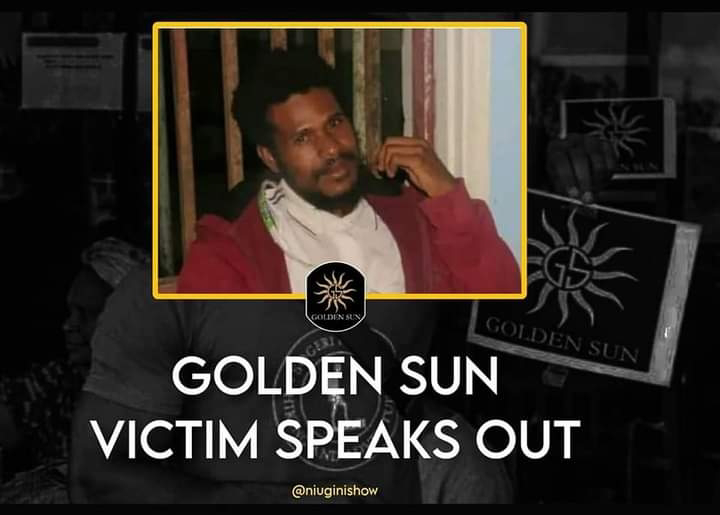
GOLDEN SUN VICTIM SPEAKS OUT

Via ABC Pacific 

Cash-strapped and unable to find a job in the country, university graduate Abraham Tamsen was looking for a way to earn some money, when his cousin sent him a link.

It took him to a website called Golden Sun, with a bright yellow interface and a few blank fields to fill in his personal details.

It seemed like the perfect opportunity. 

All he had to do was sign up and pay a fee and then he could start earning money simply by watching 15-second clips of blockbuster movies and writing short, positive reviews – so he was told.

It cost Mr Tamsen K700 to join on "level D", which was all he could afford.

He was confident he would make the money back quickly.

On Facebook, he had seen people claiming to have made huge profits in just a few weeks through Golden Sun. He got straight to work reviewing movies like Pirates of the Caribbean and The Good, The Bad, And The Ugly.

"I thought it would benefit me," he told ABC. "I spent most of my time – almost like 80 or 90 per cent of my daily hours – on this."

Mr Tamsen was linked up with a "regional manager" who went by the name "Michael Wiggins" and claimed to live in Sydney, Australia.

They chatted over the instant messaging app Telegram, but never via phone or video call.

Michael Wiggins gave advice to Mr Tamsen and other team members, encouraging them to sign their friends and family up to Golden Sun so they could all earn bonuses.

He told them Golden Sun was registered in the United Kingdom and had links to Universal Studios and other major movie production companies.

On Facebook, there were even claims that Tesla founder Elon Musk was an investor.

For a while, it was all going so well. Mr Tamsen made two "withdrawals" from his Golden Sun account, which involved requesting that the points he earned from watching movies be converted into cash. A few days later, the physical money landed in his bank account but last week, he went to make a third withdrawal. "Everything went blank," he said.

"I can't log into my account or even contact the regional managers because their account was deleted on Telegram."

The Golden Sun website has gone offline and its managers' chat messaging and social media accounts have disappeared. 

Mr Tamsen says he now believes the whole thing was an elaborate scam.

"I'm angry," he said.

"But at the same time, I thought to myself 'that was my mistake'. I made the choice to go for that. But anyway, I learned from that."

It's no consolation, but the 25-year-old is not alone.

Emergency Employment Visa Order signed

Minister Emelee signing the Order, By Glenda Willie

Vanuatu’s Chamber of Commerce and Industry (VCCI) has been granted the power to bring at least 1,500 foreign workers into the country under the newly developed Emergency Employment Visa, as announced by the Minister of Internal Affairs, Christophe Emelee on Tuesday this week. The move comes in response to a growing working gap in the private sector, as more Ni-Vanuatu workers leave their jobs for seasonal work in Australia and New Zealand.

According to Director of Immigration, Jeffrey Markson, and Minister Emelee, the visa will be valid for one year, after which its effectiveness will be assessed to determine whether it should continue. The Minister’s office, in collaboration with the Immigration Department and Labour Department, has already developed the Visa and other required documents associated with it.

To obtain an Emergency Employment Visa, applicants must have a valid police clearance, provide a medical certificate, and a support letter from the VCCI. The Labour Office will also provide a letter to confirm the application based on their assessment. Once submitted, the applications will be processed within five working days, and the visa will be issued by the Immigration Department.

However, the visa comes with several restrictions. Workers cannot change companies or workplaces during their 12-month stay under the Emergency Employment visa. The position occupied by a worker cannot be changed either. The visa also cannot be extended beyond 12 months. After a year, if the worker decides to stay in the country, they will be required to apply for a normal employment visa and follow the regular procedures, including paying the full fees.

Fees associated with the Emergency Employment Visa have been reduced by half, making it more accessible to applicants. For instance, the work permit fee has been reduced from VT200, 000 to VT100, 000. There is also a special package fee of VT150, 000 for a couple and four children.

Director Markson called on interested applicants to provide all the requirements stated in the form to fast-track their application. The authorities reserve the right to refuse applications if necessary, in accordance with the law.

The Emergency Employment Visa has been developed to address the immediate need for foreign workers in Vanuatu. While it is a temporary solution, it may help bridge the gap in the workforce as more Ni-Vanuatu workers seek seasonal employment abroad.

  • Mar 30, 2023

    glenda@dailypost.vu

    10 Indonesian Strategies to Conquer the Struggle of the West Papuan Nation:


    1. LITERAISM DOMINATION

    The main strategy of colonialism is to use military force to conquer the nation's territory.  Military aggression was deployed.  

    The killing operation was carried out.  

    The people were expelled, terrorized and helpless.  

    Then military reinforcement and occupation through territorial commands was established.  All sectors are controlled under military pressure.  Military violence was carried out repeatedly so that the colonized really surrendered.

    2. CONTROL - RESOURCES

    Colonialism's goal was to extract natural resources to enrich the rulers and build their political power.  The natural resources of the colonized people were confiscated, the people were evicted, then exploitation was promoted without compromise with the nation owning the natural resources.  Colonized peoples are made alienated and economically powerless so that they are subject to the production and distribution of goods and services owned by the colonials.

    3. POWER EXPANSION

    This is a colonial strategy of conquest to strengthen regional control colonies by opening and expanding their administrative, colonial areas.  Formation of regions: newly expanded divisions and divided as small as possible.  Then the law and all rules are tightened to control and dominate.  Colonized peoples are recruited to become officials in order to forget their fate as colonized people.

    4. MIGRATION OF COLOR CITIZENS

    The goal of colonialism is to take  over the territory.  So large-scale shipments of colonial citizens were carried out. Because they were the ones who, in quantity and quality, would conquer the colonized people and support the programs of the colonial rulers.  In the end, the conquered territories will be claimed as their nation, so that with their racist superiority they feel fully entitled.

    5. EXTERMINATION OF HISTORY & CULTURE

    The invaders will try to destroy it history and culture of the colonized peoples submissive to the invaders.  All values, norms, language, customs, and political history are prohibited from being displayed in public spaces in social life.  Then it was replaced with the colonialist's popular culture.  The conquered peoples were forced to memorize and respect the history and culture of the colonizing peoples.

    6. DESTROY MORALITY

    The fastest way of conquest is to destroy consciousness. So that the invaders destroy the morale of the colonized people through drinking, prostitution, gambling, and useless riots.  

    He knows that alcohol and sex are a quick way to destroy a colonized nation so that it does not exist and is easily conquered.  In order for the productive sectors to be controlled by the colonizers and the colonized people truly surrender.

    7. DIVISION CONNECTION

    The invaders will break up the defense force colonized peoples in conflicts division created by the occupiers.  Fighting against sheep, wars between religions, wars between clans, tribes, and groups in captivity.

    The colonized peoples were kept busy fighting each other in the colonial political packages given for example expansion, positions, parties, elections, etc.  This was done so that the colonized people would not be aware, unite and fight against the invaders.

    8. COLONIAL LEGAL REPRESSION

    In the colonies, the voices of criticism and.

    This struggle was silenced and repressed with law.  The people who fight against the colonialists will be accused of treason, separatism, criminals or terrorists.  If they were not killed, they were unjustly arrested and imprisoned under colonial criminal articles.  Also, if the people defend their rights to customary land, customary forests, and all their rights, they will be confronted with colonial laws that protect rulers and entrepreneurs (companies).  ?
     

    9. INFORMATION CONTROL

    Media, education, and all public spaces are controlled and controlled to influence the perceptions of the colonized people.  The goal is for the colonized people to justify and strengthen the narrative of the colonial rulers.  All the propaganda and stigma against the colonized people was launched so that the colonized people blamed themselves and their fellow nations, so that the colonized people felt they needed colonialists.

    10. STRENGTHEN FOREIGN ALLIES

    Colonialism broke the International Law.  However to maintain its illegality, the invaders.  need the support of foreign countries by offering the economic benefits of their colonies to foreign countries.  Global power is controlled to cover up the engineering of colonialism and then strengthens natural resource investment relations in the colonized areas and military assistance.  So that the international support the colonial conquest.

    His conclusion: Indonesian colonialism colonized the West Papuan people not because of human resources but because they wanted to control the natural resources in Papua's paradise.

     Reference:
     Papuan socialists
     Diyeugi, 30 March 2023
     Musa Boma Mapia 777

    𝐔𝐋𝐌𝐖𝐏 𝐏𝐑𝐎𝐕𝐈𝐒𝐈𝐎𝐍𝐀𝐋 𝐆𝐎𝐕𝐄𝐑𝐍𝐌𝐄𝐍𝐓 𝐎𝐅 𝐓𝐇𝐄 𝐒𝐀𝐈𝐑𝐄𝐑𝐈 𝐑𝐄𝐆𝐈𝐎𝐍 — ULMWP Wilayah Saireri

    Wednesday, 22 March 2023 (4pm-West Papua time). The ULMWP Provisional Government in Saireri region officially formed a committee for fundraising as an expression of support and solidarity with their Melanesian sibling (Vanuatu) in need.   

    West Papua Solidarity for Victims of Natural Disasters in Vanuatu was officially formed on Wed 22, 2023. The purpose of forming this committee is to accommodate and raise funds for victims of the Vanuatu Natural Disaster.

    The composition of the committee names are as follows:

    1. Pietkael Hiowati, Committee Chair
    2. Heri Mora, Secretary
    3. Mrs. Marcelina Ayomi, Treasurer
    With all members of the ULMWP Provisional Administration at the districts and villages.

    All elements of the nation and people of West Papua from Sorong-Merauke, let's help our Melanesian family in Vanuatu who are currently in the process of recovering from the natural disasters they faced.

    Thank you for your attention and cooperation.

    Head of the ULMWP Interim Government for the SAIRERI Region

      TTD 
    𝐸𝐷𝐼𝑆𝑂𝑁 𝐾𝐸𝑁𝐷𝑌

    #Vanuatu #WestPapua #Melanesia
    #fundraising #HelpMelanesianFamily

    Robbery Case in Mount Hagen: Caught in act

    March 6, 2023 - The National Main Stories


    By JILL MIRR


    A MAN got stuck in a narrow gap, another surrendered to authorities, while three escaped following a failed robbery attempt in Mt Hagen on Thursday night, police say.


    Western Highlands police commander Supt John Sagom said the man was running away from police and security guards when he got stuck in the narrow gap, from which he had to be pulled out.


    “The man was (stuck) in the (small) space 30 to 40 meters deep for hours before he was rescued and brought to the police station at around 9am on Friday,” he said.


    “We do not know what would have happened to him if it was raining that night given the small space he was trapped in.”


    He confirmed that police and security guards responded swiftly to the robbery attempt on Thursday night. Two men – the one who got stuck in the small space and another who surrendered to police – are now in custody.


    Sagom said that the possible charge to be faced by the two suspects was burglary given the nature of the incident.


    Police are yet to verify information that shops in town were also broken into on the same night.


    He urged the three men on the run to give themselves up to police.

    Meanwhile, a group of volunteers cleaning up the city said while they were busy trying to clean up and doing something good for the city, some hooligans were spoiling their efforts by robbing businesses and people.


    They appealed to all young people in the area to join hands in making Mt Hagen safe and clean for its residents and visitors.