Search This Blog

Total Pageviews

Advertisement

Labels

Blog Archive

West Papua - The UN's Dream Project 60 Years On

In the PNG Parliament NCD Governor Powes Parkop asked a series of questions during Question Time on West Papua.

Wednesday 1 December 2020.

(Reposted):
 
https://www.facebook.com/765439466917271/posts/4407650296029485/
NCD GOVERNOR HON. POWES PARKOP'S QUESTIONS WITHOUT NOTICE TO FOREIGN AFFAIRS MINISTER IN PNG PARLIAMENT

Thank you, Mr Speaker. 

INTRODUCTION

On this day Thursday December 1st 1961 West Papua declared independence and raised its national flag the Morning Mtar. They had a Legislative and an executive government, a standing army and all the national symbols of a nation state. 

They had their National anthem Hai Tanaku Papua ( oh my land Papua). Their territorial boundaries were precise and demarcated. Then in January 1962 the Indonesian invaded and the rest is history. 

Since then we (PNG) have adopted a policy that is shameful and is totally unethical to say the least. 

Hiding under a policy of friends to all and enemy to none might be ok for rest of the world but it is a total capitulation to Indonesia aggression and illegal occupation.

 It is more a policy of seeing no evil, speaking no evil and to say no evil against the evils of Indonesia. So much has happened since which should be bothering on our conscience. How do we sleep at night when our own people on the other side are subjected to so much violence, racism, deaths and destructions? 

How can we call ourselves Christians when fellow Christians are being subjected to so much abuses on their own land?

 How can we hold ourselves high as the biggest Melanesian State when the other half of our land which we share same ancestors, culture, language, traditions, songs, dance, river, mountains and seas continue to live as if they don’t exist.

 In the recent a past priest has been killed, thousands of people have fled their homes and become internal refugees and some have crossed over to our side of this one island, one land. Not one word of complain or concern or event protest has been aired. 

Even the people who have crossed over recently are from same tribe as the Min people on our side, speaking same languages and sharing same ancestry. We have not uttered a word of complaint or protest. 

QUESTIONS

Mr Speaker, my questions therefore are as follows : 

1. Are we going to revise our policy towards West Papua and adopt a more ethical morally courageous policy. 

2. Do we plan to raise the matter in the Melanesian Speaker Head Group and if so, when? 

3. What have we done or plan to do to apply pressure on Indonesia to allow the UN Human Rights Rapporteurs to visit the territory to inquire into the specific human rights complaints and the general human rights conditions in west Papua consistent with the Resolution of the Pacific Islands Forum in 2019. 

4. What steps are we doing to assist the ACP Countries escalate the resolution adopted in Nairobi Kenya on West Papua to the United Nations. 

5. Considering that PNG is a key member of MSG and MSG has recognize the United Liberation Movement for West Papua as a observer Member of the MSG what plans do we have provide support to the ULMWP? Can we allocate them funds from our budget or space here in PNG to step up an office capacity to purse their right to self determination. 

Imagine if in 1974 when we had declared self-government and Indonesia invaded and no one came to our assistance. Imagine in 1980 when the French manipulated Jimmy Steven’s to stop the independence of Vanuatu and imagine if Sir Julius Chan and Government then did not send the Kumul Force to Espirutu Santo.

When are we going to have the courage to speak the truth on what is happening on our ancestral land to the West? How long are we going to allow fear to dictate our decisions and actions and do what is morally and ethically correct?

Thank you, Mr Speaker

RESPONSE BY PNG FOREIGN AFFAIRS MINISTER

Minister for Foreign Affairs, Soroi Eoe's response is that he will raise it in Parliament.

...ends.

Pacific leaders recently highlighted the West Papua at the 76th annual UN General Assembly session.

The issue of self-determination for West Papua was highlighted for the first time since the 1960s by Papua New Guinea.

Papua New Guinean prime minister James Marape spent more than 40 minutes addressing the assembly, but his speech included some brief indirect and ambiguous remarks that have been widely interpretated as referring to the situation in occupied West Papua.

“While commenting on the United Nations’ peace effort in PNG, I would also like to recall the Pacific islands leaders forum in 2019 and the outstanding visit by the UN human rights’ mechanisms to address the alleged human rights concerns in our regional neighbourhood,” Mr Marape said.

“This visit is very important to ensure that the greater people have peace within their respective sovereignties – and their rights and (the) cultural dignities are fully preserved and maintained.”

The territory’s Free West Papua movement applauded the remarks, suggesting that “those 30 seconds are highly valued, appreciated and respected because every second counts to prevent another Papuan death accompanied by another loss of land”.

While his speech was carefully constructed and avoided naming Indonesia directly as responsible for human rights abuses, Vanuatuan prime minister Bob Loughman was more direct.

“In my region, New Caledonia, French Polynesia and West Papua are still struggling for self-determination,” he said. “Drawing attention to the principle of equal rights and self-determination of peoples as stipulated in the UN charter, it is important that the UN and the international community continue to support the relevant territories giving them an equal opportunity to determine their own statehood.

“The indigenous people of West Papua continue to suffer from human rights violations.

“The Pacific (Islands) Forum and ACP (African, Caribbean and Pacific states) leaders, among other leaders, have called on the Indonesian government to allow the United Nation’s office of the High Commissioner for Human Rights to visit West Papua province and to provide an independent assessment of the human rights situation.

“Today, there has been little progress on this (UN) plan. I hope that the international community, through appropriate UN-led process, takes a serious look at this issue and addresses it fairly.”

Resolutions that were adopted, which were met in 2019, had called for the root causes of the West Papuan problems to be addressed.

On 1 December 2021, this week, the 60th anniversary of self - government for West Papua which the Dutch began on 1 December 1961 was celebrated by indigenous Melanesian Papuans.

After decades, 60 years on, Melanesian consciousness for the inalienable right of West Papua and the indigenous people fighting for freedom seems to find traction.

 PIF and MSG have a position on West Papua. So, does ACP.

PNG followed the ' Greek Tragedy' from day one. So, did Australia. Both signed the UN Protocol on Responsibility To Protect Doctrine Chapter 1 and 2. Indonesia was among 15 countries that blocked the ratification of the UN protocol.

The tide of history is changing.

A NATION OF HYPOCRITES: Make PNG A Christian Nation

China is currently the world's leading economic power, in China there is nearly Zero Church and they demolish mosques as they stand!

Finland has the most stable economy in the world today. There are less than twenty churches in Finland!

Switzerland has the second most stable economy in the world. Switzerland has fewer than thirty churches!

Denmark is the third most stable economy in the world, there are about 23 churches in Denmark.

Indonesia a most populated non Christian country in South East Asia. But has a powerful military arsenal in the region 

United Arab Emirates is 47 years old (one year ahead of PNG) virtually has no Church. But is a icon of innovation and technologies in the world.

These countries are considered to have the highest number of atheists, but they are blessed!

Come to Papua New Guinea, there are more than 10,000 churches per region including thousand churches in a Province alone! 

In Papua New Guinea we have more churches than schools and hospitals combined!

More pastors than doctors.

Leaders are God-fearing!

Everyone one is born again!

Everyone is covered with the blood of Jesus!

Jesus even became the husband of all single women (according to them) in revival churches!

Everyone is filled with the Holy Spirit!

The only functional thing that is running smoothly and developing every day in PNG is Church. Look everywhere around you, Church is the only institution which is run and operated by Papua New Guineans that is successful. Do you know why? Because it doesn't benefit or develop the lives of people. What it does is to keep people in poverty and to make them pray for imaginary breakthrough. 

How do you expect to get out of poverty and to develop your community if you still love church more than education and technology? Poor PNG communities have many churches in one village but they don't have even a single factory that is producing something and creating jobs. In China there are more factories than churches, Chinese spend the whole night working and producing jobs for their children while we spend the whole night praying and fasting for our problems.

They say Jesus Christ died on the cross for PNG. But all I see is Papua New Guineans pinned on the cross of poverty and life of pain. I see people hanging on the cross of economic exclusion, police brutality and political exploitation. If Jesus Christ died for your sins why are you still suffering. Dogs of Europeans eat better than some of us. But PNG is rich with oil and all minerals. If you think a foreign European called Jesus Christ died for your sins ask yourself why are you still suffering?

However, none of these claims reflect the moral and ethical elevation that is hoped for in a society. PNG may one of the most violent, drankards and corruption den country in the world.

We are among the laziest, the most deceiving, the most corrupt, the most hypocritical, the most hateful on the planet today, with all our Jesus and the Holy Spirit!

Our politicans and people need to distinguish between religion and stupidity or between spirituality and tradition.

The genocide in West Papua…..

The genocide in West Papua…..much is now known, if not earlier. The question now is if human suffering could be alleviated through a greater effort by the international community. Papua New Guinea, being close cousin to West Papua alone could have prevented such horrors, and probably does not make a convincing case that even a modest effort would have had significant impact. Prime Minister, Peter Oneill, after 60 years of genocide in West Papua did it.


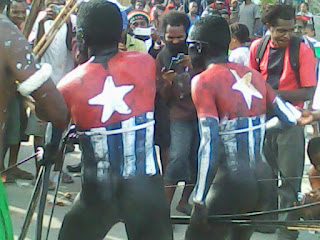
We are all Papuans, and tribal Melanesians. The Pacific Region remains mute, led by Australia, which has blood on its hands. Based on declassified information, private papers, and interviews, other citizenship media coverage everyday on the Papua Conflict, a lack of political will cannot be an excuse, and failure to intervene is like shaking the hands of the devil..and welcoming a problem from hell itself. West Papua is not a problem from hell...Indonesia is. Indonesia, somehow must be stopped. These two tribal Melanesians shown in the photo, depict what it means to means to be Melanesian, during a recent independence rally in Abepura, West Papua.

They will need a helping hand...from fellow 'as tangets' in Papua New Guinea, the Pacific Region, and humanity. Free West Papua. Now.
The human rights abuses occuring in West Papua come complete with reports pouring in today on the situation. We see the drama which offers an uncompromising and disturbing examination of 21st century acts of genocide, but to date the international community , probably led by the U.S, has failed to cause the needed responses to them. Read on: http://westpapuamedia.info/.../commonwealth-attorney.../

In the course of human history, we can revisit the Turkish genocide directed at Armenians in 1915-1916, the Holocaust, Cambodia's Khmer Rouge, Iraqi attacks on Kurdish populations, Rwanda, and Bosnian "ethnic cleansing," and in doing so, argue that U.S. intervention has been shamefully inadequate. West Papua has reached that point, and burns in the vortex of an armed conflict. Read the latest reports on the drama in Jayapura, Manokwari, and elsewhere.Jayapura:http://westpapuamedia.info/.../Manokwari...//t.co/uXaTcCMC. Other reports:http://t.co/di9mdHz6

What is the unwritten rule that nonaction is better than action with any backlash for countries friendly to West Papua and its tribal Melanesians; We are talking about the Melanesian Spearhead Group’s and the Pacific Island Forums’s unwillingness to see a moral imperative. I see a moral imperative, and it is time now to act for West Papua. Melanesia and the Pacific Region are challenged, now more than before, to reevaluate the principles being applied to foreign policy choices. In the face of firsthand accounts of genocide, we cannot repeatedly just look on and refuse to accept the reality of genocidal campaigns carried out by Indonesia in West Papua. Australia, especially, knows full well the story of genocide occurring on its doorstep. Read on:http://www.google.co.id/url?sa=t&rct=j&q=johnrumbiak.... And, the idea that Indonesia can continue to keep West Papua in the dark, with able assistance and support from Australia is a joke. It only drives the lush of freedom for West Papua to greater heights, but with the costs defined clearly in human lives decimated up till today. On this account, Australia has blood on its hands Read on:http://www.google.co.id/url?sa=t&rct=j&q=johnrumbiak... 

The emotional force of all discourses on the human rights crisis in West Papua, and the arguments for Indonesia to come clean before the international community, is carried by citizenship media or undercover jounalists with moving, sometimes almost unbearable stories of the victims and survivors of such brutality. It could be argued that West Papua and its people deserve a West Papua Declaration in order to fight against genocide in Melanesia, and the Pacific Region. There has been progress, with Solomon Islands, Papua New Guinea, and Vanuatu already mounting strategies diplomatically to address the Papua Conflict. We need more effort. This will be in keeping with the prominent work by, among those who made a difference, Raphael Lemkin, a Polish Jew who invented the word genocide and who lobbied the U.N. to make genocide the subject of an international treaty, and Senator William Proxmire, who for 19 years spoke every day on the floor of the U.S. Senate to urge the U.S. to ratify the U.N. treaty inspired by Lemkin's work. Indonesia, somehow must be stopped. Something can be done to help the situation, led by the U.S.Read on:http://www.google.co.id/url?sa=t&rct=j&q=octovianusmote... 

Belden Namah face to face. The man behind the enigma

16 August 2013
SONJA BARRY RAMOI

Belden NamahDEEP IN THE MOUNTAINS of Paru Paru village not far from Panguna mine - the village of the late secessionist leader and first president of Bougainville, Joseph Kabui – a delicate military action was underway.

Defence Force helicopter pilot, Captain Charlie Andrews, was ordered by PNG Defence Force Commander Brigadier General Jerry Singirok to get Captain Belden Norman Namah out of there.

The terrain was in enemy territory and under the control of the Bougainville Revolutionary Army. But there was no place for a chopper to land.

Captain Namah – in a daring display of bravery – was airlifted from the bush by hanging onto the skid of the chopper. Only a very strong and highly skilled man could do that. Namah was a highly trained Special Forces Unit commando.

Did Belden Namah, now Opposition Leader of Papua New Guinea, tell me the story to impress me? No. I heard the story from someone else and asked Namah to confirm if it was true.

"Yes it's true”, he replied. That was it.

There are many more tales of Namah’s military exploits and deeds to be told. Some, still classified, will no doubt surface later.

His role in rescuing OPM (Operasi Papua Merdeka) hostages the in two separate incidents near the PNG-Indonesia border in 1996 and 1999 still needs to be told.

I know Opposition Leader, Hon Belden Namah, very well. He is not scared of anything. He only fears God. He is a fighter and he doesn't go down easily.

If he was prepared to sacrifice his life and help save more than 360,000 lives on Bougainville and later go to jail with two comrades for resisting an intervention by mercenaries in the infamous Sandline Affair, does anyone seriously believe that an arrest warrant will scare him?

Why is so much speculation and false information about the Opposition Leader posted in the social media – especially Sharp Talk? Do his critics miss him that much?

Everybody loves a hero. PNG certainly needs many more heroes. When I wrote, during the political impasse, that retired Colonel Yaura Sasa would go down in the minds of many Papua New Guineans as a hero, I was criticised because Sasa had been charged with mutiny.

About one year later the mutiny charge against Sasa was thrown out thanks largely to leading Port Moresby lawyer Tony Waisi, from West Sepik. And the hero who quelled the so-called mutiny was none other than Belden Norman Namah, who should be credited for defusing a potentially deadly clash between factions of the army and the police force.

Some of us are too good at tearing down people and our political leaders based on false information and incomplete stories fed to us by a biased foreign and domestic media.

Napway Kunum, an engineer from Jiwaka Province, working on a fly in fly out basis on an offshore gas plant in Iraq, knows Belden Namah well from their student days at Sogeri National High school.

I asked Napway to share his recollection of Namah. Napway, was president of the Judo Club at Sogeri at the time and his room-mate was Gerald Alec from Sandaun Province.

Napway recalled that Belden - who was one year behind him and Gerald - would go to their room every Wednesday to join them at judo training.

“He is one of those that did not speak much but will listen attentively and then go ahead and will get things done,, recalled Napway, “on that you can depend on him. He was always in a hurry trying to get something done.”

He also described Namah as “quiet and easy going with determination.”

“If things aren’t right, he’ll throw himself at it to get it right. Those are his traits. One thing, he’ll call a spade a spade.

“He’ll be loyal to you when he knows that what you are doing is good for people and country. If it’s not he’ll be in the way. That’s all the way from Sogeri.”

It appears they spent a great deal of time talking about the OPM freedom movement in West Papua.

“OPM kept us busy discussing them into the night,” said Napway who added, “It’s not surprising that BN joined the army, and I thought Gerald also did.”

“One thing I found about BN is that he always had respect for me and Gerald, and he would listen attentively. Gerald and he would discuss the suffering of the West Papuans and I would listen in on how unfairly they were treated.

“They’ll say it’ll be best to help them out. So there and then I knew that BN would always fight for the underdogs, and that’s natural, his inbuilt character.”

When Napway, who has worked in many places in PNG and overseas as an engineer in the petroleum industry, was in Kutubu he knew three security supervisors who had been in the army and served in Bougainville during the civil war.

“They said BN is one hell of a person who can move single-handedly forward after he planned out an operation and those were daring ones. They didn’t tell me the full story but I could gather from what they were saying that BN was one hell of a warrior.”

I confided in Napway: “In this very volatile world, you and I know that PNG needs BN”.

Napway replied: “PNG needed BN 40 years ago, Sonja, and that’s not kidding. That’s not discrediting our fathers who brought us to independence. They did what they could. Between independence and now, we let greed get in the way of developing our nation. And that’s where we need him. And that’s 40 years back.”

Certainly nobody can rightfully claim that Belden Namah is greedy, certainly not when he is probably Papua New Guinea’s first multimillionaire philanthropist politician who gives from the goodness of his heart and not to get publicity.

Are there so many gullible people around? If it was true that Belden Namah is a power-hungry ‘would be dictator’, then why did he hand power over to Peter O’Neill, practically on a golden platter, when he had the numbers and the money to become prime minister himself?

One thing is for certain, considering the tremendous support he had at the time, he could have simply snapped his fingers and taken over the country if he had so desired.

Belden Namah is a world leader - whether some stupid people like it or not - who at least can afford to pay for his travels around the world using his own private funds.

Not long ago he was in Europe. Ask yourself - how many politicians can purchase airfares and stay in five star hotels using their own honest, hard earned money? It seems that not many people know that Belden Namah is a self-made multimillionaire today because he wisely invested the money he made - starting many years ago before he entered parliament - from his share of timber royalties.

Starting from day one, he has made his stance very clear on the asylum seekers and many other issues more than enough times already. Why should he keep on repeating himself like a fool for fools? If people missed what he has said they can always look it up!

Namah is a man who is short, sharp and straight to the point. He is a 'silent achiever' who does not go around boasting and bragging about what he has achieved in order to appear more popular by scoring likes on the social media forums.

Belden Namah is a leader who believes in sharing duties and responsibilities. He does not have a monumental ego that says, 'me, me, me’ unlike certain other politicians who enjoy scoring political points by attacking and trashing their opponents.

Namah certainly would never shout at anybody merely for asking questions, unlike some more loudmouth leaders.

Where other leaders are haughty and hypocritically full of themselves - with their egos maybe somewhere up in the sky - Namah is down to earth, humble and honourable.

I have met and spoken with many politicians and statesmen – governor generals, prime ministers, deputy prime ministers, opposition leaders, speakers, ministers, ordinary MPs, premiers, deputy premiers, presidents, lord mayors – at both national and local level from when I was a kid.

Politics is in my blood. It is in my family – on both sides.

I foresee that Belden Namah will become prime minister one day and that he has a long political career ahead of him – akin to two political icons and giants from the Sepik: Sir Michael Somare and Sir Pita Lus.

Until recently, I would normally keep confidential what politicians I know and what I know about them.

"We are duty bound to give back to our people their sovereignty, freedom, pride and independence,” Belden Namah said recently.

“We are an independent nation. Australians have f'ed us up since they colonised us. They left us with basically nothing when we became independent in 1975.

“We can't afford to bring them back. We do not need their support either. We have all the wealth in the world God has blessed us with. All we need is a strong, vibrant, prudent and patriotic leadership.

“We are the only ones who can provide that to protect our people from neo-colonialism and corporate greed.

“May we be God's instruments of change for our people and our beautiful country.”

PNC – led Parliamentary Monarchy: The Revolt Is Inevitable?

In the count – down to APEC PNG 2018, and its aftermath, the PNC – led parliamentary monarchy may be prone to trigger a revolt or resistance. It would be inevitable after the options to legitimate the role of state fails to yield in which the threshold is already reached, and it cannot manipulate minds and emotions of the people or citizenry anymore. And, it is too much for society. 

Here a revolt is inevitable. This is so especially if the executive cannot manufacture consent of the people, and the tip of the ice berg is those who are protesting over whatever issue, to rule before the next periodic elections in 2022. 
 
The Opposition is calling for national general strike. It means there is something lacking about the role of the legislature as a mechanism of checks and balance. It further points to the fact that coalition – building in PNG’s parliamentary monarchy or Westminster democracy which is characterized by coalition governments, after ten national general elections since independence in 1975, has turned into a one – way traffic.
 
Yet, the country’s parliamentary monarchy is defined by prime ministers being called to account by having greater limits on their autonomy. 

Thus, a prime minister’s powers are limited in four ways: he shares executive power with cabinet ministers from other parties, requiring a process of bargaining and negotiation over key policy decisions within the government; he also remains continually dependent upon the support of a multiparty coalition in parliament to pass the government’s legislative proposals; as head of the government his ruling regime faces the continual threat of a no confidence vote in parliament; and, the ruling regime remains accountable to the electorate for its record and performance at regular intervals. 

The Opposition is doing its job.There are arguments for and against why there is no other way. And, the slogan is 'Enough Is Enough.'

Case 1

Political stability is necessary:

- Enables the government to devise and implement policy programs to bring development
- Provide a favourable business environment
- Changing governments disrupts the implementation of development programs. 

According to research, from independence in 1975 to 2002 successive votes of no confidence have removed prime ministers and sometimes replaced the executive in its entirety. No government has ever had the chance to fully implement its policies. In 2002, Ben Reilly noted that Papua New Guinea’s unbroken record of democracy has not been accompanied by economic development. 

PNG politics was unstable before 2002. Between 1975 and 2018, even though PNG has had only nine national elections, there were 15 changes to the prime minister’s position, many more than just the six times prime ministers were removed after elections.

Case 2

Political stability entrenches corruption:

- Prevents diagnosis of symptom of a much deeper problem due to the way politics in Melanesia goes on.
- Allows the malpractice of an irresponsible government to continue.

 For instance, Jon Frankel and his co-authors argued in 2008 that political instability in Melanesia is a result of MPs who consider access to elected office as the main avenue for power and wealth, and the outcome of a struggle by those MPs not in control of the resources to oust the executive. Those in the executive controlling the resources are then forced to use bribery, coercion and all kinds of malpractice to remain in power.

The Opposition has weighed out its role as part of the legislature but still called for a national general strike on Friday 25th October 2018. It seems a dysfunctional legislature has struggled to come to terms with the decision of the ruling regime led by prime minister Peter Oneill for PNG to host the APEC Leaders’ Summit amidst the country’s public health, currency exchange and foreign debt crises.  

In other parts of the world effective uses of nonviolent resistance has made a difference. In this case, ordinary citizens can make their economic and political power felt, a day when they can show their strength and commitment to make a strong statement peacefully without the spectacle of being arrested for taking part in protests to demand that government be held accountable where necessary.

Decide. 'I Will Stay Home!' effort is for one day, a mosquito bite, but it might make the difference you want to see.

Queen Elizabeth II Heartbroken as Barbados Names New President And set to be Free Of British Colonial Rule Next Month

THE QUEEN is facing losing one of her overseas realms as Barbados continues to take steps towards becoming a republic by coming month.
Ms Mottley told Bajans: "I am happy to report to the people of this nation today, that Her Excellency Dame Sandra Mason has consented to my government nominating her, at the appropriate time, to be the first president of this nation.

"We feel that this is the way we want to go and we want to thank her excellency for so graciously consenting in this manner.

"My people, we have come too far as a nation and what we are simply trying to do is to close the discussion on independence."

Mentioning the first Prime Minister of Barbados, Errol Barrow, Ms Mottley continued: "We are not trying to take away Barrow’s legacy, as some people fear. Far from that.

Barbados will soon be free of British colonial rule — and set to have a Black woman as its first president.

According to WION News, Prime Minister Mia Amor Mottley nominated Dame Sandra Mason as the country’s first president as an independent republic. Dame Mason will assume the role on Nov. 30, 2021, when the country’s final ties with the British monarchy are officially fully severed.
The United States of Africa congratulates Barbados for taking this bold step to decolonize itself and congratulates Dame Sandra Mason set to make history as the first President of Barbados.
“We believe that she is a fitting nomination for the post of being the first president of Barbados to be elected by this parliament of Barbados,” Mottley said.

 Barbados PM Mia Mottley announced the Opposition Leader has agreed to a joint nomination of outgoing GG Dame Sandra Mason as 1st President of Barbados - subject to passing of Constitution Amendment Bill which deals with Presidency.
This makes a turning point in Barbados history as the sun sets on the remnants of the British Empire.
The Queen is no longer the head of state, Maybe she should publish her CV on LinkedIn to see if she will find new Countries that want to be a British Colony!
#Barbados #UnitedStatesOfAfrica

BREAK-IN SUSPECT CAUGHT WITH HOME MADE GUN

Thursday 14th OCT 2021.

A man who broke into a tucker shop at Sabama's Bundi camp was quickly subdued by the shop-owner until Fox unit 104 arrived and took him into custody. 

The intruder struck at around 4am today but the owner was awake.

The would be victim told police in Pidgin, "Em holim hom-med gan tasol nogat bulet na me holim em."

"He was brandishing a home-made gun but it was not loaded and I pounced on him."

According to the shop-owner, some of his accomplices fled.

The shop-owner contacted police and Fox unit 104 responded immediately and brought the suspect to Badili Police Station.